- Drought conditions shifted nationwide due to uneven precipitation and cold temperatures.
- Parts of the Southwest showed improvement from earlier storms.
- Snowpack deficits remain a concern across much of the Colorado River Basin.
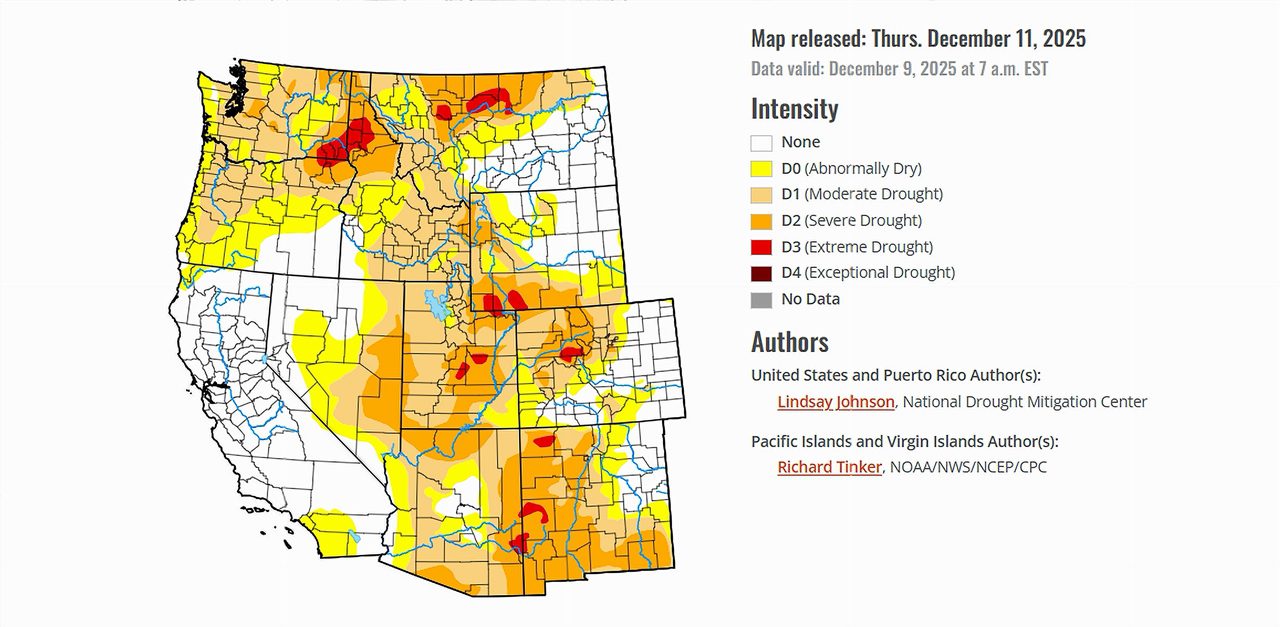
Saturday, December 13, 2025 — The U.S. Drought Monitor released on December 11, 2025 , shows a country divided by weather extremes. Large portions of the nation experienced colder-than-normal temperatures, particularly in the Midwest and Northeast, where much of the week’s precipitation fell as snow. While snow contributes to long-term water supplies, it offers little immediate relief for dry soils and low streamflows.
In contrast, parts of the Gulf Coast and Southeast received moderate to heavy rainfall, alleviating short-term dryness and drought. Meanwhile, the central Plains saw little to no precipitation, allowing dry conditions to persist or slowly intensify. Across the West, the picture was mixed, shaped mainly by where storms delivered rain and mountain snow—and where they did not.
Western Conditions and the Role of Snowpack.
In the western United States, storm systems brought significant moisture to the Pacific Northwest and portions of the northern Rocky Mountains. These storms improved conditions in areas that received heavy rain or deep mountain snow. However, locations that missed these systems saw drought expand, especially where snowpack remains well below normal for this time of year.
Snow water equivalent, a key measure of how much water is stored in mountain snowpack, remains below the 30th percentile at many monitoring sites across the Interior West. While some northern mountain areas are near average, large sections of the West continue to lag behind, raising concerns for water availability later in the year.
Conditions in the Colorado River Basin.
The seven Colorado River Basin states—Arizona, California, Colorado, Nevada, New Mexico, Utah, and Wyoming—continue to reflect these uneven patterns. According to the Drought Monitor, parts of the Southwest, including southeastern California and western Arizona, showed improvement this week even without new precipitation. These gains are attributed to moisture from earlier storms gradually moving through soils and stream systems.
Elsewhere in the Basin, conditions worsened where snowpack is notably low. East-central Nevada experienced expanding drought due to a combination of poor snow accumulation and long-term precipitation deficits. In Wyoming, eastern areas saw an increase in abnormal dryness where recent precipitation was limited, although heavy snow along parts of the Idaho–Wyoming border led to localized improvements.
Colorado’s conditions remained largely stable, with light snowfall easing small pockets of dryness but not significantly changing broader drought patterns. Utah and New Mexico continue to face challenges tied to below-normal precipitation and snowpack, leaving much of the Basin vulnerable as winter progresses.
Why These Patterns Matter.
The Colorado River Basin relies heavily on winter snowpack to replenish rivers, reservoirs, and groundwater supplies. While recent improvements in parts of the Southwest are encouraging, the Drought Monitor highlights that many Basin areas remain dependent on future storms to rebuild snowpack to normal levels. As of mid-December, the Basin’s overall drought status reflects modest short-term gains alongside persistent long-term concerns.
What’s Ahead.
Forecasts referenced in the Drought Monitor suggest continued precipitation for the Pacific Northwest and northern Rockies, while much of the Interior West, including large portions of the Colorado River Basin, is expected to receive little to no precipitation in the near term. Outlooks also favor warmer-than-normal temperatures across much of the West, which could further influence snow accumulation and water storage.
As winter continues, conditions across the Colorado River Basin will remain closely tied to where storms track and how much snow ultimately falls in the region’s headwaters.