- Alfalfa uses more Colorado River water than any other single crop.
- A new study finds irrigation cutbacks could save up to half that water.
- The approach focuses on timing, not eliminating alfalfa farming.
- Public comment deadlines on Colorado River rules are approaching.
Wednesday, February 11, 2026 — In a February 4, 2026 segment on Phoenix’ public news station KJZZ , reporter Sam Dingman explored new research suggesting that alfalfa, long criticized for its heavy water use, may actually offer a path toward water savings in the Colorado River Basin. Drawing on analysis by journalist Jonathan Thompson, a contributing editor at High Country News, the report explained how alfalfa dominates agricultural water use in the basin because it is both widespread and grown year-round in warm regions such as southern and central Arizona. The segment introduced the concept of “deficit irrigation,” a practice that temporarily reduces or suspends watering without permanently damaging the crop. That discussion served as a bridge to a much deeper academic analysis published in 2025 that examines whether alfalfa can be managed more flexibly to improve regional water security.
What the New Study Examined.
The peer-reviewed study, Reimagining alfalfa as a flexible crop for water security in the Southwestern USA, was published in Science of the Total Environment in 2025 by a multi-institution research team led by Emily Waring and Helen E. Dahlke. The researchers analyzed alfalfa production across six Southwestern states that rely heavily on the Colorado River and related systems. Using satellite-based evapotranspiration data and economic modeling, the study assessed how much water could be saved if alfalfa growers stopped irrigating during the hottest part of the summer, generally after July 1, while allowing the crop to go dormant.
The study estimated that alfalfa accounts for roughly one-quarter of all consumptive water use in the Colorado River Basin. However, the researchers emphasized that alfalfa also plays a central role in the regional agricultural economy, supporting dairy and beef production and providing wildlife habitat. The goal of the research was not to eliminate alfalfa, but to determine whether changes in irrigation timing could reduce water demand without collapsing farm operations.
How Summer Deficit Irrigation Works.
Under summer deficit irrigation, farmers suspend irrigation for part of the late summer and early fall. Alfalfa is unusually tolerant of this approach because it can survive dry periods and resume growth when water returns. During the months when irrigation is paused, yields decline, but the crop is not destroyed. According to the study, this strategy targets the period when alfalfa produces lower-quality hay while consuming a disproportionate share of water due to high temperatures.
The researchers found that if summer deficit irrigation were widely adopted, it could save between 16 and 50 percent of the water currently used for alfalfa across the Southwest. In volume terms, that equates to approximately 1.3 to 4.2 billion cubic meters of water per year, depending on how broadly the practice is applied and how water savings are measured.
Economic Tradeoffs for Farmers.
The study also examined whether deficit irrigation could make economic sense for growers. Using case studies from California’s Tulare and Imperial counties, the researchers compared traditional full-season irrigation with scenarios where farmers reduce irrigation and sell the conserved water. Their analysis showed that deficit irrigation becomes financially viable when the market value of water exceeds the value of the lost late-season alfalfa harvest.
In some regions, particularly in the Lower Colorado River Basin where water scarcity is most acute, the price of water during summer months already approaches or exceeds those thresholds. In those cases, selling conserved water could offset reduced hay production. The study emphasized, however, that outcomes vary by location, water pricing structure, and local water law.
Implications for Colorado River Negotiations.
The findings arrive as federal and state agencies continue negotiations over new Colorado River operating rules. Much of the current debate centers on how to reduce water use without devastating rural economies. The study suggests that targeted changes to irrigation timing, rather than permanent land fallowing, may offer a middle ground.
Researchers cautioned that deficit irrigation would require improved water measurement, clear accounting rules, and infrastructure to support water transfers. They also noted that implementation would be easier in the Lower Basin, where large farms dominate, than in the Upper Basin, where alfalfa is often grown on small parcels.
Reassessment, Not Elimination.
The authors concluded that alfalfa’s role in Western water management deserves reassessment. Rather than viewing the crop solely as a problem, they argued it could function as a flexible tool during drought, provided farmers are compensated fairly and regulatory systems allow water to move where it is most needed. The study underscores that any large-scale shift would depend on policy decisions now under consideration.
Public input remains a key part of those decisions. Federal agencies have set deadlines for public comment on proposed Colorado River management frameworks, and those deadlines are approaching. Stakeholders across agriculture, municipalities, and environmental groups are being asked to weigh in on how water reductions should be shared.
Citation.
Emily Waring, Helen E. Dahlke, John T. Abatzoglou, Josué Medellín-Azuara, Matt A. Yost, Khaled M. Bali, Colleen C. Naughton, Daniel H. Putnam, Robert Sabie, Siddharth Kishore, Nicholas R. Santos, Joshua H. Viers, Reimagining alfalfa as a flexible crop for water security in the Southwestern USA, Science of The Total Environment, Volume 990, 2025, 179851,ISSN 0048-9697,
https://doi.org/10.1016/j.scitotenv.2025.179851.
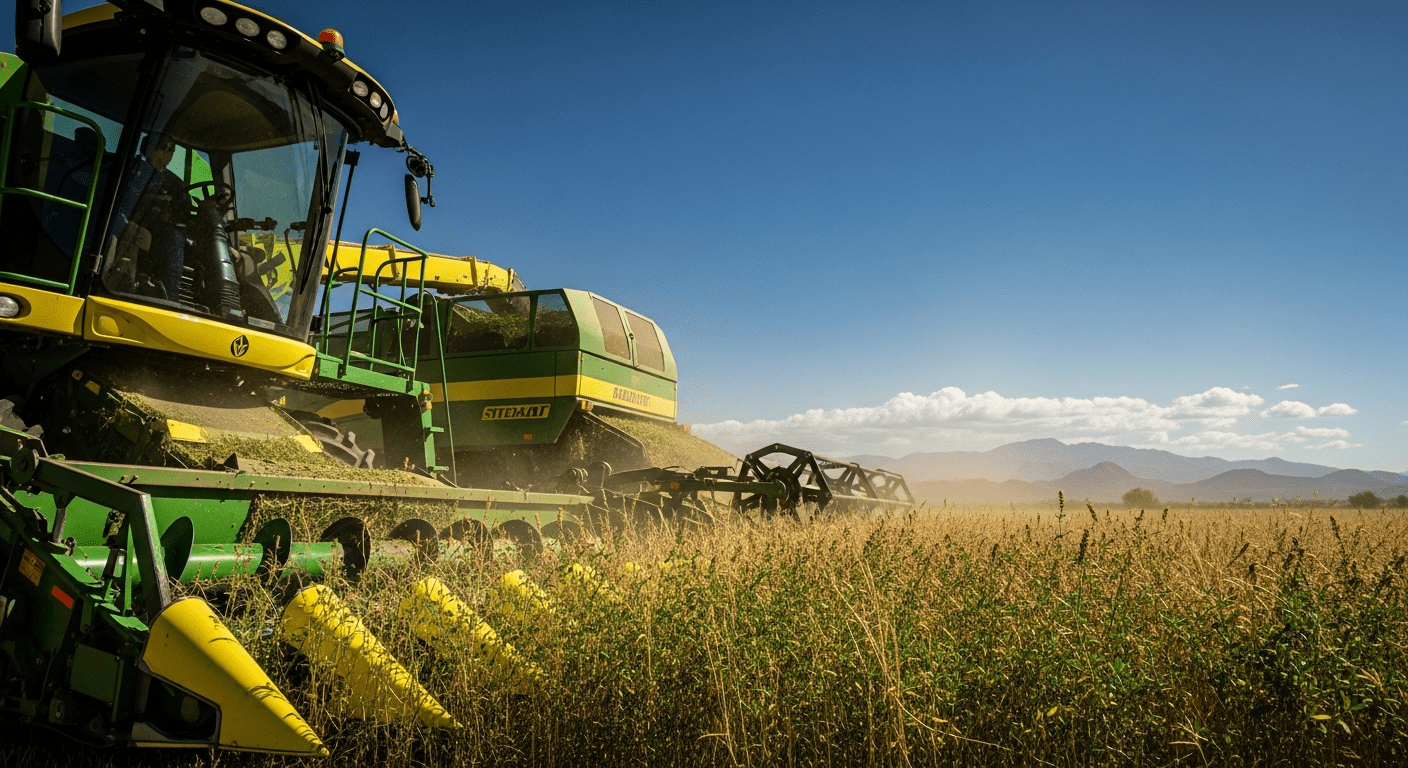
Image is AI-generated.
Q&A
What is deficit irrigation?
Deficit irrigation is a farming practice that intentionally reduces or suspends watering for part of the growing season to save water while keeping crops alive.
Why focus on alfalfa?
Alfalfa is the single largest agricultural water user in the Colorado River Basin due to its acreage and year-round growing season in warm climates.
Does deficit irrigation eliminate alfalfa farming?
No. The approach allows alfalfa to go dormant temporarily and resume growth when irrigation returns.
How much water could be saved?
The study estimates potential savings of 16 to 50 percent of alfalfa’s current water use across the Southwestern United States.
What are the risks?
Challenges include water accounting, infrastructure for water transfers, and ensuring farmers are compensated fairly under existing water laws.
Why does the public comment deadline matter?
Decisions made in current Colorado River rulemakings will shape how water reductions are implemented, making public input critical before deadlines close.