- Lake Powell inflow may reach only one-third of normal.
- Snowpack across the basin remains far below average.
- A warm winter caused snow to melt early and fall as rain.
- Lake Mead projections continue to decline through 2027.
Friday, March 20, 2026 — New forecasts released in mid-March 2026 show the Colorado River entering another difficult year, with far less water expected to reach key reservoirs that supply millions across the West.
According to reporting by Ryan Spencer in Summit Daily News on March 13, 2026, federal forecasters now expect only about 2.3 million acre-feet of water to flow into Lake Powell during the spring runoff season. That amount is roughly one-third of normal.
Spencer reports that hydrologist Cody Moser with the National Oceanic and Atmospheric Administration’s Colorado River Basin Forecast Center warned that conditions may worsen in the near term. “I anticipate this water supply forecast trending lower, at least during the next two weeks,” he said during a water briefing.
If those projections hold, the inflow to Lake Powell would rank among the lowest recorded in more than six decades.
Warm winter reshapes the snowpack.
The problem begins in the mountains.
The Colorado River depends heavily on snow that builds up during winter and slowly melts in spring. This year, that system has been disrupted.
Forecasters report that temperatures across the basin were several degrees above normal throughout the winter. In many areas, precipitation fell as rain instead of snow, and existing snow melted earlier than expected.
As a result, the amount of water stored in snow, known as snow-water equivalent, is only about half of normal above Lake Powell.
Some areas are struggling even more. The Colorado River Headwaters region in northwestern Colorado received only about 70 percent of its usual precipitation since October. Snowpack levels in key basins are also sharply reduced, with some measuring between 40 percent and 50 percent of normal.
Moser explained that even soil conditions reflect this unusual winter. Soils are wetter than average, not because of healthy snow buildup, but because snow has already melted. “You don’t really want to see these types of soil moisture conditions prior to the April through July runoff season,” he said.
Less water flowing downstream.
The reduced snowpack means less water flowing into rivers and reservoirs during the critical spring runoff period.
Forecasts show that several rivers in the headwaters region, including the Eagle River and Roaring Fork, may carry only about half their normal volume between April and July.
Across the broader basin, conditions are uneven. Some areas in Wyoming and Arizona received closer to normal precipitation, but the core snow-producing regions in Colorado have been much drier.
This imbalance matters because the Colorado Rockies play a central role in feeding the river’s main flow.
Lake Mead outlook continues to decline.
The impacts do not stop at Lake Powell.
Water released from Lake Powell flows downstream to Lake Mead, the nation’s largest reservoir and a critical supply for states like Nevada, Arizona, and California.
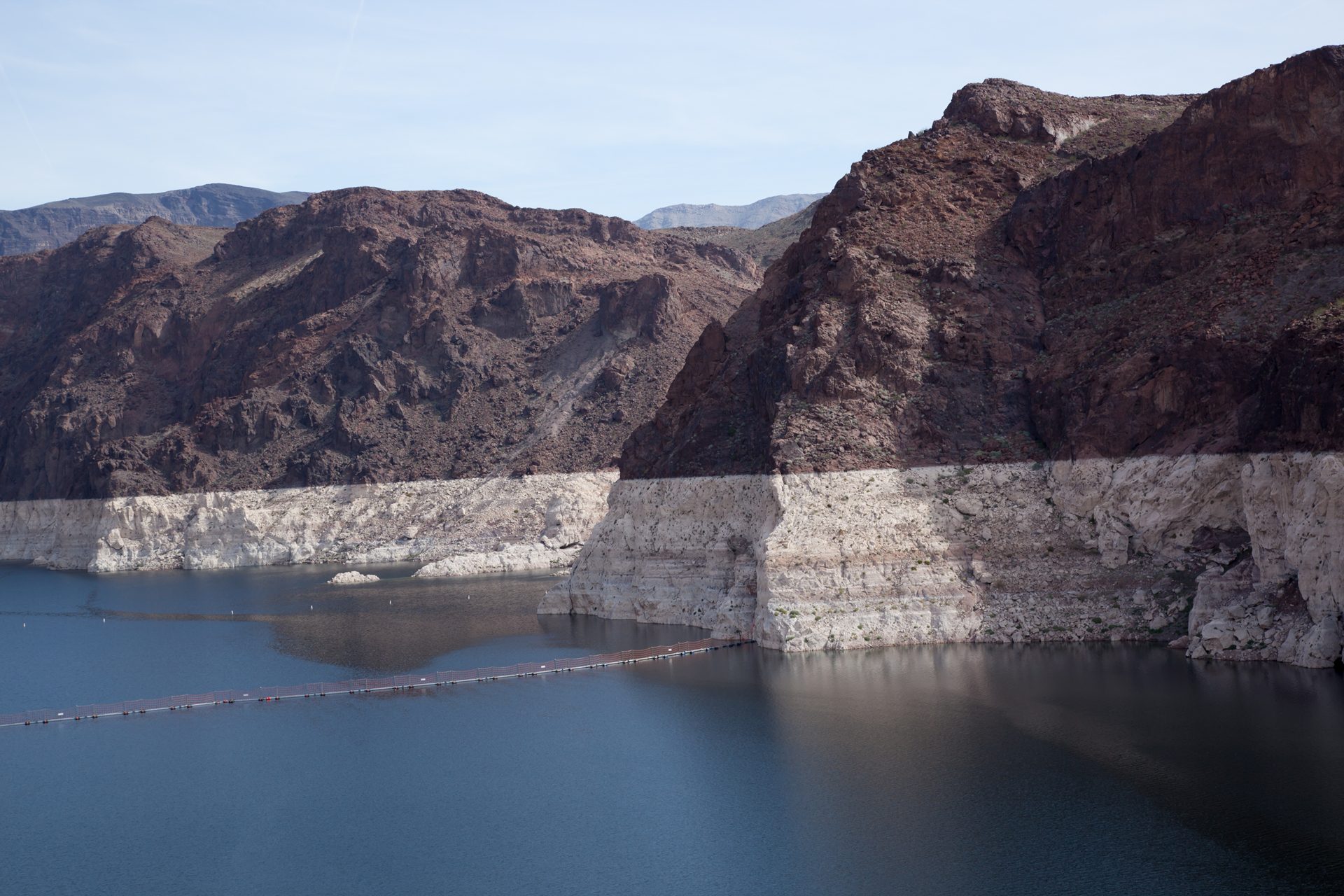
Reporting by Greg Haas of KLAS-TV on March 13, 2026 notes that Lake Mead is already about 34 percent full. New projections show the reservoir dropping even further than previously expected.
Earlier estimates suggested a decline of about six feet by November 2027. Updated projections now show a drop closer to eight feet. Under more severe scenarios, water levels could fall even lower.
The Bureau of Reclamation’s latest modeling indicates that spring and early summer inflows into Lake Powell may reach only about 36 percent of average. For the full water year, inflows are projected at about 52 percent of normal.
A system under long-term pressure.
The Colorado River supplies water to about 40 million people across seven states. It also supports agriculture, cities, and ecosystems throughout the Southwest.
Scientists and water managers have noted that rising temperatures over the past two decades have reduced the river’s overall flow. Estimates suggest the system now carries roughly 20 percent less water than it did before the long drought began around 2000.
Alan Halaly of the Las Vegas Review-Journal reported on March 18, 2026 that federal forecasters recently downgraded expected inflows into Lake Powell to as low as 27 percent of average, describing the situation as “a blaring alarm” for the river system.
Uncertainty remains, but risks are clear.
Despite the concerning outlook, experts caution that the season is not yet finished.
“There are still several months before the runoff season wraps up,” Moser said, noting that late-season storms could improve conditions.
Even so, the current forecasts highlight how sensitive the Colorado River system has become to temperature and snowfall changes.
With negotiations over long-term river management still unresolved, the declining water supply adds urgency to decisions that will shape the future of the West.