- A federal pilot tested ozone nanobubble treatment in sewage-impacted flows.
- Significant reductions in bacteria and odors were documented during operations.
- Engineers identified technical hurdles that limit immediate large-scale use.
Friday, December 26, 2025 –– On December 19, 2025, the United States Section of the International Boundary and Water Commission announced the completion of a pilot project testing ozone nanobubble technology in sewage-contaminated flows of the Tijuana River near the international boundary.
The project was conducted between September 9 and October 15, 2025, in partnership with Greenwater Services, a contractor specializing in water treatment technologies. The goal was to evaluate whether ozone delivered through nanobubbles could reduce bacterial contamination and odors under real-world river conditions that include fluctuating flows, trash, sediment, and untreated wastewater.
Why the Tijuana River Matters.
The Tijuana River has long carried untreated or partially treated wastewater from Mexico into Southern California. These cross-border flows frequently exceed public health standards and have contributed to beach closures, degraded air quality, and repeated public health concerns in nearby communities.
Unlike controlled treatment facilities, the river presents a challenging environment for any in-stream technology. Flows vary widely, debris loads are heavy, and contamination can spike suddenly during storm events or infrastructure failures upstream.
How the Pilot Worked.
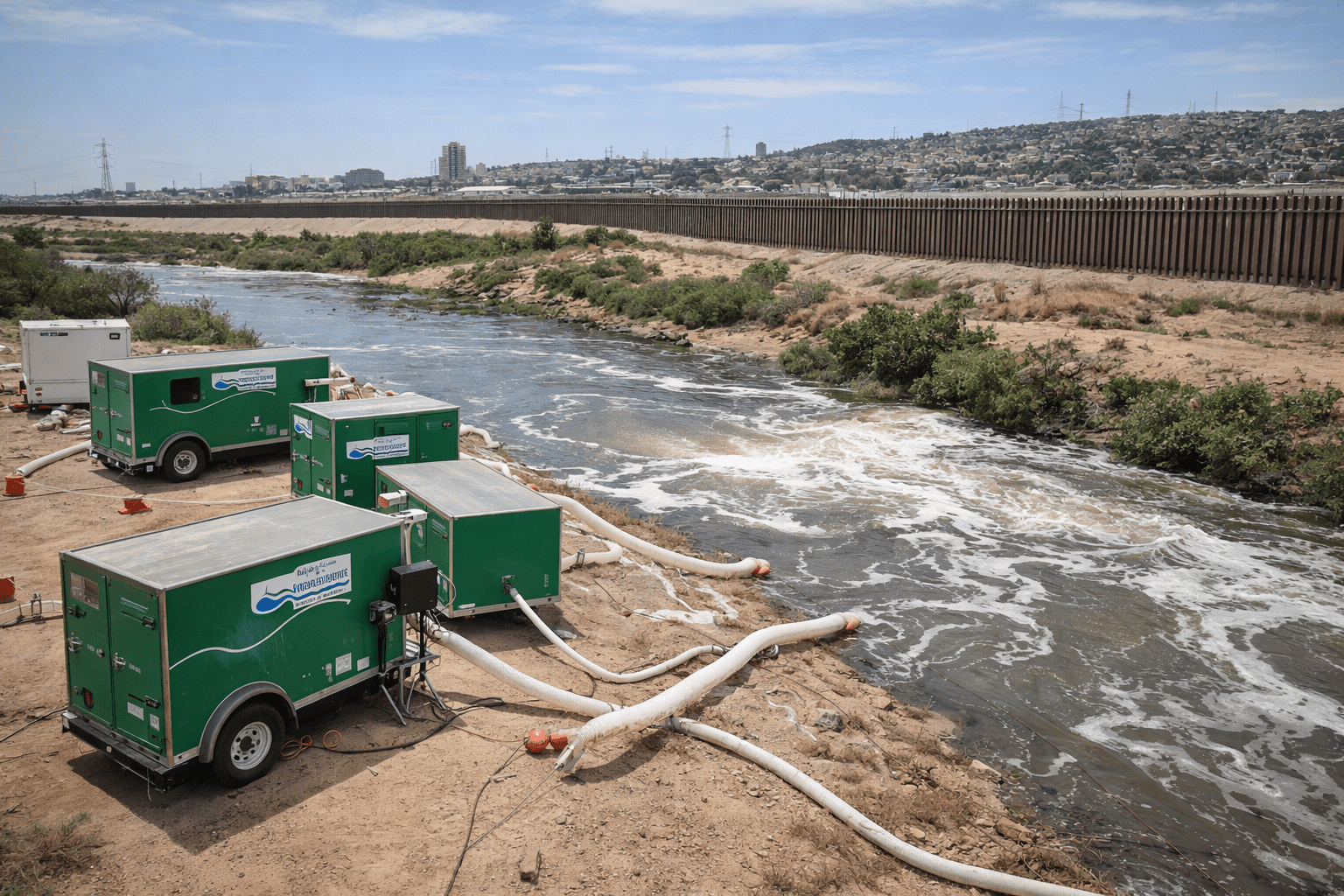
The pilot deployed four ozone nanobubble units just downstream of the international boundary. These units inject ozone into the water using microscopic bubbles designed to persist in the water column longer than conventional ozone treatment methods.
During the pilot, operations were limited primarily to daytime hours. Overnight flows often carried large amounts of trash that clogged equipment, making continuous operation impractical without additional debris management.
Despite these limitations, engineers were able to collect water quality samples before and after treatment to measure performance.
Measured Reductions in Bacteria.
According to the pilot report, the technology produced substantial reductions in total coliform bacteria and Escherichia coli during treatment periods.
Near-field downstream sampling, taken approximately five yards below the treatment area, showed cumulative reductions of more than 90 percent for total coliforms and more than 80 percent for E. coli. Samples collected farther downstream, at distances of roughly 250 yards, also showed reductions exceeding 80 percent for both indicators.
Pre-treatment bacterial concentrations were extremely high, with total coliform levels reaching into the hundreds of millions of Most Probable Number units. Post-treatment measurements consistently showed lower concentrations, even during abbreviated operating windows.
Odor Reduction and Observations.
In addition to laboratory results, personnel stationed near the site reported noticeable reductions in sewage odors during treatment periods. Border enforcement staff working in the area observed improved air conditions when the system was operating.
No adverse environmental or public health impacts were reported during the pilot. The treatment does not leave chemical residues, as ozone breaks down naturally into oxygen.
Operational Challenges Identified.
While the pilot demonstrated effectiveness, it also revealed significant challenges. Heavy debris loads repeatedly clogged equipment. Trash boom installation temporarily halted operations, and an unexpected flooding event on October 14, 2025 damaged equipment and forced early termination of the project.
Engineers concluded that any larger-scale deployment would require substantial design modifications. These include improved debris filtration, additional treatment units to handle variable flows, and infrastructure capable of operating safely during storm events.
What Comes Next.
The International Boundary and Water Commission stated that it will continue evaluating treatment technologies that could reduce public exposure to sewage contamination along the border. Officials noted interest in potential funding partnerships and further testing to determine whether ozone nanobubble systems can be adapted for long-term, large-scale use in unpredictable river systems.
The agency emphasized that the pilot was an evaluation tool, not a final solution, and that further engineering and coordination would be required before broader implementation could be considered.
Image is AI-generated, based on the report.
Frequently Asked Questions
What problem was this pilot trying to address?
The pilot focused on reducing bacterial contamination and odors from untreated sewage flowing through the Tijuana River into the United States.
What technology was tested?
The project tested ozone delivered through nanobubbles, which allows ozone to remain active in water longer than conventional methods.
Did the pilot improve water quality?
Yes. Sampling showed significant reductions in total coliform bacteria and E. coli during treatment periods.
Why was the pilot limited in duration?
Operations were constrained by heavy trash loads, fluctuating river flows, and an unexpected flooding event that damaged equipment.
Is this a permanent solution for the Tijuana River?
No. The pilot demonstrated potential but also identified technical challenges that must be addressed before any large-scale or long-term deployment.
Will more testing occur?
The International Boundary and Water Commission stated it will continue evaluating treatment technologies and potential partnerships for future projects.