
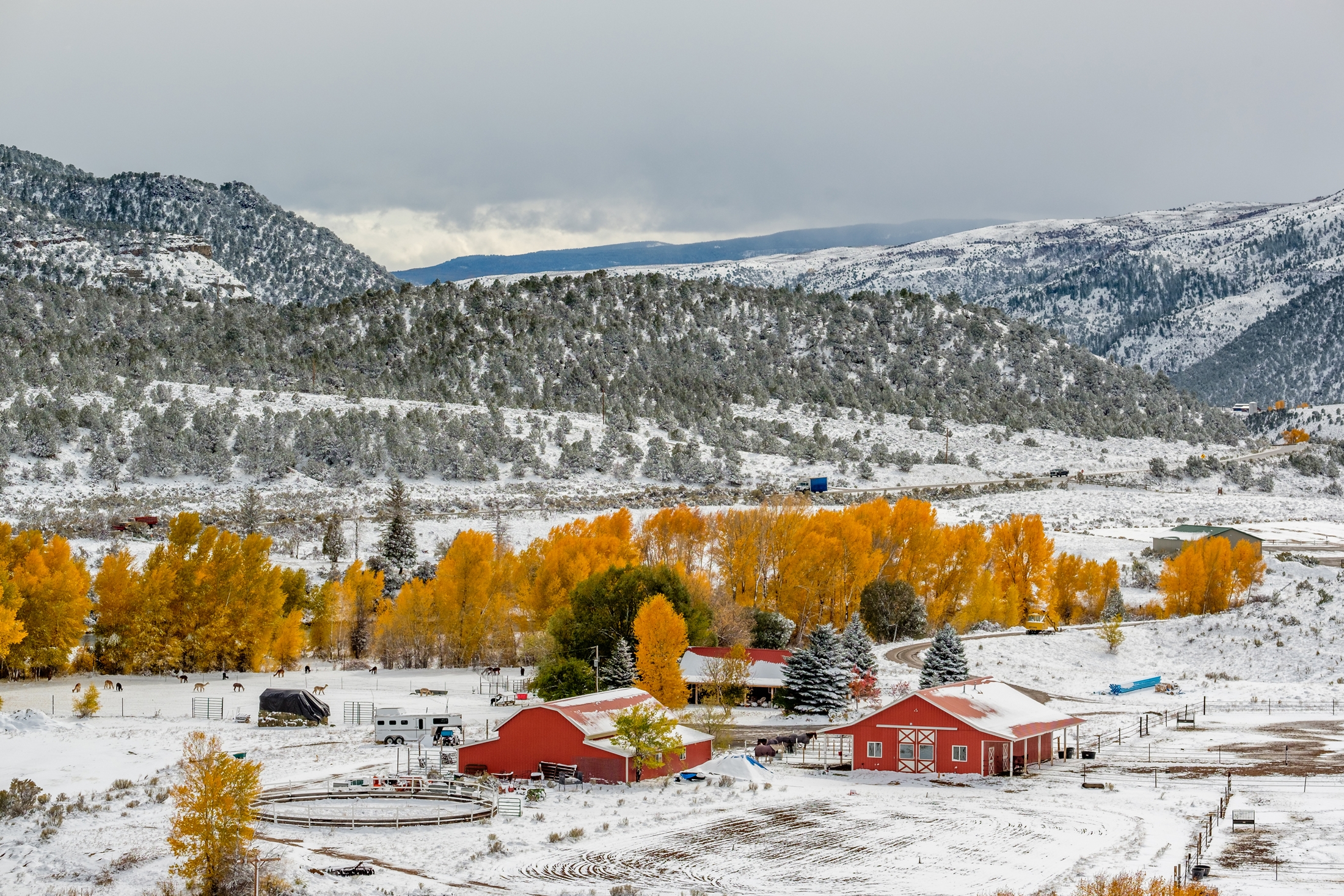
- Warmer winter temperatures have caused more precipitation to fall as rain instead of snow.
- Snow cover across the West is the lowest for early December since at least 2001.
- New Mexico snow cover is far below typical levels for this time of year.
- Snowpack water content varies widely across the region.
- Federal forecasters say conditions could still shift later in winter.
Friday, December 12, 2025 — Source New Mexico reports that federal meteorologists have identified a snow drought across much of the western United States, driven not by a lack of precipitation but by higher-than-average winter temperatures that are turning snowfall into rain. Data from the National Oceanic and Atmospheric Administration show that as of early December, snow covered about 90,000 square miles in the West, the smallest area recorded for that date in more than two decades. Nearly all western regions experienced record or near-record warmth in November, with the most pronounced snow deficits spanning mountain ranges in California, Oregon, and Washington. In New Mexico, satellite observations detected roughly 1,400 square miles of snow cover by December 10, about one quarter of the typical level and the lowest since 2018. Snow-water equivalent across most of the state measured about 75 percent of normal, dropping to just 20 percent in the southwest. NOAA emphasized that early-season snow conditions can change rapidly, noting that a single major storm can significantly alter snowpack totals as winter progresses.
Below is the article from Source New Mexico , republished in full under the Creative Commons license CC BY-NC-ND 4.0.
‘Snow drought’ observed across the West, amid higher-than-average winter temps
by Patrick Lohmann, Source New Mexico
December 11, 2025
Even though precipitation across the West to date is average or close to it, high temperatures across the region have turned snow into rain, leading federal meteorologists in a Thursday announcement to declare a “snow drought.”
As of Dec. 7, snow covered about 90,000 square miles across the West, the smallest area covered on that date since at least 2001, according to the National Oceanic and Atmospheric Administration.
Nearly every region in the West experienced record or near-record November warm temperatures, according to the NOAA.
While meteorologists determined the most “snow drought” runs across mountain ranges in California, Oregon and Washington, New Mexico’s snow cover measures one quarter of the median level usually observed on Dec. 10, according to data from the National Snow and Ice Center at the University of Colorado in Boulder.
The center’s map shows snow mostly along the state’s border with Colorado on Wednesday, as well as some in the Sandia Mountains near Albuquerque and a little sprinkled across the Gila National Forest.
New Mexico’s roughly 1,400 square miles of snow cover detected Dec. 10 marks the lowest on that date since 2018, according to the center, when just about 80 square miles across the state had visible snow.
How bad is the Western megadrought? Scientists look at tree rings to find context from history
The highest Dec.10 total over the last 25 years was observed in 2010, when snow blanketed more than 25,000 square miles. That’s the same year that the state saw the most area covered in the center’s history: 56,000 square miles covered on Jan. 31 of that year.
The NOAA announcement noted that New Mexico’s low snow cover also reflects its relatively dry water year overall, particularly compared with next-door Arizona, which experienced its 9th-wettest autumn on record.
Across most of New Mexico, the snow-water equivalent, which measures the amount of water in snowpack, ran 75% of normal, except in southwest New Mexico, where it’s only 20%.
The Thursday drought update from the NOAA noted that even though the region is currently experiencing “snow drought,” conditions could change quickly.
“Winter just began,” the NOAA said in its announcement. “And snowpack can change dramatically with a single storm this early in the season.”
New Mexico’s peak snow cover typically occurs Dec. 31, according to the National Snow and Ice Data Center’s analysis, when satellites can usually detect about 20,000 square miles of New Mexico mountains covered in white.
Source New Mexico is part of States Newsroom, a nonprofit news network supported by grants and a coalition of donors as a 501c(3) public charity. Source New Mexico maintains editorial independence. Contact Editor Julia Goldberg for questions: info@sourcenm.com.