
- A new United Nations report finds that many water systems are no longer recoverable.
- The Colorado River Basin reflects a broader global pattern of long-term overuse.
- Groundwater depletion and shrinking lakes are reshaping water security worldwide.
- Future water planning must reflect permanent limits rather than temporary shortages.
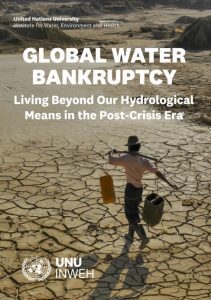
Friday, January 23, 2026 — On January 21, the United Nations University Institute for Water, Environment and Health released a major flagship report titled Global Water Bankruptcy: Living Beyond Our Hydrological Means in the Post-Crisis Era. The report concludes that many of the world’s water systems have moved beyond episodic crisis and into a long-term condition of depletion caused by decades of overuse, pollution, and ecosystem degradation.
The report introduces the concept of “water bankruptcy” to describe situations in which rivers, aquifers, lakes, wetlands, soils, and glaciers have been drawn down beyond safe limits for so long that historical water conditions can no longer be restored. Unlike droughts or short-term emergencies, water bankruptcy reflects a permanent shift in hydrological baselines.
Understanding Water Bankruptcy in Practical Terms.
 The report explains water bankruptcy using a financial analogy. Renewable water sources such as rivers, seasonal snowpack, and rainfall function like income, while groundwater, glaciers, wetlands, and soil moisture act as long-term savings. According to the report, many regions have spent both their income and their savings simultaneously.
When this occurs, water systems lose their ability to recover even during wetter years. Aquifers compact and permanently lose storage capacity. Rivers fail to meet environmental flow needs. Wetlands disappear, eliminating natural buffers against floods and droughts. Once these thresholds are crossed, the report notes, restoration is often physically impossible or economically unrealistic within human planning timeframes.
A Global Pattern Across Major River Basins.
While the report is global in scope, it emphasizes that water bankruptcy is not confined to any one region or level of development. Major river basins across Asia, the Middle East, Australia, South America, and North America now show similar symptoms of long-term decline.
The report identifies heavily stressed systems such as the Indus River in South Asia, the Yellow and Yangtze Rivers in China, the Tigris–Euphrates system in the Middle East, the Murray–Darling Basin in Australia, and the São Francisco River in Brazil. In these basins, long-term overuse has reduced natural resilience, and environmental flows are routinely violated.
These systems increasingly rely on groundwater to compensate for declining surface supplies, accelerating depletion of underground reserves and locking regions into long-term water deficits.
The Colorado River Basin in a Global Context.
Within the United States, the Colorado River Basin is highlighted as a clear example of these global trends. The basin supplies water to approximately 40 million people across seven states and supports extensive agricultural production, urban growth, and energy generation.
According to the report, decades of over-allocation, combined with sustained groundwater pumping, have pushed the Colorado River system beyond conditions where historical recovery can be assumed. Even when short-term improvements occur due to heavy snowfall or rainfall, reservoir levels remain far below long-term averages.
The report emphasizes that climate change alone does not explain this condition. Instead, it reflects legal, economic, and land-use commitments that exceed the basin’s sustainable hydrological capacity under current and projected conditions.
Groundwater Depletion as a Shared Global Risk.
Groundwater depletion emerges in the report as one of the most serious and least visible drivers of water bankruptcy. Globally, groundwater now supplies about half of all domestic water use and more than 40 percent of irrigation water.
The report finds that roughly 70 percent of the world’s major aquifers show long-term declining trends. In regions such as India, Iran, Mexico, China, the Middle East, and the western United States, decades of intensive pumping have caused land subsidence, saltwater intrusion, and water quality degradation.
These impacts permanently reduce aquifer storage capacity. Once compacted, aquifers do not rebound, even if pumping is reduced. In coastal and delta regions, groundwater depletion also increases flood risk and infrastructure damage, compounding long-term economic and environmental costs.
Shrinking Lakes, Rivers, and Wetlands Worldwide.
The report documents widespread declines in surface water bodies as another defining signal of water bankruptcy. More than half of the world’s large lakes have lost water since the early 1990s, affecting hundreds of millions of people who depend on them for drinking water, fisheries, local climate regulation, and livelihoods.
Examples include the Aral Sea in Central Asia, Lake Urmia in Iran, and the Great Salt Lake in the western United States. Reduced inflows caused by upstream water use, combined with higher temperatures, have accelerated water loss and increased salinity.
Wetlands, which store water and reduce flood and drought impacts, have disappeared at roughly three times the rate of forests over the past five decades. Their loss reduces natural water storage, intensifies drought impacts, worsens air quality by generating dust, and eliminates critical wildlife habitat.
Food Production Under Increasing Water Constraints.
Because agriculture accounts for approximately 70 percent of global freshwater withdrawals, the report places particular emphasis on food-producing regions. It estimates that more than half of global food production now occurs in areas where total water storage is declining or unstable.
In irrigated agricultural regions across South Asia, the Middle East, North China Plain, western North America, and parts of South America, water-intensive cropping patterns persist despite shrinking supplies. The report warns that this mismatch increases vulnerability to food supply disruptions, price volatility, and rural economic instability.
From Crisis Management to Long-Term Water Planning.
A central conclusion of the report is that traditional water crisis management is no longer sufficient. Crisis management assumes a return to normal conditions after droughts or emergencies. Water bankruptcy management accepts that the old normal no longer exists.
For regions like the American West, this means water planning must be based on reduced and more variable supplies rather than historical averages. The report calls for restructuring water rights, rethinking water-intensive land uses, and protecting remaining natural systems that support long-term water availability.
Broader Implications for Stability and Security.
Beyond physical shortages, the report frames water bankruptcy as a growing social and economic risk. As water systems degrade, competition between agricultural, urban, industrial, and environmental uses intensifies. The report documents a steady increase in water-related conflicts worldwide, particularly in shared and transboundary basins.
Because water systems are interconnected through trade, migration, and global food markets, water failures in one region can trigger consequences far beyond national borders. The report warns that unmanaged water bankruptcy could increasingly influence migration patterns, food security, and geopolitical stability.
Report Conclusions and Citation.
The United Nations report makes clear that recognizing water bankruptcy is not an act of surrender. Instead, it is described as a necessary step toward more honest, science-based decision-making.
For the United States and the Colorado River Basin, this recognition reinforces the need for long-term planning that reflects permanent constraints. The report concludes that future water security depends on managing what remains, preventing further irreversible damage, and aligning water use with what natural systems can realistically support in the decades ahead.
UNU-INWEH Report: Madani, K. (2026). Global Water Bankruptcy: Living Beyond Our Hydrological Means in the Post-Crisis Era. United Nations University Institute for Water, Environment and Health (UNU-INWEH), Richmond Hill, Ontario, Canada. DOI: 10.53328/INR26KAM001