
- Early-season heat wave brewing across Colorado River Basin states.
- Unusual warmth could challenge March records from California to Wyoming.
Friday, March 13, 2026 — A surge of early-season heat is building across the Colorado River Basin, and forecasters say the warmth expected for the remainder of March is far from typical for this time of year. Weather agencies across the West are warning that temperatures may climb 15 to 30 degrees above normal in some areas. In a region already watching drought and water supplies closely, the sudden warmth could speed up snowmelt, increase evaporation, and raise concerns for agriculture and reservoirs.
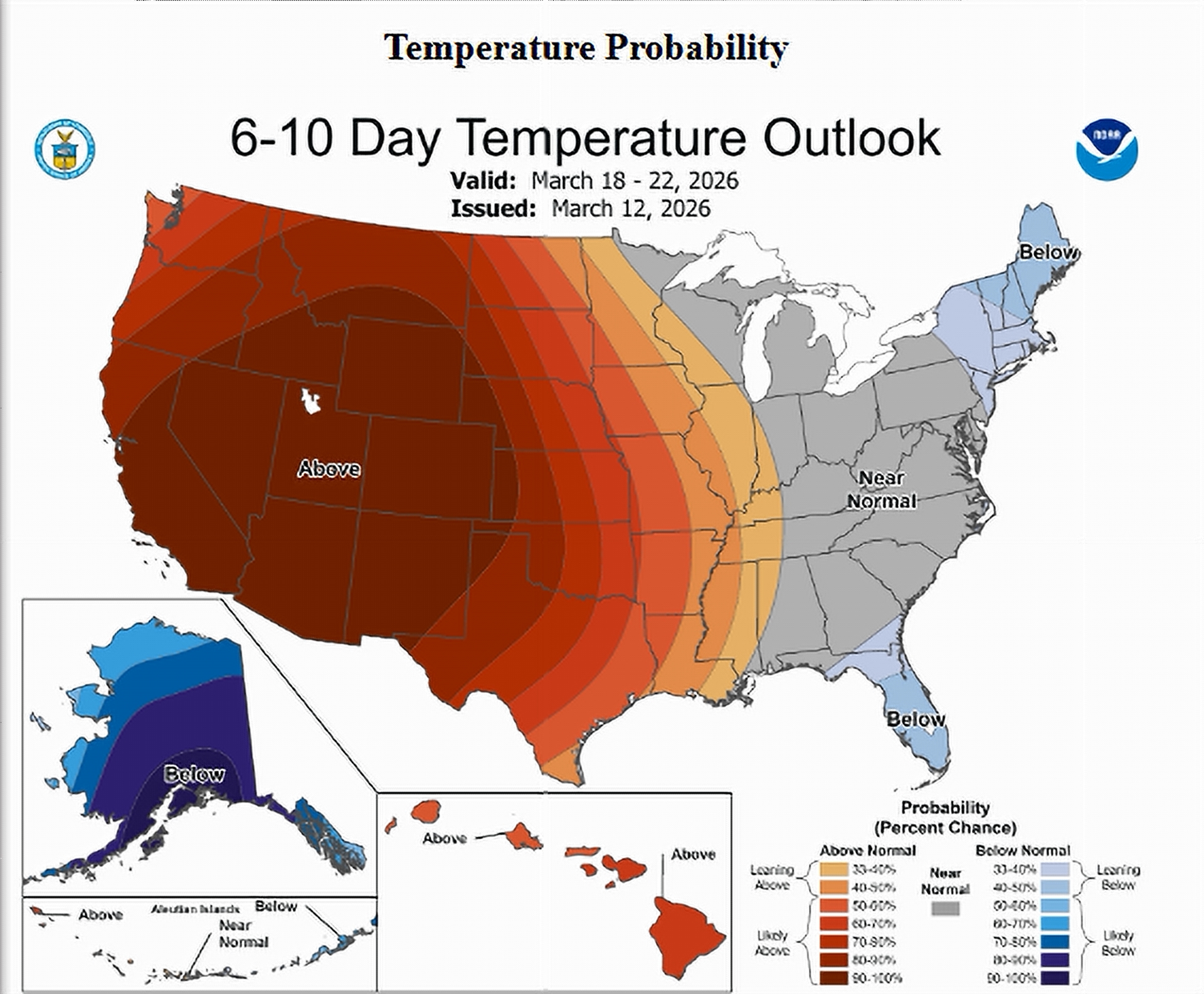
The Climate Prediction Center, part of the National Oceanic and Atmospheric Administration, says the odds strongly favor above-normal temperatures across the Southwest, Great Basin, and parts of the Rocky Mountains. In fact, some forecasts show a greater than 90 percent chance of warmer-than-average weather during the middle of March.
California Heat Advisory.
The heat signal is strongest in southern California, where the National Weather Service has already issued a Heat Advisory for parts of the Los Angeles and Ventura County region. Advisories like this are uncommon in March. Inland temperatures have been forecast to reach the 90s, with some desert areas pushing even higher. These levels may not seem extreme in mid-summer, but they stand out when they arrive weeks ahead of the normal warm season.
Dramatic Temperature Swings in Arizona.
Arizona could see some of the most dramatic temperature swings. Forecasters at the National Weather Service office in Phoenix say desert highs may climb into the 90s and even reach 100 degrees, a level that could threaten records for the earliest triple-digit day ever observed in the city. Early heat like this can increase heat stress for outdoor workers and hikers who may not yet be acclimated to summer conditions.
Unusually Hot Weather for Nevada and New Mexico.
In southern Nevada, including the Las Vegas region, meteorologists say temperatures could run about 20 degrees above normal during the warmest part of the forecast period. Officials are also warning about moderate heat risk, a measure used by the National Weather Service to estimate potential health impacts. Moderate heat risk means some people—especially older adults and those working outside—could begin feeling the effects of the heat.
New Mexico may also see unusually hot weather for March. Forecast discussions from the National Weather Service office in Albuquerque say temperatures could climb 15 to 25 degrees above the long-term average. Meteorologists noted that some locations may approach or break long-standing temperature records if the current pattern holds.
The Utah Forecast.
Even normally cooler states in the upper basin are expected to feel the warm pattern. In Utah, the National Weather Service says temperatures could reach 20 to 30 degrees above normal, with some cities potentially flirting with all-time March records. Rapid warm-ups like this often occur when a strong high-pressure ridge settles over the western United States.
Warming Trends Predicted for Colorado and Wyoming.
In Colorado, forecasters say a brief cool period may be followed by a sharp warming trend. By the middle of March, temperatures along the Front Range could climb high enough to challenge daily record highs. While the warmth may feel pleasant to many residents, rapid temperature swings can complicate snowpack forecasts and water planning across the state.
Farther north, Wyoming is expected to see warmer-than-normal temperatures later in the forecast period. The National Weather Service office in Riverton says there is a high probability of well-above-average temperatures, and some areas could see record warmth by mid-month. Wyoming’s mountain snowpack is an important source of water for the Colorado River system, so rapid warming always draws attention from water managers.
Repercussions for Water Planning and Supplies.
For people living in the Colorado River Basin, the early heat is more than just a weather curiosity. The basin supplies water to about 40 million people across the western United States, and temperature swings can affect snowpack, reservoir levels, and water demand. When heat arrives early in the season, it can accelerate spring runoff and increase evaporation from soils and reservoirs.
Forecasters emphasize that weather patterns can change, but the current outlook suggests that March 18 through March 26 may bring the most intense warmth across the basin states. For residents, farmers, and water managers alike, it is a reminder that the West’s climate is growing more unpredictable—and that even spring can now bring summer-like heat.
Image: 6-10 Day Outlook from the National Weather Service’s Climate Prediction Center.