- Heavy storms improved conditions in California.
- Snowpack remains below normal in key mountain areas.
- Severe to extreme drought persists across much of the Colorado River Basin.
- Dry conditions expanded in parts of Wyoming and northern Colorado.
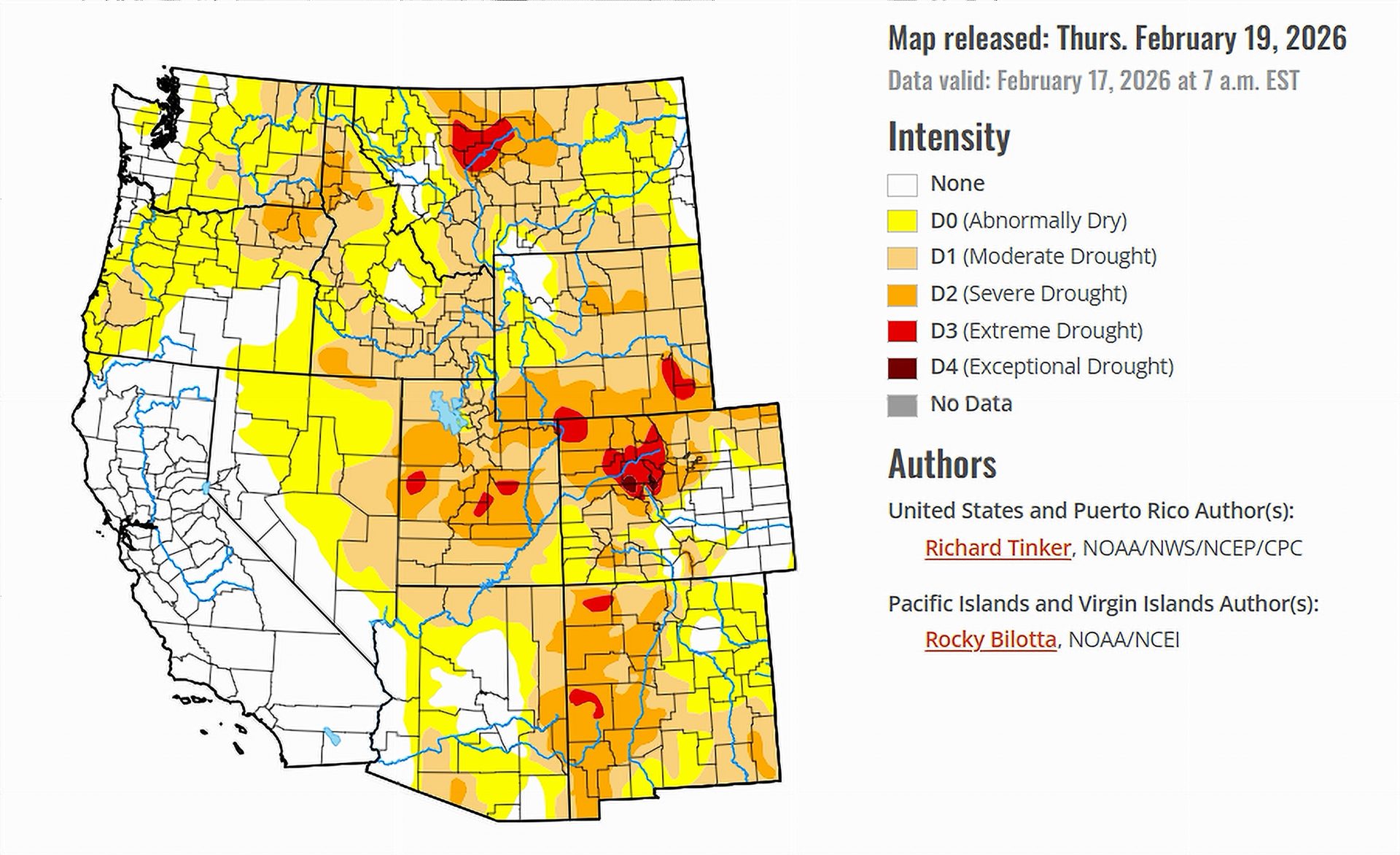
Saturday, February 21, 2026 –– The February 19, 2026 U.S. Drought Monitor shows storm relief in California, but severe to extreme drought continues across much of the Colorado River Basin. Snowpack remains below normal in key mountain regions of Colorado, Utah, Wyoming, Arizona, Nevada, and New Mexico, raising ongoing water supply concerns for the West.
A Mixed Picture Across the Nation.
The Drought Monitor reflects a country divided between recent relief and continuing dryness.
Heavy precipitation returned to parts of the West Coast after several warm, dry weeks. California received the most significant moisture, with more than 1.5 inches across wide areas and isolated mountain locations approaching 10 inches in liquid equivalent. Several feet of snow accumulated in portions of the Sierra Nevada. Despite this welcome snowfall, overall snowpack in parts of the West remains below normal for this time of year.
Elsewhere in the country, conditions varied. Parts of the Southeast and lower Mississippi Valley saw moderate rainfall, while areas in the High Plains and Upper Midwest continued to struggle with limited precipitation. In several regions, drought intensified more than it improved.
For residents and water managers in the Colorado River Basin, the most important developments lie within the seven basin states: Arizona, California, Colorado, Nevada, New Mexico, Utah, and Wyoming.
California: Storm Relief, But Snowpack Concerns Remain.
California stands out this week as nearly free from dryness and drought. Widespread precipitation, particularly along the western tier and in higher elevations, erased most drought classifications.
However, while snow piled up in parts of the Sierra Nevada, the overall snowpack remains significantly below normal in some areas. Snowpack acts as a natural reservoir for the Colorado River system, slowly releasing water into streams and reservoirs during spring and summer. Below-normal snow levels can limit runoff later in the year, even after strong winter storms.
Colorado River Basin: Drought Still Widespread.
Outside California, drought conditions remain entrenched across much of the Colorado River Basin.
Severe drought (D2) to extreme drought (D3) now stretches across most of the western half of New Mexico, adjacent areas of Arizona, central and northern Utah, and parts of Colorado. In the High Plains region, moderate drought (D1) or worse covers most of Wyoming and extends into northern, central, and western Colorado.
Widespread deterioration was noted in Wyoming and central through eastern Montana due to scant precipitation. In Colorado, severe drought (D2) or worse remains common across northern and central areas.
In Utah and Nevada, light to moderate precipitation fell in some locations, but not enough to produce significant improvement. Central sections of both states continue to experience drought classifications, and snowpack in several areas remains below normal.
New Mexico saw limited improvement in parts of central and south-central regions due to earlier precipitation, but severe to extreme drought continues across most of the western portion of the state.
Arizona remains affected by drought in its northern and western sections, where severe and extreme drought designations persist.
Snowpack: A Critical Factor for the Basin.
One of the most significant concerns for the Colorado River Basin is mountain snowpack. The recent precipitation has not significantly boosted snow levels in several areas that remain below normal, including:
- Much of west-central and southwestern Colorado.
- Central sections of Utah and Nevada.
- Scattered locations across western Wyoming.
- The southernmost Rocky Mountains.
Because the Colorado River depends heavily on snowmelt from the Rocky Mountains, below-average snow accumulation can limit spring runoff and reservoir inflows.
Upcoming Trends.
Forecasts call for additional precipitation along parts of the West Coast, including northwestern California and sections of the Sierra Nevada. Light to moderate precipitation is expected across portions of the interior West, including the Great Basin and higher elevations of the Rockies.
The six- to ten-day outlook suggests increased chances for below-normal precipitation across parts of the southern Rockies and southern tier of the United States. Warmer-than-normal temperatures are expected across much of the West and Plains, which can increase evaporation and reduce snowpack retention.
The Basin’s Ongoing Challenge.
While California has seen substantial short-term relief, much of the Colorado River Basin continues to experience moderate to extreme drought conditions. Snowpack remains below normal in several key mountain regions that supply the river system.
The February 19 report underscores a familiar pattern: periodic storms can provide temporary improvement, but long-term water supply conditions across the basin remain closely tied to sustained precipitation and mountain snow accumulation in the months ahead.