- New robot maps soil moisture across entire orchards.
- Technology helps farmers avoid overwatering and waste.
- System can improve crop health and reduce pollution.
- Researchers say it could help farms survive water shortages.
Friday, April 3, 2026 — Water is becoming harder to manage across the West, especially in agriculture. Farms depend on getting the right amount of water at the right time, but that is not always easy.
On April 2, 2026, researcher Jules Bernstein reported that scientists at the University of California, Riverside have developed a new robotic system designed to solve this problem. The goal is simple but important: help farmers use less water while still growing healthy crops.
The system works by creating a detailed map of soil moisture across an orchard, tree by tree. Instead of guessing how much water different areas need, farmers can now see it clearly.
Why Current Methods Fall Short.
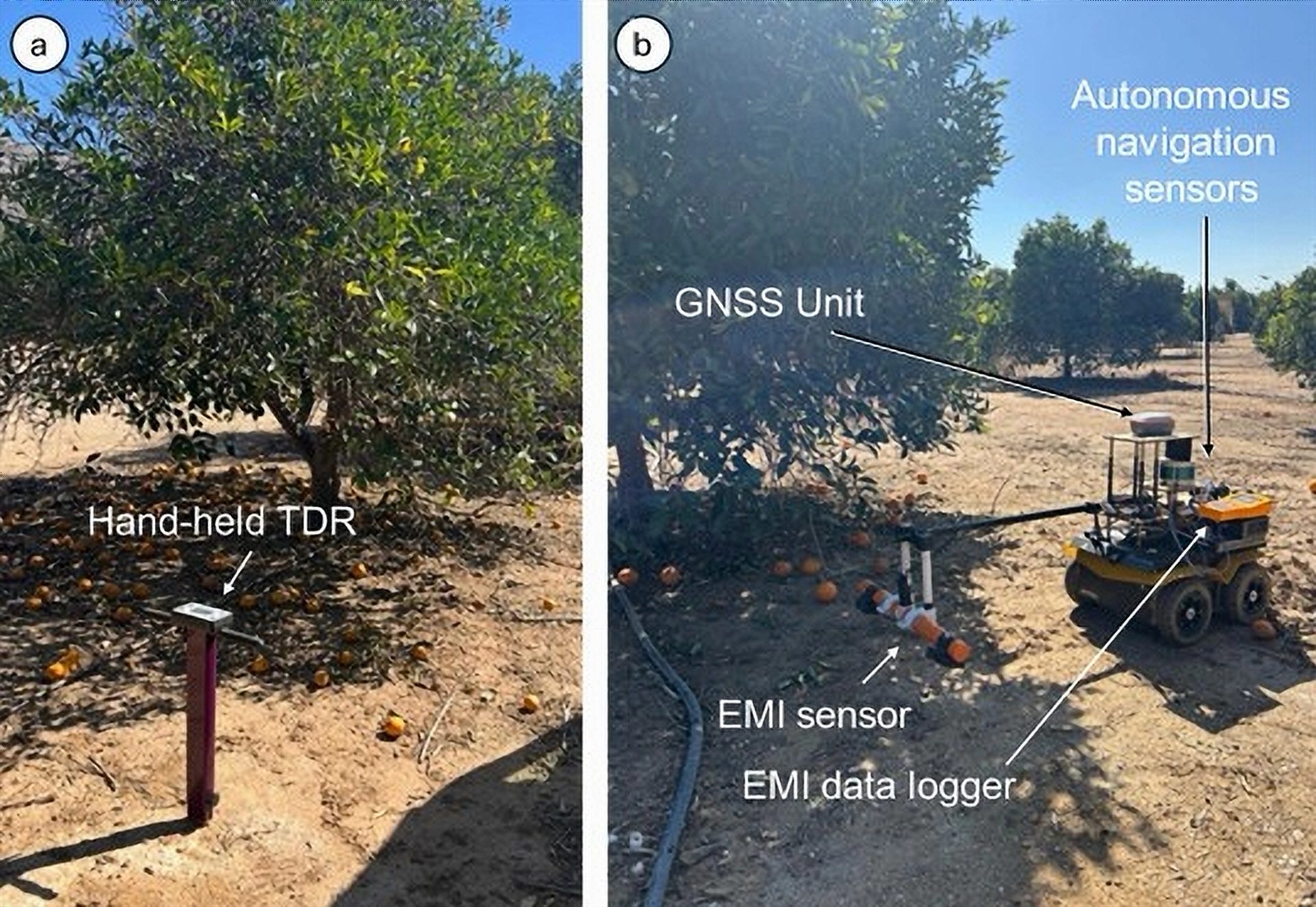
Many growers already use soil sensors buried in the ground. These tools measure how much water is available to plants. However, they only collect data from a few spots.
That leaves large areas unmeasured. Farmers often have to make decisions based on limited information.
As researcher Elia Scudiero explained in the UC Riverside report, traditional sensors “only tell what’s happening in the immediate areas where they’re placed.”
This can lead to uneven watering. Some trees get too much water, while others do not get enough.
How the Robot Works.
The new system takes a different approach. A small robot moves through the orchard and measures a property called electrical conductivity in the soil.
This measurement is important because it varies with the amount of water present, along with other factors such as soil type and salt content.
The robot collects this data across the entire field. Researchers then combine it with readings from existing sensors to build a model that estimates moisture levels everywhere.
The result is a full map showing exactly where water is needed.
Finding the “Sweet Spot.”
Watering crops is not just about giving them more. There is a balance.
Too little water stresses plants and makes them more vulnerable to pests and disease. Too much water can suffocate roots by pushing out oxygen in the soil.
Scudiero described this balance as a “sweet spot,” where plants get just enough to stay healthy.
This new technology helps farmers stay in that range more consistently.
Benefits Beyond Water Savings.
The impact could go beyond saving water.
When fields are overwatered, fertilizers can wash past plant roots and into groundwater. This can lead to pollution problems.
By applying only the water crops actually need, the system may reduce that risk.
It could also help farmers deal with rising costs and tighter groundwater rules.
“If water becomes limited, farmers have two choices,” Scudiero said. “They can retire orchards, or they can find ways to produce the same crops using less water.”
From Research to Real Farms.
The project began in 2019 and has been tested at UC Riverside’s citrus research fields. The research team has already filed a patent related to how the robot works with soil sensors.
The next step is testing the system on commercial farms. That will require machines that can handle real-world conditions such as weather, terrain, and different crop types.
Private companies may eventually turn the technology into products that growers can use widely.
A Step Toward Precision Agriculture.
This work is part of a larger movement known as precision agriculture. The idea is to use data, sensors, and automation to manage farms more efficiently.
In dry regions like California and much of the West, that efficiency is becoming essential.
If successful, this robot could help farmers produce more food using less water. As Scudiero summed it up: more crop per drop.
Citation; Image Source.
Francesco Morbidini, Aritra Samanta, Carmelo Maucieri, Konstantinos Karydis, Peggy A. Mauk, Todd H. Skaggs, Elia Scudiero,
Robotic mapping of soil volumetric water content with geospatial soil apparent electrical conductivity in micro-irrigated citrus orchards in California, Computers and Electronics in Agriculture, Volume 245, 2026, 111540, ISSN 0168-1699,
https://doi.org/10.1016/j.compag.2026.111540.
(https://www.sciencedirect.com/science/article/pii/S0168169926001353)