- Drought worsened across parts of the West during the latest reporting week.
- Snowpack in key western basins remained far below normal.
- The Colorado River Basin entered April with major reservoirs still low.
- Arizona, California, Colorado, Nevada, New Mexico, Utah, and Wyoming remain under growing pressure.
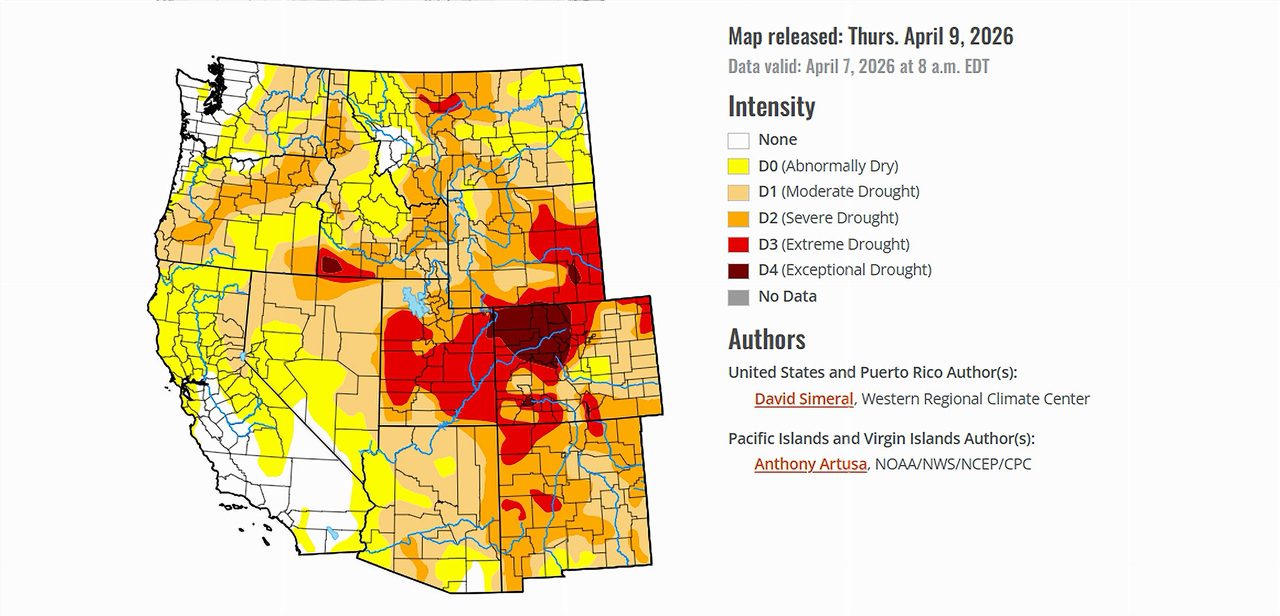
Saturday, April 11, 2026 — The United States entered spring with a complicated drought picture, according to the U.S. Drought Monitor Report issued on Thursday, April 9 . Some parts of the Midwest, South, and Plains saw welcome relief after strong rounds of rain. But much of the West moved in the opposite direction. Dry weather, unusual warmth, and weak mountain snowpack continued to strain water conditions across large areas of the region. The March 2026 period was especially notable. It was the warmest March on record for the contiguous United States, and the January through March period was the driest such stretch on record.
For the Colorado River Basin, that broad national pattern matters because the basin depends so heavily on mountain snow. Snow that builds through winter and melts slowly in spring acts as a natural water bank. This year, that bank is badly depleted. As of April 7, snow water equivalent stood at just 26 percent of median in the Upper Colorado region and 17 percent in the Lower Colorado region. The Rio Grande region, which also reflects severe dryness across parts of the interior West, was even lower at 13 percent.
A Basin Running on Thin Snowpack.
The latest drought report shows that conditions continued to deteriorate across the West, including areas tied directly to the Colorado River Basin. During the reporting week, drought worsened in parts of California, Nevada, Wyoming, and New Mexico. The report also noted broader degradation across the region, even though some mountain areas received a modest shot of precipitation. That moisture helped, but not enough to reverse the larger trend. Most of the remaining snowpack is now confined to the highest elevations.
Colorado stands out for a troubling reason. The report says the state’s snow water equivalent is the lowest on record. In a normal year, Colorado’s mountain snowpack usually peaks around April 8. This year, it peaked a full month earlier, on March 8. That kind of early peak can signal a shortened runoff season and less sustained flow heading into the hotter months.
This matters far beyond Colorado’s borders. The seven Colorado River Basin states, Arizona, California, Colorado, Nevada, New Mexico, Utah, and Wyoming, all depend in different ways on runoff from the Rockies and surrounding high country. When the snowpack is this poor, the basin enters spring with very little cushion.
Reservoirs Remain Low.
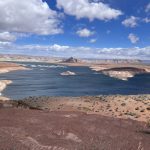
The report also offers a snapshot of the basin’s two best-known reservoirs. Lake Powell was 24 percent full, and Lake Mead was 33 percent full at the time of the report. Those numbers reflect how much strain has already been placed on the river system after years of drought and overuse pressures. They also show why mountain snowpack is watched so closely each spring. A weak runoff season leaves less room for recovery.
California and the Basin’s Western Edge.
California is not only important in its own right. It also helps tell the larger story unfolding across the basin and the broader West. Statewide snowpack in California was just 16 percent of normal on April 7. The Northern Sierra was especially weak at 5 percent of normal, while the Central Sierra stood at 19 percent and the Southern Sierra at 27 percent. The report also listed multiple California locations among the driest on record or near record during the previous 30 days, including Mount Shasta, Santa Cruz, and San Diego.
That does not mean every part of California affects the Colorado River the same way. But it does reinforce the report’s central theme: much of the West is dry at the same time, and many of its mountain water sources are underperforming.
What the Report Shows for the Basin.
Taken together, the latest U.S. Drought Monitor summary paints a stark picture for the Colorado River Basin states. Drought expanded or intensified in several western states tied to the basin. Snowpack remained far below normal across the Upper Colorado and Lower Colorado regions. Colorado reported its lowest statewide snow water equivalent on record. And the basin’s two largest reservoirs remained well below full.
The report’s short-term outlook offered some chance of added moisture in parts of the Far West and northern Rockies, while much of the Southwest, including Arizona and New Mexico, was expected to stay dry in the immediate forecast period. That leaves the basin moving deeper into April with little margin for error.