
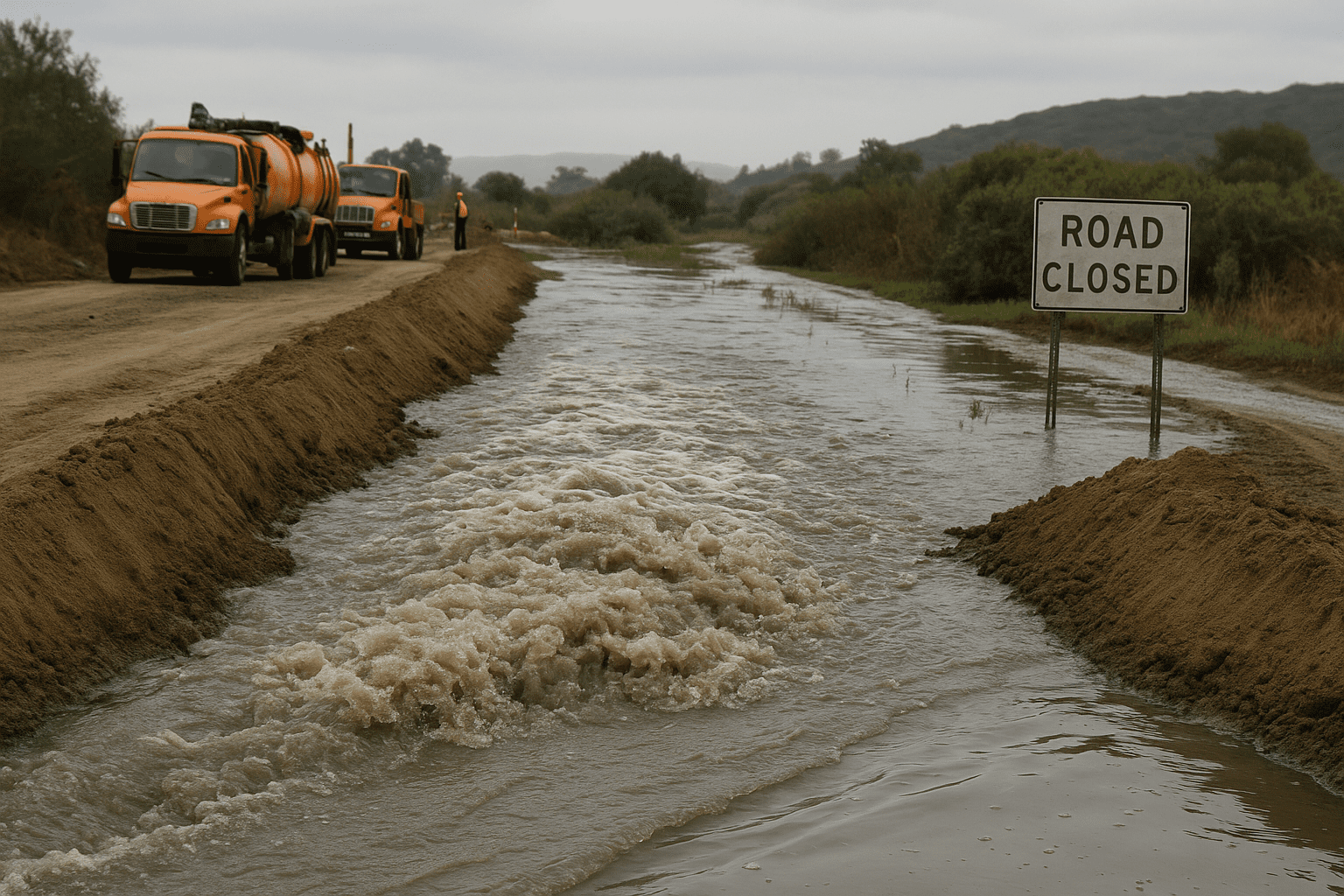
- A sewer line failure in Mexico sent untreated wastewater toward Imperial Beach.
- Federal agencies report progress on long-delayed border-region treatment upgrades.
- New scientific research shows how sewage plumes affect coastal health risks.
- Residents say recurring spills continue to harm neighborhoods and depress property values.
Monday, December 8, 2025 — California’s South Bay residents woke to strong odors drifting across the Tijuana River Valley after a sewer line ruptured in Mexico on December 7, 2025. Officials estimated that roughly 120,000 gallons of untreated wastewater moved toward Imperial Beach before emergency crews built new berms and deployed vacuum trucks to intercept as much of the flow as possible.
According to the United States International Boundary and Water Commission, workers at nearby pump stations were already in the middle of construction upgrades when a line failed on the Mexican side. Heavy rainfall reportedly contributed to the break. The agency said the damaged line had been contained, with crews remaining on site until flows fully subsided.
Although the immediate spill response was rapid, it was also familiar. Similar cross-border sewage incidents have affected South Bay communities for decades, closing beaches, deterring tourism, and prompting sustained calls for long-term binational solutions.
Local Residents Say Temporary Fixes No Longer Build Confidence.
People who have lived along the estuary for years describe a cycle of persistent odors, closures, and frustration. Longtime resident Leon Benham, who has lived near the river for more than six decades, told reporters the contaminated flows create conditions where certain vegetation thrives because of excess nutrients. He also said the repeated spills have contributed to falling home values in the neighborhood.
Many South Bay residents have said that each new spill adds to skepticism that real progress is being made, despite years of planning and numerous federal announcements.
Federal Agencies Report Accelerated Progress.
In late October, the United States Environmental Protection Agency completed a 100-day review of ongoing border-region wastewater projects. The agency said construction schedules across both nations had shortened by about nine months. The review followed a July 2025 agreement between the EPA and Mexico’s Ministry of Environment that sought faster timelines, greater financial cooperation, and infrastructure sized for future population growth.
According to the EPA, cumulative reductions in project timelines now total roughly 12 years. Two projects accounted for most of the gains: rehabilitation of aging pipelines in the Tijuana River system and upgrades to Pump Station 1, a key backup facility designed to reduce the chance of spills when primary pumps fail.
Earlier this year, the EPA and the United States International Boundary and Water Commission also completed a 10-million-gallon-per-day expansion of the South Bay International Wastewater Treatment Plant. The project had originally been expected to take two years but finished in 100 days. Additional expansion to about 50 million gallons per day remains planned for completion by the end of 2027.
Federal officials have indicated that a new treaty document outlining the next phase of obligations is expected before the end of 2025.
Persistent Air and Water Quality Risks Highlight the Stakes.
Scientists have documented that impacts extend beyond beach closures. A peer-reviewed analysis from Scripps Institution of Oceanography found that hydrogen sulfide levels in parts of the Tijuana River Valley can rise well above California air-quality thresholds during significant sewage events. Researchers also identified numerous gases associated with sewage.
Public access along Monument Road at Border Field State Park has remained closed due to contaminated mud, road damage, and standing water. County and state agencies have distributed air purifiers in surrounding neighborhoods as a short-term measure.
At the same time, new research published in 2025 highlights the complexity of managing wastewater plumes in coastal environments. The GeoHealth study, led by Scripps Institution of Oceanography, examined how untreated wastewater released near Punta Bandera in Mexico can travel northward and affect beaches in southern San Diego County. Using multi-year ocean simulations, researchers found that:
-
High wastewater exposure events tend to reach beaches such as Imperial Beach about once a month and typically last less than a week.
-
Lower salinity and lower temperature along the shoreline correlate strongly with higher wastewater concentrations.
-
A risk-assessment model built from the simulations showed moderate correlation with real shoreline Enterococcus measurements collected in 2024.
The study emphasized that wastewater plumes can behave differently across locations, with more frequent but shorter events occurring farther from the source. The results also show how a combination of dilution, mixing, shoreline geography, and seasonal ocean conditions shapes when and where public health risks emerge.
Citation:
Agarwal V, Feddersen F, Brasseale E, Bowman JS, Send U, Lankhorst M, Giddings SN, Spydell M, Wu X, Gopalakrishnan G, Sevadjian J, Berman KE, Marhoefer-Jess S, Barton AD. Real-Time Empirical Risk Assessment From Recurrent Coastal Sewage Plumes. Geohealth. 2025 Dec 2;9(12):e2025GH001434. doi: 10.1029/2025GH001434. PMID: 41346723; PMCID: PMC12672925.
Long-Term Relief Remains Dependent on Binational Infrastructure.
The December spill illustrates how vulnerable the border region remains while major infrastructure work continues in both countries. Even with recent construction gains, federal officials have acknowledged that interim upgrades will not eliminate all spills during wet-weather months. Repairs and expansions in Mexico are considered equally essential to reducing cross-border flows.
For residents, the real test will come when new systems are fully operating and can withstand heavy rains without sending untreated wastewater toward neighborhoods, beaches, and ecological reserves.
Image is AI-generated.
FAQ
What caused the December 7 sewer spill?
A sewer line broke on the Mexican side of the Tijuana River system during rainy conditions, sending an estimated 120,000 gallons of sewage toward Imperial Beach.
Are construction projects underway to address the issue?
Yes. The United States and Mexico are carrying out coordinated upgrades to pipelines, pump stations, and treatment facilities. Federal agencies reported in October that recent agreements had accelerated construction timelines by several months.
Will current projects prevent future spills?
Not immediately. Officials have said interim improvements help increase capacity but cannot prevent every failure, especially during storms. Long-term relief requires completion of major expansions in both countries.
Why are South Bay residents still concerned?
Communities near the estuary have experienced recurring sewage events for years. Many residents say the odors, closures, and health concerns make it difficult to trust that lasting solutions are near.
What does new scientific research show about health risks?
A 2025 study from Scripps Institution of Oceanography found that wastewater plumes typically reach Imperial Beach about once a month, can persist for several days, and are strongly associated with lower salinity and temperature along the shoreline. These conditions can increase the risk of gastrointestinal illness.
Is the air affected as well as the water?
Yes. Previous research has documented spikes in hydrogen sulfide and other sewage-related gases in the Tijuana River Valley during spill events, prompting distribution of air purifiers and ongoing monitoring.