Early March storms brought one to three inches of rain to parts of the Ohio River Valley and the Mississippi River region. That moisture helped ease drought conditions across several states in the Midwest and parts of the Appalachian region. Even with those improvements, long-term drought still lingers across much of the Northeast, where streamflows remain unusually low.
Conditions remain difficult across the Southeast and parts of the Southern Plains. In several areas, rainfall over the past few months has been far below normal. Some regions are still experiencing severe drought (D2) and extreme drought (D3), while wildfire activity has already begun in parts of Florida.
But the most closely watched drought signals this spring are developing in the western United States.
Low Snowpack Creates Concern in the West.
Across the western states, snowpack levels remain unusually low for this time of year. Snowpack acts as a natural reservoir, slowly releasing water into rivers and reservoirs during the spring and summer.
As of early March, snow water levels across much of the West were far below normal. In several mountain regions, snowpack measured less than forty percent of average conditions. Temperatures during late February and early March were several degrees warmer than normal, triggering early snowmelt in some areas.
This combination of low snowpack and early melting raises concerns for water supplies heading into the warmer months.
Even in areas where drought conditions have not yet intensified, the lack of mountain snow signals potential challenges ahead.
The Colorado River Basin Faces a Difficult Start to Spring.
The Colorado River Basin states—Arizona, California, Colorado, Nevada, New Mexico, Utah, and Wyoming—depend heavily on winter snowpack for their annual water supply. Much of the river’s flow begins as snow in the Rocky Mountains and surrounding ranges.
This year’s snowpack in several of those headwater regions is already running well below normal.
In Colorado, which provides a large share of the Colorado River’s water, snowpack levels in major river basins were reported at less than seventy percent of average conditions for early March. Those numbers are concerning because spring runoff from the Rocky Mountains feeds reservoirs, farms, and cities across the basin.
Dry conditions are also expanding in parts of the Four Corners region. Drought recently spread into southeastern Utah and intensified in other parts of the state. Some areas there are now classified as severe drought (D2) or extreme drought (D3).
Elsewhere in the West, the situation remains uneven. California remains free of formal drought designations, but statewide snowpack is only about 53% of normal levels. Even without official drought status, reduced snowpack can still affect future water supplies.
Why Snowpack Matters for Western Water.
Snowpack is one of the most important indicators for water conditions in the Colorado River Basin.
Each winter, mountain snow stores water that slowly melts through the spring and summer. That gradual melt feeds rivers, fills reservoirs, and supports agriculture across the Southwest.
When snowpack is low, less water flows into the river system. Early melting can also cause water to run off too quickly, reducing the amount stored in reservoirs for later use.
Because the Colorado River serves tens of millions of people and millions of acres of farmland, snowpack levels are closely monitored throughout the winter and spring.
Looking Ahead.
Weather forecasts for mid-March suggest warmer-than-normal temperatures  are likely across much of the western United States, including California, the Great Basin, and the Southwest. In many areas, the probability of above-normal temperatures exceeds ninety percent.
At the same time, below-normal precipitation is expected across large parts of the West.
If those patterns continue, the combination of warmth and dry weather could further pressure already low snowpack across the Colorado River Basin.
Water managers, farmers, and communities across the West will be watching the coming weeks closely as the spring runoff season approaches.

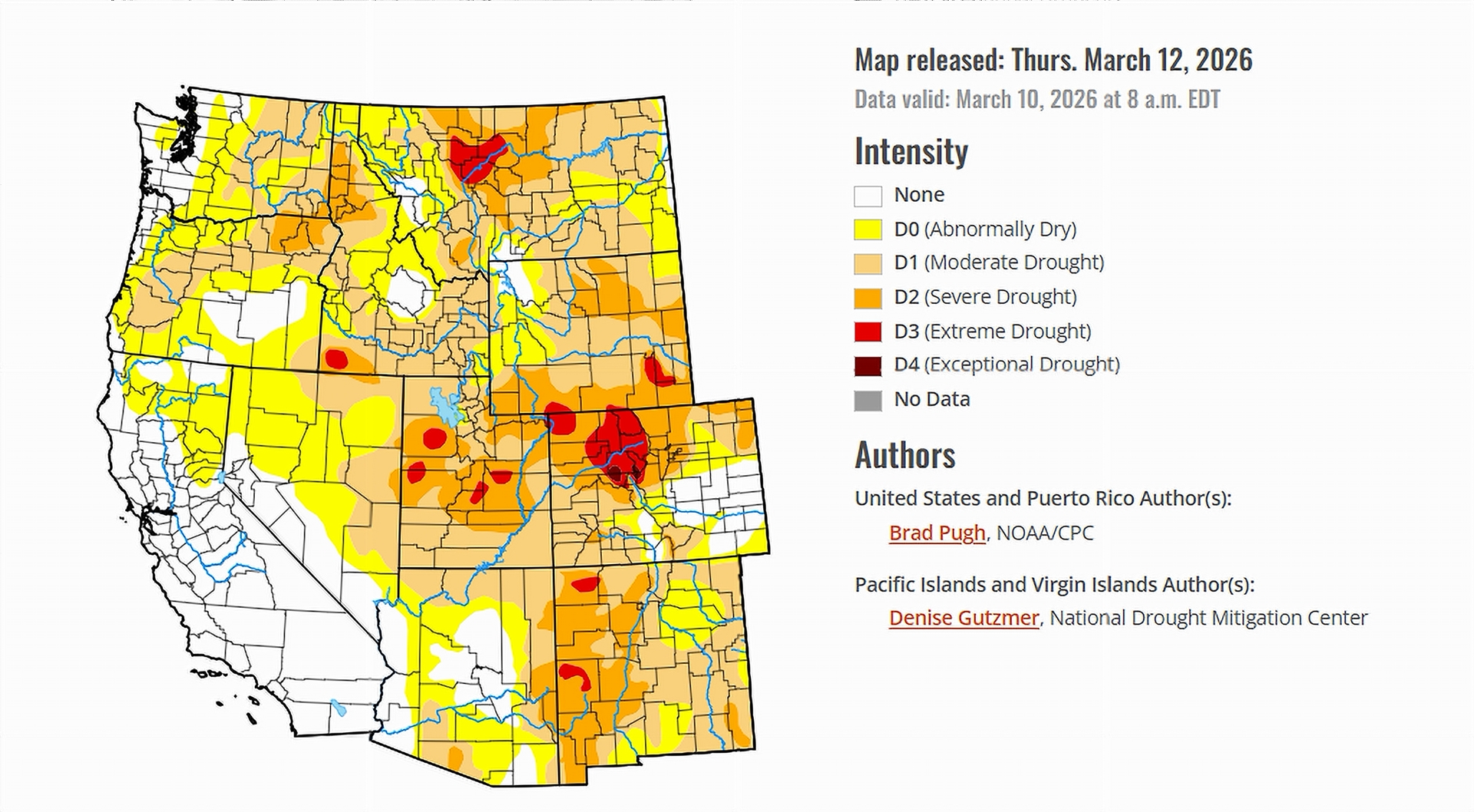
 , drought conditions across the United States remain uneven as spring approaches. Some regions recently received beneficial rainfall, improving short-term conditions, while other areas continue to struggle with long-term dryness. The national picture reflects a patchwork of improvement and concern, with particular attention now focused on the western states where snowpack levels are unusually low.