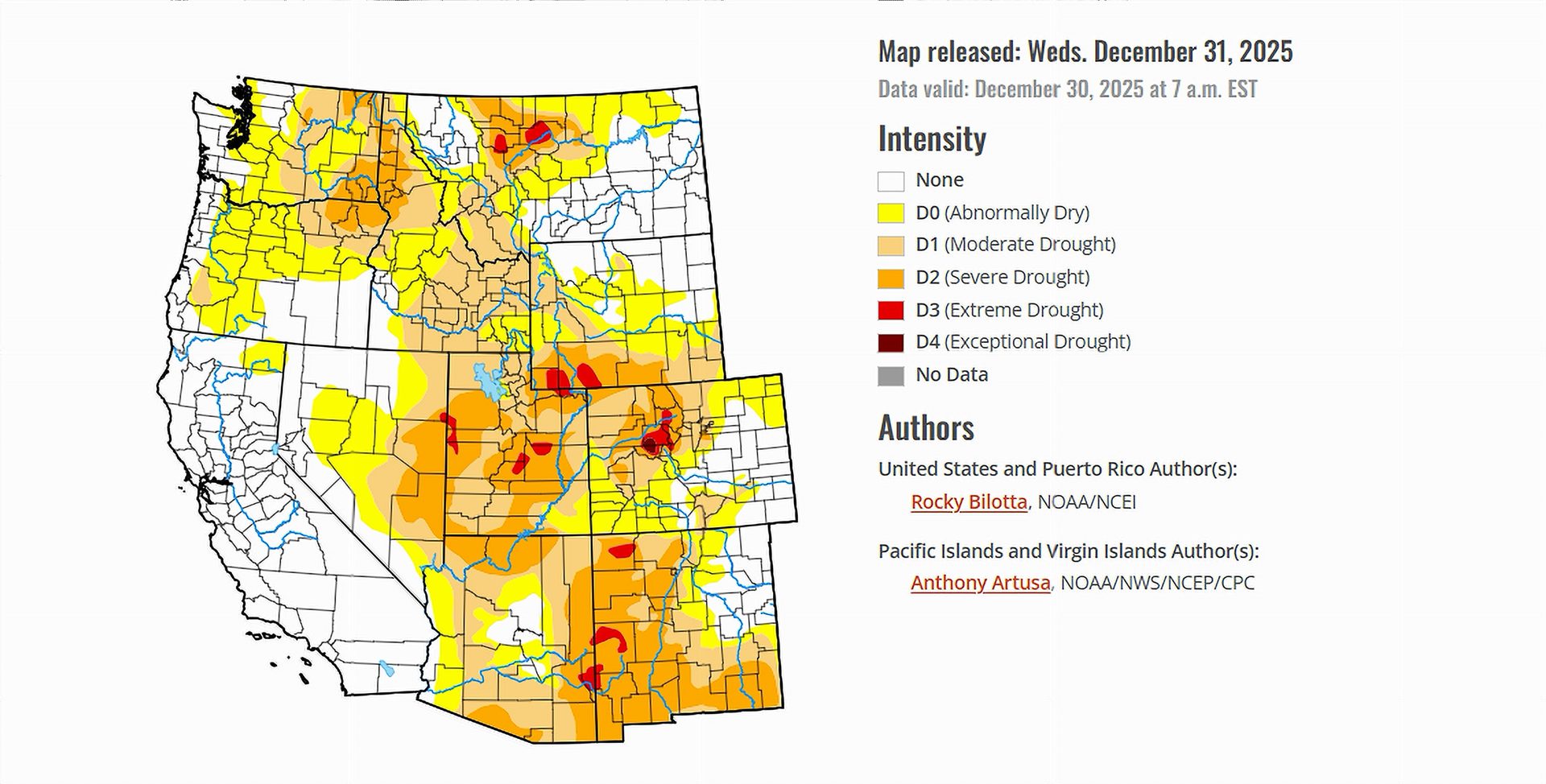
- Drought conditions shifted late in December as major storms crossed the country.
- The western United States saw notable precipitation, though impacts varied by area.
- Parts of the Colorado River Basin improved, while other areas grew drier.
Saturday, January 3, 2026 — The final week of December brought dramatic weather contrasts across the United States. A prolonged period of unusual warmth dominated much of the central and southern country during the holiday week, followed by a sharp reversal as a powerful winter storm swept east. While parts of the nation experienced blizzards, freezing temperatures, and travel disruptions, precipitation remained uneven overall.
According to the U.S. Drought Monitor report released December 31, 2025 , rainfall and snowfall were near or below normal across large portions of the country. At the same time, the western United States stood out as a region where storms delivered meaningful moisture. This uneven pattern led to both drought improvements and setbacks, depending on location.
Recent Weather Patterns in the Colorado River Basin.
Across the seven Colorado River Basin states—Arizona, California, Colorado, Nevada, New Mexico, Utah, and Wyoming—conditions reflected this mixed national trend.
Temperatures during the reporting week were generally above normal across much of the Basin, with some locations in Nevada and Utah running as much as 25 degrees Fahrenheit warmer than average. Despite the warmth, several areas benefited from recent storms that brought rain and mountain snow.
Over the past two weeks, large portions of the Basin received above-normal precipitation. Some areas recorded several inches of moisture, which helped improve short-term drought indicators such as soil moisture and streamflow. These conditions supported reductions in moderate drought (D1) and severe drought (D2) in parts of the region.
Where Conditions Improved.
Storm systems delivered beneficial precipitation to parts of the Southwest and interior West, including areas of southern Arizona, central Arizona, Nevada, and Wyoming. In western Wyoming, recent snowfall was substantial enough to eliminate areas previously classified as severe drought.
Elsewhere in the Basin, moderate drought conditions improved or were removed, particularly in portions of Nevada and Arizona. Abnormal dryness (D0) also receded in some areas where repeated storms helped restore short-term moisture levels.
California experienced some of the most notable precipitation during the period. An atmospheric river event brought heavy rain and mountain snow, improving conditions in several areas and removing abnormal dryness in parts of southern California.
Areas That Continued to Dry.
Despite recent storms, not all parts of the Colorado River Basin saw relief. Interior and eastern portions of the region remained drier than normal. In western Utah, a lack of sustained precipitation led to an expansion of severe drought. Central Nevada also saw worsening conditions, with moderate drought and abnormal dryness expanding where moisture deficits persisted.
In Colorado, drought conditions intensified in some areas. Extreme drought expanded in central parts of the state, while moderate drought grew in southern Colorado. These changes reflected ongoing precipitation shortfalls combined with warmer-than-normal temperatures.
Why These Changes Matter.
The Colorado River Basin supplies water to tens of millions of people, vast agricultural areas, and major ecosystems across the West. Even short-term shifts in drought conditions can affect soil moisture, snowpack development, reservoir inflows, and river operations.
The late-December storms provided important, though uneven, relief. While some areas saw meaningful improvements, others entered the new year with continued or worsening dryness. The U.S. Drought Monitor emphasizes that drought conditions evolve over weeks and months, and sustained precipitation is typically needed for long-term recovery.