- Federal land in Utah was conveyed to the Washington County Water Conservancy District.
- The exchange supports long-term water management in Washington County.
- Critical habitat for the Mojave desert tortoise was added to federal ownership.
- Environmental review and public processes concluded in late 2025.
Thursday, January 1, 2026 — On Tuesday, December 30, 2025, the Bureau of Land Management announced the completion of a land exchange in southwestern Utah involving 929 acres of public land and the Washington County Water Conservancy District. The transaction, known as the Red Cliffs–Warner Valley Land Exchange, followed several years of environmental review and public input.
According to the Bureau of Land Management announcement dated December 30, 2025, the exchange was designed to support future water management needs in Washington County while strengthening long-term conservation protections within the Red Cliffs National Conservation Area. The region has experienced rapid population growth, increasing demand for both water infrastructure and land-use planning.
Under the exchange, the federal government conveyed 929 acres of land to the Washington County Water Conservancy District. In return, the Bureau of Land Management received 89 acres of privately owned land located within the conservation area that has been designated as critical habitat for the federally threatened Mojave desert tortoise. Federal officials stated that bringing this land into public ownership helps consolidate habitat protections and reduces the risk of development on ecologically sensitive areas.
“This mutually beneficial exchange could not have been accomplished without close coordination with local governments, other agencies, and the public,” said Gloria Tibbetts, Bureau of Land Management Color Country District Manager, in the December 30, 2025, release.
Environmental Review and Decision Process.
The details of the exchange are documented in the Bureau of Land Management National Environmental Policy Act register under Environmental Assessment DOI-BLM-UT-C030-2023-0008-EA. The environmental assessment process concluded in November 2025, after the Bureau of Land Management signed a Finding of No Significant Impacts earlier in the year and addressed public comments and protests.
The environmental review examined potential effects on recreation, grazing, existing infrastructure, wildlife habitat, and land management efficiency. Federal officials determined that acquiring the non-federal parcel within the Red Cliffs reserve would improve protection for the Mojave desert tortoise and allow for more coordinated management of conservation lands.
The federal parcel conveyed to the district is located in Warner Valley, approximately one and one-half miles from the St. George Regional Airport and east of Washington City. The land lies within the Sand Mountain Special Recreation Management Area and includes surface and mineral rights. Existing uses in the area include recreation facilities, pipeline corridors, access roads, and grazing allotments.
Coordination with Washington County.
Washington County acted as a facilitator for the exchange and contributed funding toward some of the processing costs. The county also administers the multi-species Habitat Conservation Plan that governs land management within the Red Cliffs reserve.
Federal participation in acquiring private lands within the reserve has been part of a long-standing commitment dating back to the 1990s. That commitment is documented in multiple land use plans, records of decision, and implementation agreements governing the Red Cliffs National Conservation Area and surrounding lands.
To complete the exchange, the Washington County Water Conservancy District entered into an option agreement to acquire the non-federal parcel transferred to federal ownership. Final acreage values were determined through an appraisal process to ensure that the lands exchanged were of equal value.
Washington County Water Conservancy District Background.
The Washington County Water Conservancy District was established in 1962 as a not-for-profit public agency to manage and stabilize water supplies for Washington County. The district was formed through a petition by local property owners and is authorized to develop water infrastructure and levy taxes to support water management activities.
Over more than five decades, the district has expanded its operations to include reservoirs, pipelines, wells, storage tanks, water treatment plants, hydropower facilities, and diversion dams. Its system is capable of producing more than 60 million gallons of water per day.
The majority of the district’s water is sold wholesale to municipal customers, including St. George, Washington City, Hurricane, Santa Clara, Ivins, Toquerville, La Verkin, and the town of Virgin. In addition to wholesale water delivery, the district also manages limited retail, secondary water, and wastewater systems.
Implications for Future Planning.
Federal officials describe the Red Cliffs–Warner Valley Land Exchange as part of a broader effort to balance growth, infrastructure needs, and conservation priorities in southern Utah. With the environmental review completed and the land exchange finalized in late 2025, the transaction now forms part of the framework guiding future water planning and habitat management decisions in Washington County.
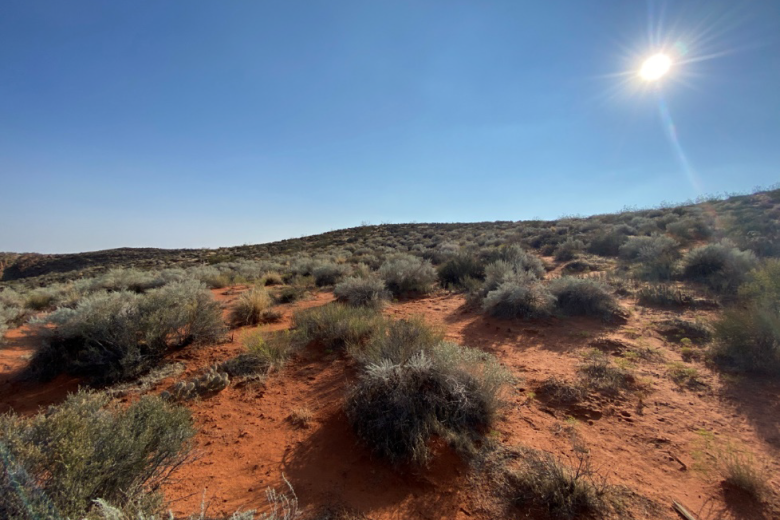
Image via the Bureau of Land Management’s Press Release: “A red dirt mound extends from the foreground to the background under a bright blue sky with bright sun.”
Frequently Asked Questions
What land was transferred in this Utah exchange?
The federal government conveyed 929 acres of public land to the Washington County Water Conservancy District and received 89 acres of private land designated as Mojave desert tortoise habitat.
Why was the land exchange approved?
The exchange supports future water management needs while increasing federal ownership of sensitive habitat within the Red Cliffs National Conservation Area.
Was environmental review required?
Yes. The Bureau of Land Management completed an environmental assessment and issued a Finding of No Significant Impacts before approving the exchange.
Did the public participate in the process?
Yes. A public participation period was held, and the Bureau of Land Management addressed comments and protests before finalizing the decision in 2025.
How does this affect Washington County’s water system?
The land transfer provides the Washington County Water Conservancy District with land that may support future infrastructure or management needs as population growth continues.
Does the exchange change conservation protections?
According to federal officials, the exchange increases protection for the Mojave desert tortoise by bringing designated critical habitat into federal ownership.