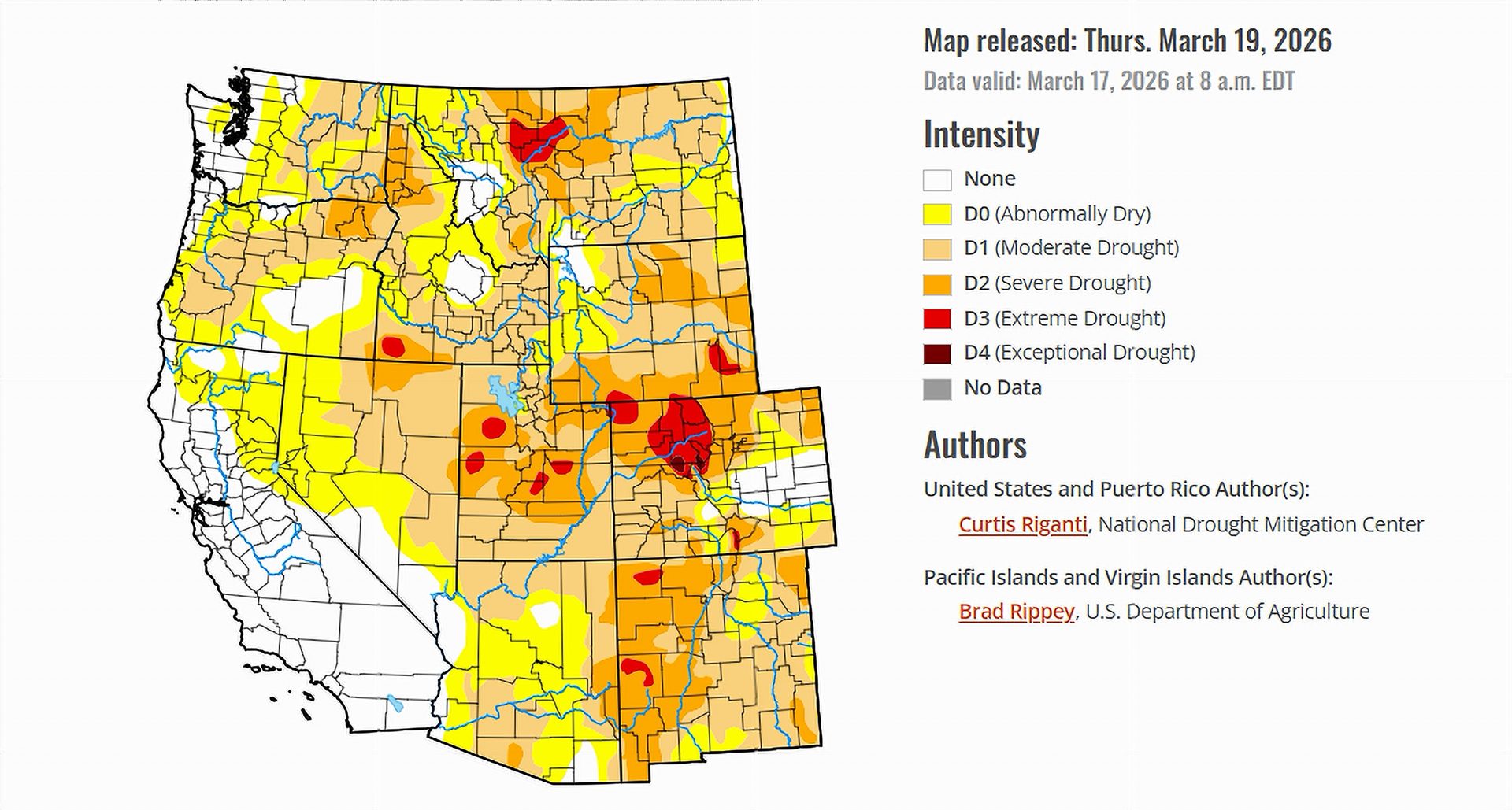
- Dry, warm weather worsened drought across much of the Southwest.
- Mountain snowpack remains far below normal in key river headwaters.
- Arizona, New Mexico, Nevada, and Colorado saw expanding drought conditions.
- Limited precipitation offers little short-term relief for the Basin.
Saturday, March 21, 2026 — The latest U.S. Drought Monitor report shows a divided country. Parts of the Midwest and Northeast received steady rain, easing drought and improving soil moisture. Snow and rain in portions of the Northwest also brought some short-term relief.
But much of the West, including the Colorado River Basin, experienced the opposite. Dry, warm, and often windy conditions dominated the week. These patterns continued to deepen precipitation deficits and reduce already limited water supplies.
The Colorado River Basin: Dryness Tightens Its Grip.
Across the seven Colorado River Basin states—Arizona, California, Colorado, Nevada, New Mexico, Utah, and Wyoming—conditions generally moved in the wrong direction.
The most significant concern is the lack of precipitation combined with rising temperatures. This combination increases evaporation, dries soils faster, and reduces runoff into rivers and reservoirs.
Large portions of Arizona, New Mexico, southern Colorado, and Nevada experienced drought conditions that expanded or intensified. Areas that missed even small amounts of rainfall were especially affected, as deficits continue to build week after week.
Snow Drought Raises Long-Term Concerns.
One of the most important signals for the Colorado River system is mountain snowpack. This snow slowly melts in spring and summer, feeding streams and reservoirs throughout the Basin.
This year, snow levels remain well below normal in several key regions. In southern Colorado and northern New Mexico, some monitoring sites have already reported near-total or complete snowpack loss for the season.
Higher elevations in Arizona, which typically hold snow well into March, are also showing signs of snow drought. Without this natural storage system, less water will flow into the Colorado River later in the year.
Arizona and Nevada See Worsening Conditions.
Arizona experienced widespread degradation in drought conditions during the week. Warm temperatures and dry air increased evaporation, while streamflows remained low. The lack of snow at higher elevations adds further pressure as spring approaches.
Nevada also saw worsening conditions, particularly in northern areas. Reports indicate that months of unusually warm and dry weather have reduced snow accumulation and stressed water supplies.
Southern Rockies Continue to Dry Out.
In southern Colorado and northern New Mexico, drought conditions intensified as both precipitation and snowpack declined. Snowmelt from mountain regions is critical for the Colorado River system.
With snow melting earlier than expected—or not accumulating at all—the Basin may see reduced runoff during the upcoming melt season.
Limited Relief in the Broader West.
Some areas of the western United States received precipitation, but the benefits were uneven and often short-lived. In places where snowpack is already far below normal, even recent storms have not been enough to reverse long-term deficits.
This pattern highlights a broader issue: short bursts of precipitation cannot fully offset months of dryness and below-average snow accumulation.
What’s Predicted.
Forecasts through late March suggest continued challenges for the Colorado River Basin. Warmer-than-normal temperatures are expected across much of the West, especially in the Southwest.
Precipitation is likely to remain below normal across large portions of the Basin, including Utah, Nevada, Arizona, and California.
Without sustained moisture and improved snowpack, drought conditions in the Colorado River Basin may continue to expand in the weeks ahead.