- A major winter storm brought widespread snow and ice but limited immediate drought relief.
- Much of the precipitation remains frozen, delaying benefits to soils and water supplies.
- Conditions across the Colorado River Basin were largely stable, with localized changes.
- Short-term forecasts suggest limited new precipitation for most of the Basin.
Saturday, January 31, 2026 — The U.S. Drought Monitor Report released on January 29, 2026, reveals that drought conditions across the United States remain largely unchanged despite one of the most expansive winter storm systems of the season. The storm delivered heavy snow, sleet, freezing rain, and ice across a wide swath of the country, from the southern Rockies to the East Coast. In many regions, precipitation totals were substantial when measured in liquid equivalent.
However, the form of that precipitation matters. Much of the moisture fell as snow or ice and remains locked in frozen ground or snowpack. Until temperatures rise enough to melt and infiltrate, that water does little to reduce drought impacts. As a result, drought improvements were limited and highly localized, while large portions of the country saw no meaningful change.
Colorado River Basin: Mostly Stable, With Pockets of Change.
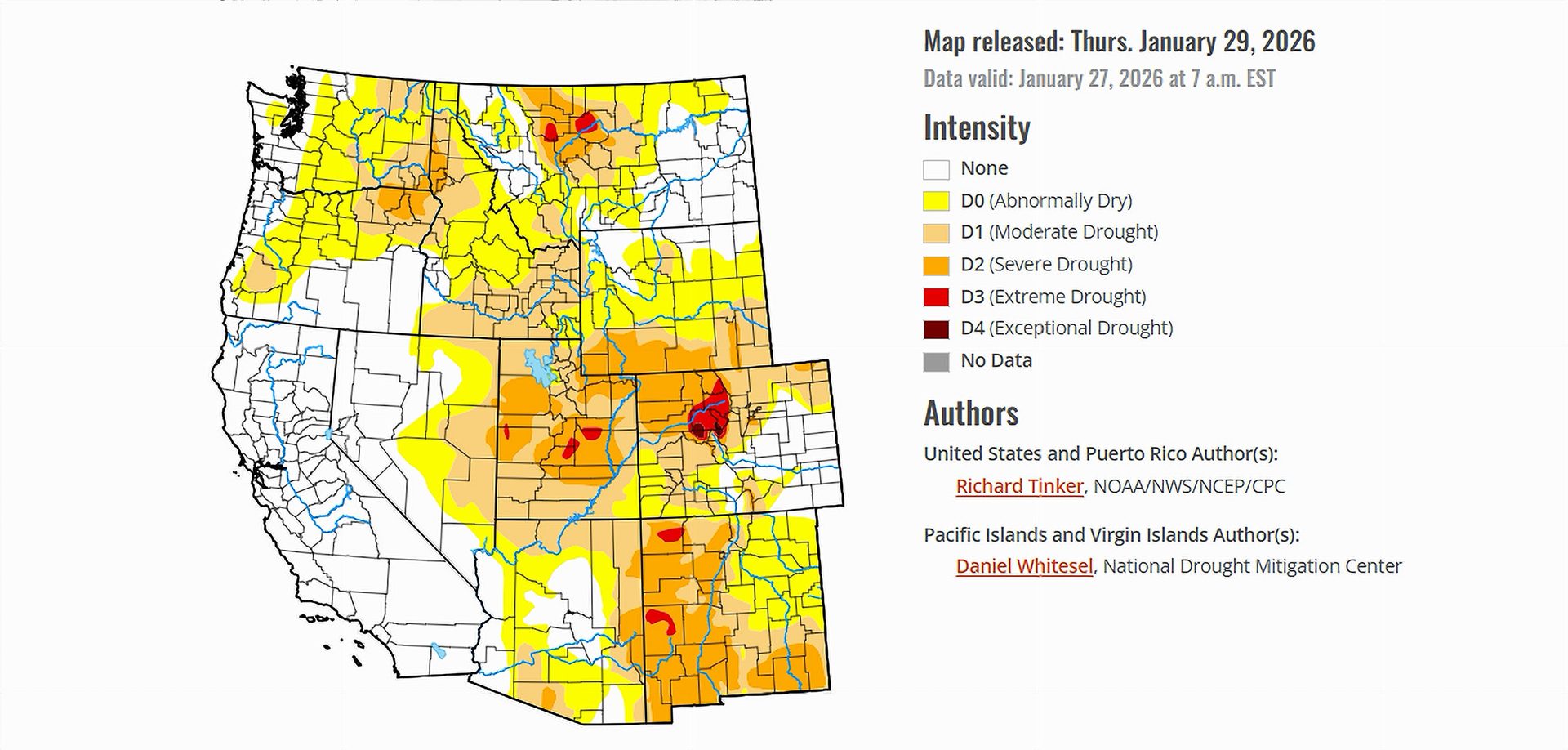
Across the seven Colorado River Basin states—Arizona, California, Colorado, Nevada, New Mexico, Utah, and Wyoming—drought conditions were generally steady during the reporting period. The Basin experienced far less direct benefit from the major winter storm than regions farther east.
Only the southern edge of the Basin saw notable precipitation. Parts of southeastern Arizona and southern New Mexico received over 1.5 inches of moisture, with some areas exceeding 3 inches. In southeastern Arizona, where precipitation fell mostly as rain, conditions improved modestly. In contrast, much of the precipitation in southern New Mexico fell as snow and remained unmelted, limiting its immediate impact. As a result, only small, targeted improvements were made in areas that received the highest totals.
Elsewhere across the Basin, including much of California, Nevada, Utah, and Wyoming, the week was largely dry. Some higher-elevation areas of Colorado and Wyoming recorded a few tenths of an inch of precipitation, but amounts were not sufficient to drive widespread change. In western Colorado, dryness intensified slightly in some locations, reflecting longer-term precipitation deficits rather than short-term weather.
Why Conditions Did Not Worsen More Broadly.
Despite limited precipitation, drought conditions did not significantly worsen across most of the Basin. This is partly due to the season. Winter is typically a period of lower water demand, and colder temperatures reduce evaporation and soil moisture loss. Additionally, several weeks of earlier storms helped stabilize conditions going into late January.
Looking Ahead: Limited Moisture, Temperature Divide.
Forecasts for early February indicate a relatively dry pattern across much of the western United States, including the Colorado River Basin. Only light precipitation is expected in parts of Wyoming and Colorado, primarily in higher elevations. No widespread storms are forecast that would bring immediate drought relief to the region.
Temperature patterns are expected to diverge sharply across the country. While the eastern United States remains colder than normal, much of the West—including the Great Basin and the central and northern Rockies—is forecast to experience above-normal temperatures. These warmer conditions may gradually help unlock snowpack at lower elevations, but they also raise concerns about evaporation and early-season moisture loss if dry conditions persist.
Bottom Line.
The late-January drought picture for the Colorado River Basin is one of relative stability rather than recovery. While parts of Arizona and New Mexico saw modest improvements, most of the Basin remains dependent on future storms and sustained snowpack accumulation to meaningfully improve long-term water conditions. For now, the benefits of winter weather remain largely on hold.