
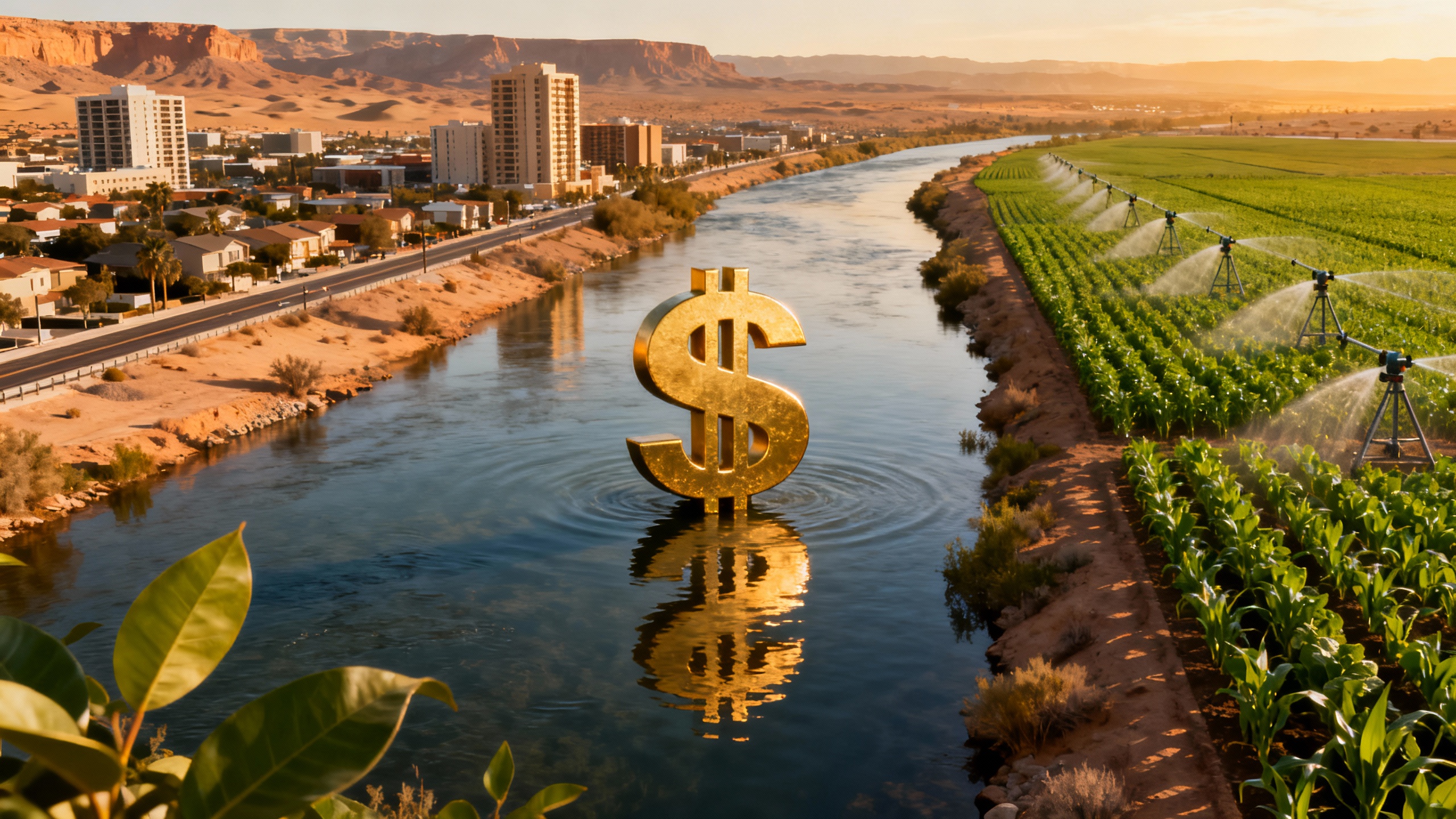
- A UCLA and Natural Resources Defense Council report finds large gaps in wholesale water prices across the Lower Colorado River Basin.
- Agricultural districts often pay little or nothing for federal water, while cities pay hundreds of dollars per acre-foot.
- Researchers say current pricing weakens conservation incentives as climate change reduces river flows.
- The report outlines pricing and transparency options as new Colorado River rules are negotiated.
Friday, December 12, 2025 — A December 11, 2025 report from UCLA’s Institute of the Environment and Sustainability and the Natural Resources Defense Council takes a detailed look at who pays for water in the Lower Colorado River Basin and how much they pay. The analysis focuses on wholesale water prices paid by large agricultural districts and municipal utilities in Arizona, California, and Nevada, the three states that make up the river’s lower basin.
The findings show a striking divide. Many large agricultural districts pay very little, and in some cases nothing at all, for water delivered through federal projects. Municipal utilities, particularly those serving cities, often pay hundreds of dollars per acre-foot for water sourced from the same river system. The authors argue that these price differences matter as the Colorado River faces long-term declines in supply driven by drought, rising temperatures, and over-allocation.
Federal Water Is Often Nearly Free.
One of the report’s most widely cited findings is the price of water supplied directly by the U.S. Bureau of Reclamation from the Colorado River. According to the analysis, federally supplied Colorado River water is delivered at a weighted average wholesale price of about $0.12 per acre-foot. In some cases, districts pay $0.00 per acre-foot for the water itself and only cover the cost of moving it through canals and aqueducts.
By comparison, water obtained from non-federal or non-state sources averages more than $850 per acre-foot. This contrast highlights how federal water pricing reflects infrastructure and delivery costs but places little or no price on the water resource itself.
The authors emphasize that the reported prices typically cover only conveyance, pumping, and maintenance. The water, even when drawn from a shrinking river system, is largely treated as free.
Agriculture Versus Cities.
The report found that agricultural districts pay far less than municipal utilities for the same volumes of water. On average, agricultural districts in the study paid about $30 per acre-foot, while municipal providers paid roughly $512 per acre-foot.
Five agricultural districts alone received nearly a quarter of all water in the dataset at no cost for the water itself. These districts are located in southeastern California, southwestern Arizona, and northwestern Nevada and receive large volumes of Colorado River water through long-standing federal contracts or rights.
Municipal districts dominate the higher price ranges. Nearly all water purchased at prices above $150 per acre-foot was bought by cities or municipal wholesalers, particularly in coastal California, where water must be transported long distances and often resold through multiple agencies.
California Pays the Most.
Geography and infrastructure also play a major role in pricing. The report shows that California districts, on average, pay significantly more for water than those in Arizona or Nevada. California’s weighted average wholesale price was more than double Nevada’s and roughly seven times higher than Arizona’s.
Researchers attribute this to higher conveyance costs, complex resale chains, and reliance on large state and federal delivery systems such as the State Water Project and Central Valley Project. Coastal cities between San Francisco and San Diego face some of the highest water prices in the West.
A System Under Climate Pressure.
The pricing disparities arrive at a time when the Colorado River system is under growing strain. The river supplies water to more than 40 million people, supports over five million acres of farmland, and underpins a regional economy measured in the trillions of dollars.
The report notes that average river flows have declined by about 13 percent compared with the previous seven decades. Climate research cited in the study projects further reductions as temperatures rise and snowpack in the Rocky Mountains and Sierra Nevada becomes more variable.
Lake Mead and Lake Powell, the system’s two largest reservoirs, remained at historically low levels in 2025 despite short-term hydrologic improvements earlier in the decade. These conditions have intensified debates over how shortages should be shared among states, cities, agriculture, and Tribal Nations.
Policy Ideas as 2026 Approaches.
The report does not advocate specific outcomes but outlines several options for policymakers to consider as new Colorado River operating rules are negotiated ahead of 2026.
One proposal discussed is a Water Reliability and Security Charge applied to federal water deliveries. The authors estimate that a surcharge of $50 to $100 per acre-foot could generate hundreds of millions of dollars annually for each major federal system, depending on volumes delivered. Those funds could be used for canal repairs, leak reduction, irrigation modernization, water recycling, and stormwater capture.
Another recommendation is the creation of a centralized, publicly accessible database that tracks wholesale water prices, volumes, and rights across the basin. The authors argue that greater transparency would help states and water managers develop more accurate water budgets and make more informed decisions as scarcity increases.
Implications for the Future.
The report arrives as the U.S. Bureau of Reclamation prepares for a major transition in how the Colorado River is managed after 2026. Basin states have struggled for more than two years to agree on how future shortages should be allocated, and federal intervention remains possible if consensus cannot be reached.
By documenting how water prices vary widely depending on location, use, and access to federal supplies, the study adds another layer to the ongoing discussion about equity, efficiency, and long-term sustainability in the West’s most important river system.
Frequently Asked Questions.
What is an acre-foot of water?
An acre-foot is the amount of water needed to cover one acre of land to a depth of one foot. It equals about 325,851 gallons and is commonly used to measure large volumes of water in the West.
Why do agricultural districts pay less than cities for water?
Many agricultural districts receive water through long-standing federal contracts or rights that charge little or nothing for the water itself. Cities often rely on more expensive sources, longer conveyance systems, and multiple resale transactions.
Does the report say farmers waste water?
No. The report focuses on pricing structures, not individual behavior. It states that low prices can weaken incentives for conservation across all sectors.
Are these prices what households pay on their water bills?
No. The study examines wholesale prices paid by large districts and utilities. Retail water bills include additional treatment, distribution, and local infrastructure costs.
Why does California pay more than Arizona or Nevada?
California often faces higher conveyance and energy costs, longer delivery distances, and more complex resale chains, especially for coastal cities far from water sources.
What happens in 2026?
Several major Colorado River operating agreements expire in 2026. New rules will determine how water shortages are managed for decades to come.