
- Snowpack across the basin is far below normal.
- Major reservoirs remain at critically low levels.
- Heat and early runoff are worsening conditions.
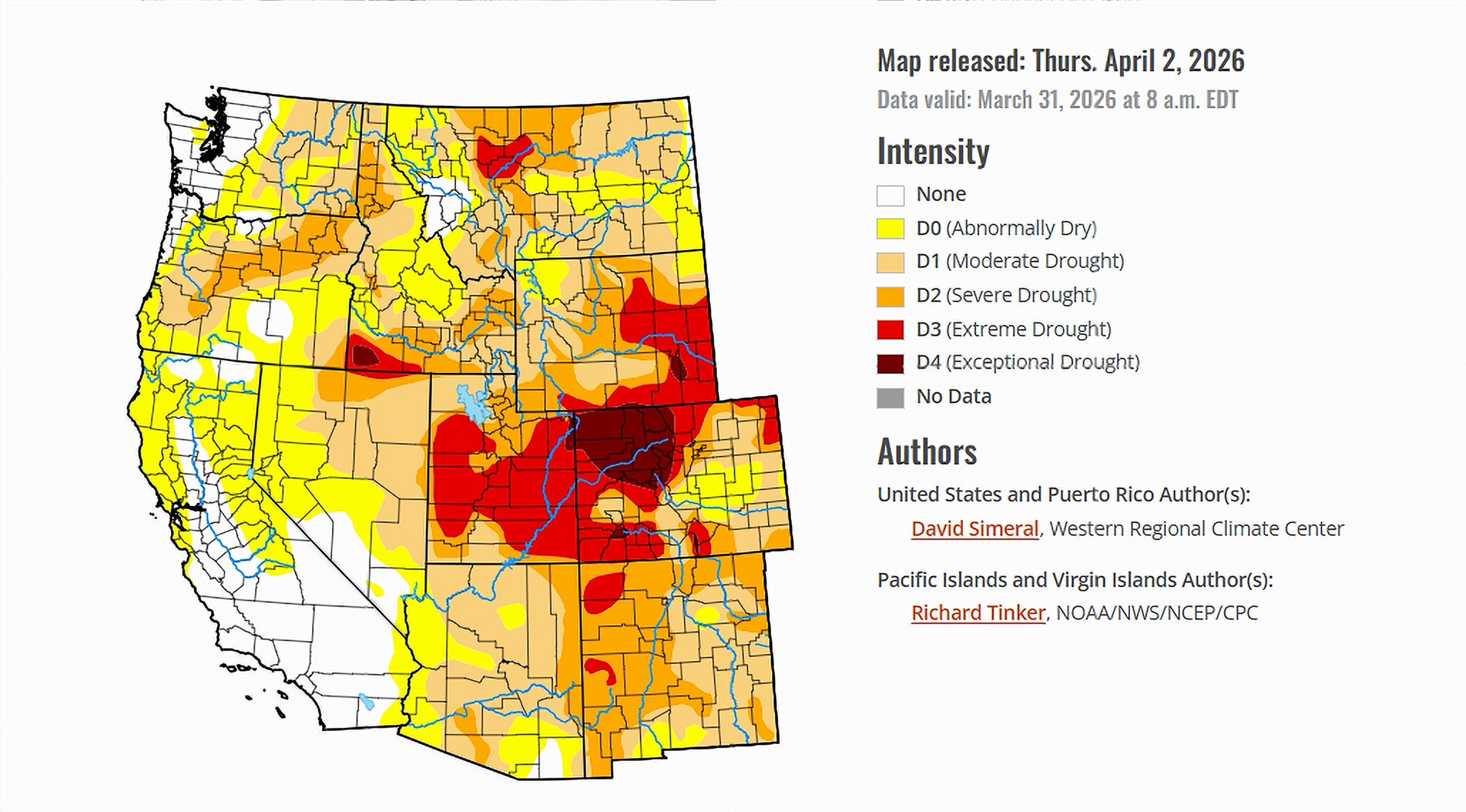
Saturday, April 4, 2026 — The latest U.S. Drought Monitor report , released Thursday, April 2, shows a country split between short-term relief and growing long-term concern. Some parts of the Midwest and Northeast received helpful rain. But across much of the West, Plains, and South, dry conditions continue to spread and intensify.
The most serious concerns lie in the western United States, where heat and lack of snow are setting the stage for another difficult water year.
The Colorado River Basin: A System Under Strain.
Across the seven Colorado River Basin states—Arizona, California, Colorado, Nevada, New Mexico, Utah, and Wyoming—conditions are deteriorating.
Snowpack, which acts as the region’s natural water storage, is alarmingly low. In the Upper Colorado River Basin, snow water equivalent stands at just 24 percent of normal. In the Lower Colorado Basin, it drops even further to 14 percent.
These numbers matter. Snowpack feeds the rivers and reservoirs that millions depend on. When it is this low, less water flows downstream in the months ahead.
Adding to the concern, many monitoring stations across the West are reporting little to no snow on the ground. In some areas, peak runoff has already passed weeks earlier than expected.
Reservoir Levels Tell the Story.
The basin’s major reservoirs reflect the strain.
- Lake Powell is roughly one-quarter full.
- Lake Mead sits near one-third capacity.
- The entire Colorado River system is only about 36 percent full.
These levels are not just low—they are below what was seen at the same time last year.
Upstream reservoirs show mixed conditions. Flaming Gorge remains relatively strong, while others, like Blue Mesa, are closer to half full. In New Mexico, Elephant Butte and Caballo reservoirs are critically low, holding just a small fraction of their capacity.
Heat and Early Snowmelt Add Pressure.
Unseasonably warm temperatures have accelerated snowmelt across the region. This creates a double challenge.
First, water runs off earlier in the season, leaving less available during the hotter summer months. Second, dry soils and high evaporation rates reduce how much of that water actually reaches reservoirs.
The result is a system that loses water before it can be stored.
Arizona and Regional Supplies.
Within Arizona, reservoir systems show moderate but declining storage. The Salt River system is just over half full, and the Verde system is slightly higher. Combined, they sit below last year’s levels.
While not yet at crisis levels, these numbers reflect a downward trend tied to the broader basin-wide shortage.
What Comes Next – A Familiar Pattern, Intensifying.
Short-term forecasts offer limited relief. Some precipitation is expected in parts of the West, but much of the Southwest—including Arizona and New Mexico—is likely to remain dry.
Temperatures are also expected to stay above normal across much of the region in early April, which could further stress already limited water supplies.
The current picture is not new, but it is becoming more pronounced. Low snowpack, early runoff, and declining reservoirs are now recurring features of the Colorado River Basin.
As spring unfolds, attention will turn to how much water actually makes it into storage—and how long existing supplies can stretch through the coming summer.