
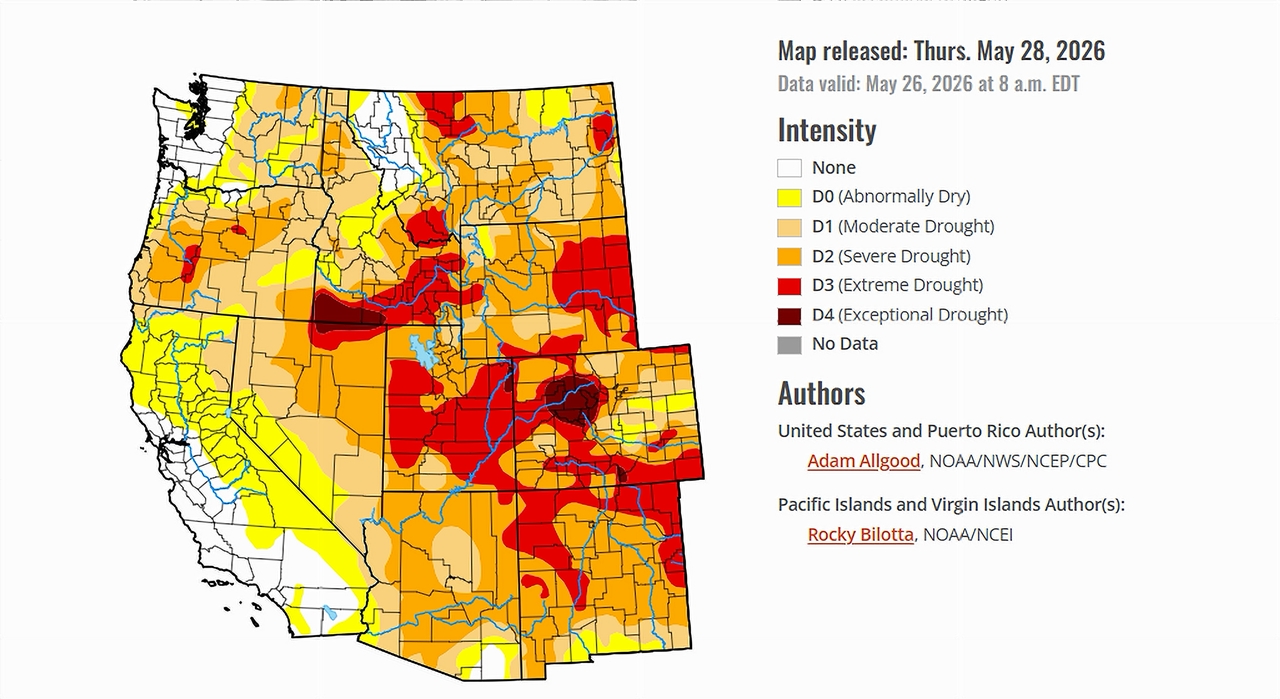
- Much of the western United States remained dry during the week.
- Parts of Colorado saw drought improvement from recent rainfall.
- Areas of New Mexico experienced worsening drought conditions.
- The latest outlook suggests increased chances for precipitation across the Four Corners region in the coming weeks.
Saturday, May 30, 2026 — As the calendar approaches summer, the drought picture across the United States remains highly uneven. While heavy rainfall brought relief to large portions of the South, Southeast, and Mid-Atlantic during the week ending May 26, much of the West continued to experience warm temperatures and generally dry conditions. According to the latest U.S. Drought Monitor report released May 28, 2026, the Colorado River Basin states continue to face a mixed set of challenges shaped by precipitation patterns, streamflow conditions, and lingering impacts from a relatively weak winter snow season.
A Dry Week Across Much of the West.
Most of the western United States saw little precipitation during the reporting period. Above-normal temperatures dominated much of the region, increasing evaporation and placing additional stress on soils, vegetation, and waterways. While a late-week cold front brought some moisture to the Pacific Northwest, the rainfall arrived too late and was generally not substantial enough to significantly change drought conditions across most western states.
For the Colorado River Basin, the biggest concern remains the combination of dry weather and declining streamflows. The Drought Monitor noted that the effects of limited winter snowpack are beginning to appear more clearly in several areas as spring runoff progresses.
Colorado Sees Some Improvement.
Not all of the news was negative.
Parts of northern and northeastern Colorado received beneficial rainfall during the week. Thunderstorms delivered up to two inches of precipitation in some locations, providing enough moisture to justify modest drought reductions in portions of the state. These improvements reflect short-term gains from recent storms rather than a complete reversal of longer-term drought concerns.
Elsewhere in Colorado, conditions were less favorable. Southeastern portions of the state remained hotter and drier, limiting the benefits seen farther north.
New Mexico Shows Signs of Stress.
The report identified New Mexico as one of the areas where drought conditions worsened during the week.
With little precipitation and above-normal temperatures, parts of the state experienced small-scale drought degradation. The Drought Monitor specifically cited falling streamflow values and the growing impacts of a winter season that produced limited snow accumulation. As mountain snowpack melts away, streams and rivers that depend on that runoff are beginning to show signs of strain.
These developments are important for the Colorado River Basin because runoff from snow-covered mountains serves as a critical source of water for rivers, reservoirs, agriculture, communities, and ecosystems throughout the region.
Reservoir Conditions Remain Stable in California.
While drought concerns persist across parts of the Basin, reservoir storage in California remained relatively stable during this typically dry time of year. The Drought Monitor noted that reservoir conditions continue to be favorable, helping prevent broader drought deterioration despite the lack of widespread precipitation.
The report did not identify major drought changes for California, Nevada, Utah, Arizona, or Wyoming during the week, suggesting that conditions generally held steady across those portions of the Basin.
What Comes Next?
There may be some encouragement in the short-term forecast.
The Drought Monitor’s outlook indicates that a late-season storm system could bring additional moisture to portions of the western United States. Looking further ahead, the Climate Prediction Center’s 8-to-14-day outlook favors above-normal precipitation across the Four Corners region, which includes parts of Arizona, Colorado, New Mexico, and Utah.
At the same time, above-normal temperatures are expected to return to much of the West. Whether forecast precipitation materializes in meaningful amounts will help determine whether drought conditions improve, stabilize, or continue to worsen as the region moves deeper into the summer season.
For now, the latest Drought Monitor paints a picture of a Colorado River Basin caught between isolated areas of improvement and ongoing concerns about streamflows, snowpack impacts, and the long dry season that still lies ahead.

 wpDiscuz