
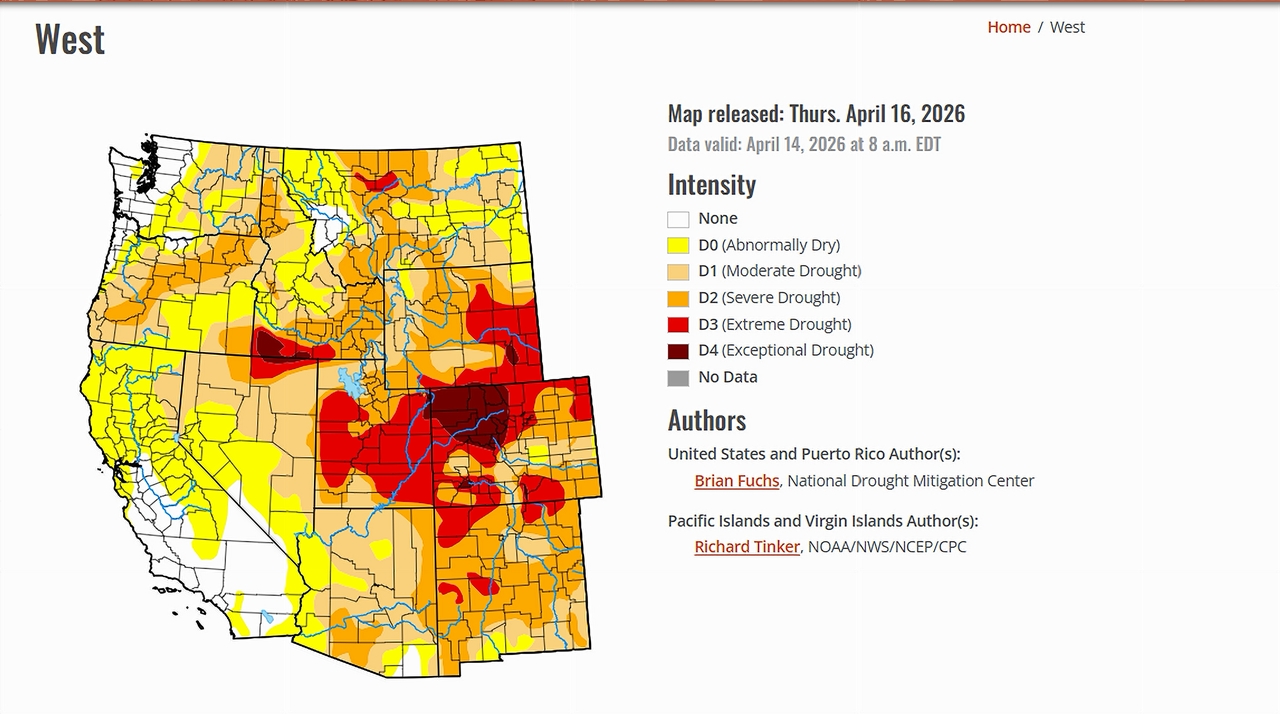
- Warm temperatures continue across much of the country.
- Dry conditions persist in key regions, including the Southwest.
- Colorado River Basin faces growing drought pressure.
Saturday, April 18, 2026 – The U.S. Drought Monitor Report released April 16 reveals that much of the United States remains warmer than usual, with several regions seeing temperatures well above seasonal norms. Rainfall has been uneven. Some areas, like parts of the Midwest and Great Basin, received helpful storms, while others stayed stubbornly dry.
This uneven pattern has allowed drought to tighten its grip in several parts of the country. The Southeast, portions of the Northeast, and large areas of the Plains continue to struggle with limited moisture.
Focus on the Colorado River Basin.
The most important story for the West lies in the Colorado River Basin states: Arizona, California, Colorado, Nevada, New Mexico, Utah, and Wyoming.
Across this region, temperatures have been consistently above normal. In Utah, Colorado, and Wyoming, readings ran 6 to 8 degrees higher than average during the week. That kind of warmth speeds up evaporation and dries out soils more quickly.
Precipitation has been mixed. Northern California and parts of Nevada saw some improvement, but these gains were not widespread enough to change the broader trend. In fact, drought conditions expanded in several key areas.
Southern Arizona saw a notable increase in both moderate and severe drought. New Mexico also experienced a spread of severe drought, particularly in eastern and northern areas.
The Snowpack Problem.
One of the biggest concerns is not just what is happening now, but what already happened over the winter.
Snowpack across the West has been below normal. In many places, snow melted earlier than expected. That early melt means less water flowing into rivers and reservoirs during the critical late spring and summer months.
At the same time, more precipitation has been falling as rain instead of snow. Rain runs off quickly, while snow acts like a natural storage system. Without that storage, water supplies become less reliable.
These factors are already beginning to show up as hydrological stress across the basin.
A Patchwork of Change.
Not every part of the Basin is worsening at the same pace. Northeastern California saw some improvement in moderate drought conditions. However, these localized gains are being offset by broader expansion of drought elsewhere.
The overall picture is one of slow but steady pressure building across the region.
What Comes Next.
Looking ahead, the short-term forecast offers limited relief for the Southwest. Dry conditions are expected to continue across much of the region, including key parts of the Colorado River Basin.
Temperatures may ease slightly in some areas, but the larger pattern remains: warm conditions, uneven precipitation, and increasing strain on water resources.
For the Colorado River Basin, the coming months will be critical.