
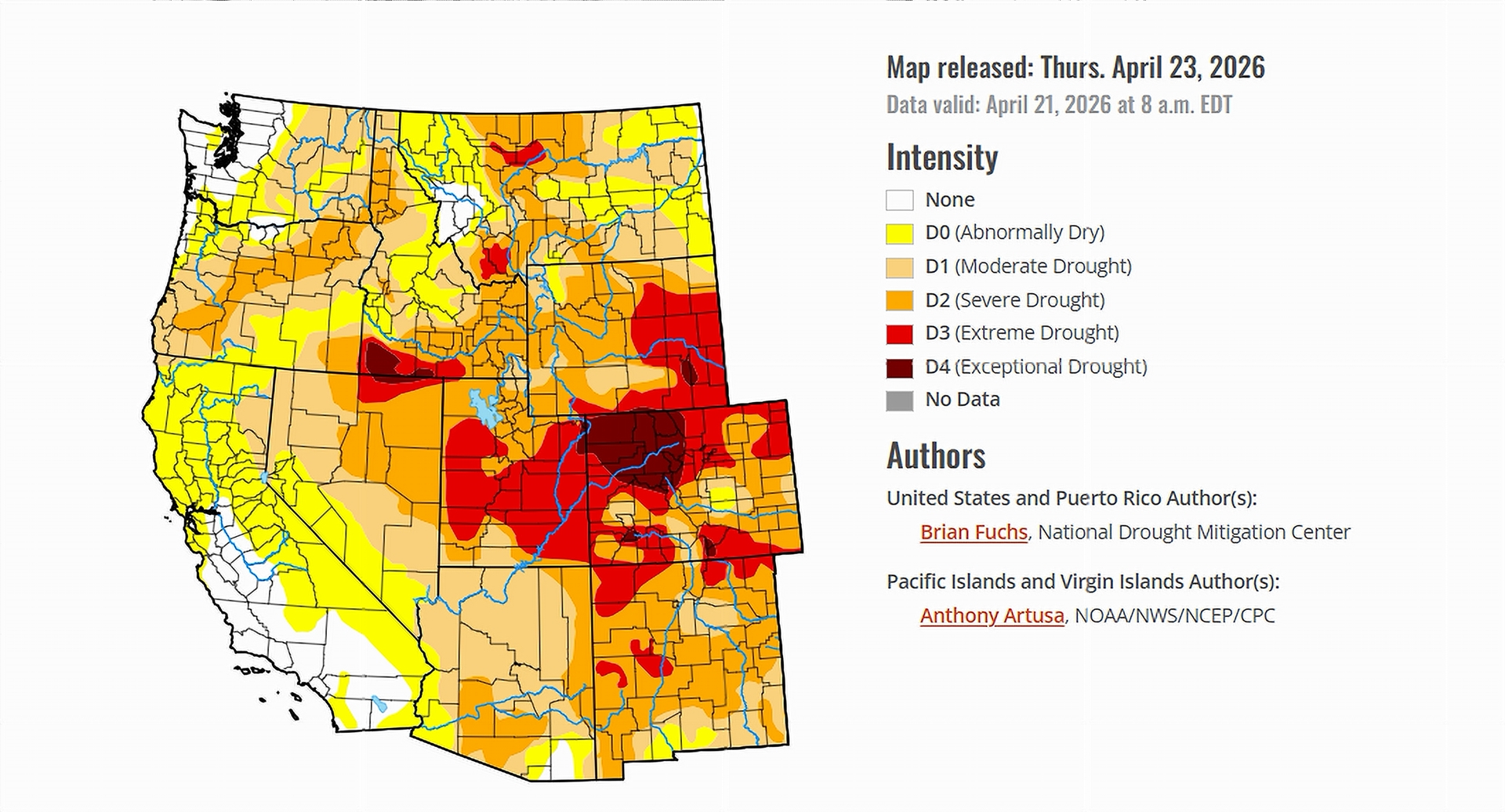
- Dry conditions continue across much of the western United States.
- Drought is expanding in key Colorado River Basin states.
- Snowpack loss and early runoff are raising water supply concerns.
Saturday, April 25, 2026 — Across the United States, drought conditions remained uneven as of the U.S. Drought Monitor Report released on April 23, 2026 . While parts of the Midwest and Northeast received significant rainfall, large portions of the South and West stayed dry. This growing divide is shaping water conditions heading into late spring, especially in regions that depend heavily on seasonal snowmelt.
A Dry Pattern Settles Over the West.
The western United States saw limited precipitation overall. Some coastal areas of California and parts of the Pacific Northwest recorded above-normal rainfall, but most inland regions remained drier than usual. Temperatures across the West were generally near or slightly below normal, though warmer pockets developed in parts of Arizona and southern California.
Despite occasional rainfall, the broader pattern remains dry. This has allowed drought conditions to expand or intensify in several areas, particularly across the interior West.
Colorado River Basin Under Pressure.
The Colorado River Basin, which includes Arizona, California, Colorado, Nevada, New Mexico, Utah, and Wyoming, continues to face mounting drought concerns.
Drought conditions expanded across much of Nevada, with areas ranging from abnormally dry to severe drought increasing in coverage. Utah saw severe drought push further into the northwest, while Arizona experienced growing areas of moderate to severe drought, especially in western and southern regions.
In Wyoming, severe drought expanded in western portions of the state. Colorado also saw continued degradation, with moderate to extreme drought spreading across parts of the state. These changes reflect a broader pattern of drying across the basin.
Snowpack Loss and Early Runoff.
One of the more concerning developments is the rapid loss of snowpack. Much of the seasonal snow has already melted, and runoff is occurring earlier than usual. This shift can reduce water availability later in the year, when demand is typically highest.
Early runoff does not necessarily translate into long-term water supply stability. Instead, it can leave reservoirs and rivers with less sustained flow during the hotter summer months.
An Uncertain Future.
Looking ahead, precipitation is expected to increase in parts of the central United States, but the outlook for the Colorado River Basin remains uncertain. While some areas may see short-term relief, the overall trend points toward continued dryness and rising stress on water resources.
As of April 25, 2026, conditions across the basin reflect a familiar pattern: limited precipitation, expanding drought coverage, and growing concerns about long-term water supply.


This is all to reminiscent of the Dust Bowl Era, which did not garner public concern until it was far too late. I fear this time there won’t be a recovery.