
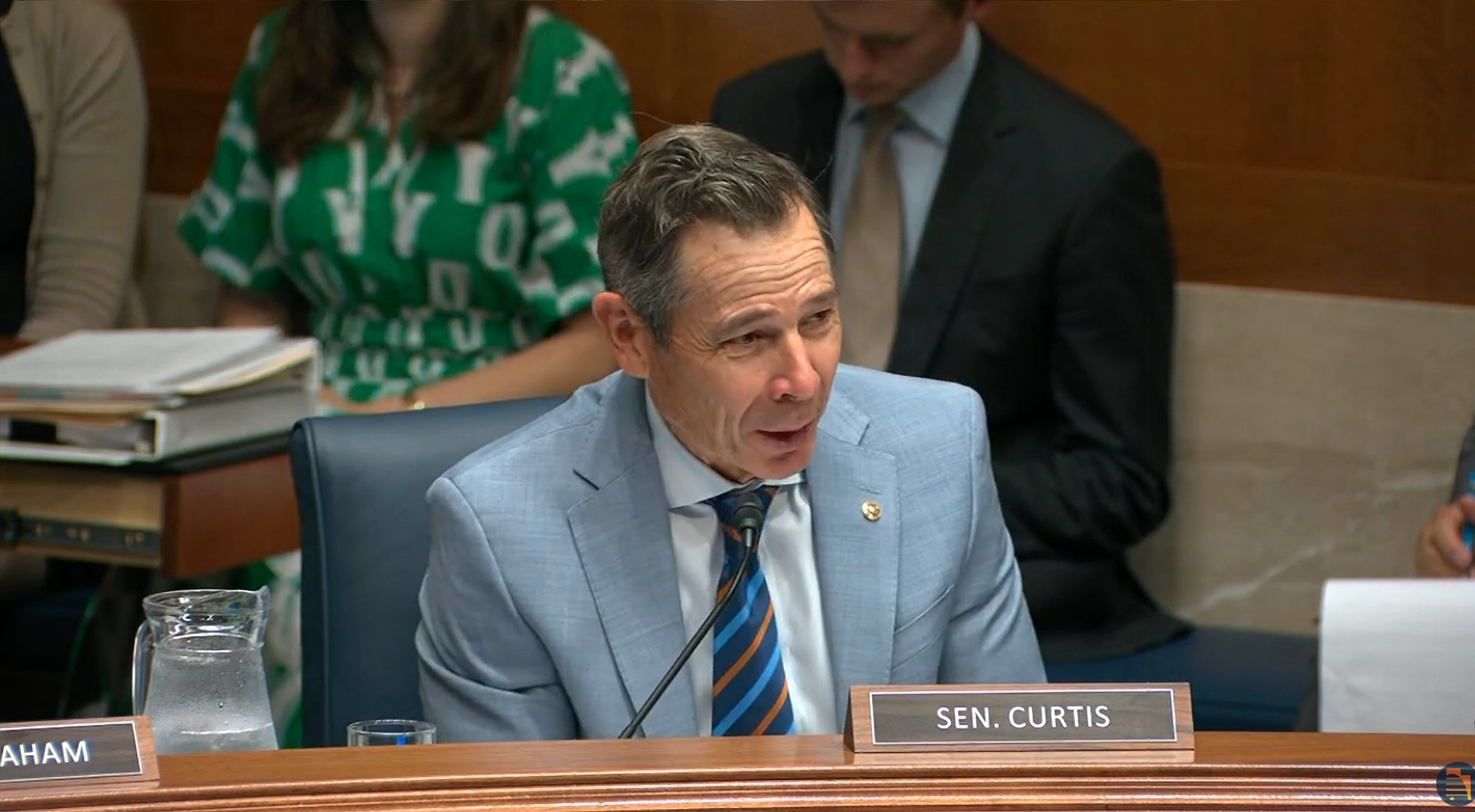
- Senator John Curtis secured federal committee approval on July 15, 2026, for $40 million in water infrastructure funding for the Utah communities of Centerville and Ephraim.
- The Senate Environment and Public Works Committee also approved a flood risk study for Moab as part of this year’s Water Resources Development Act.
- Curtis called on the committee to keep the Great Salt Lake on its radar, praising a broad coalition of state, local, and private partners already working to save the shrinking lake.
Friday, July 17, 2026 — Water has become the word on every Utahn’s lips. Severe and extreme drought has settled across much of the state, and the pressure is building fast. On July 15, 2026, the Senate Environment and Public Works Committee took a meaningful step toward relief, approving a package of water projects for three Utah communities as part of the annual Water Resources Development Act, a major piece of federal legislation that funds the nation’s water and flood-control infrastructure.
Leading the charge was U.S. Senator John Curtis, a Republican from Utah and a member of the committee. When he speaks at events around the state, he says the message he hears is consistent and urgent.
“Utah is in a record drought,” Curtis told the committee . “Everywhere I go, it’s ‘water, water, water, water.’ And I think in many cases, as many pressing problems we have as a country and as a state, water still rises to the top.”
What Got Approved and Where.
The committee approved three separate measures targeting different corners of the state, each responding to a distinct local need.
Centerville, a small city just north of Salt Lake City, stands to receive $20 million for a broad range of environmental infrastructure improvements. That money would go toward water and wastewater systems, water supply upgrades, stormwater management, water quality enhancements, and aquifer storage and recovery infrastructure. Aquifer storage and recovery is a process that captures water during wet periods and stores it underground in natural rock formations, then pulls it back out when communities need it most during dry spells.
Ephraim, a rural community in Sanpete County in central Utah, would also receive $20 million, focused on water and wastewater infrastructure. Without federal help, Curtis said, these towns simply could not afford to move forward.
“I’m very pleased, particularly for the communities of Ephraim and Centerville, who will benefit from this in their ability to bring clean water to the residents and otherwise would not be able to do it without this bill,” Curtis said.
Moab, the red-rock tourist hub in southeastern Utah, received approval for a feasibility study to evaluate flood risk management along Mill Creek and Pack Creek. A feasibility study is essentially a formal investigation that determines whether a project is practical, affordable, and worth building, before any construction dollars are committed.
The Great Salt Lake Looms Large.
Curtis did not stop at the three local projects. He used his time before the committee to shine a light on what many consider Utah’s most pressing long-term water challenge: the Great Salt Lake.
The lake has been shrinking for decades, exposing miles of dry lakebed that can whip toxic dust into the air and threaten the ecosystem that millions of migratory birds depend on. Curtis signaled he plans to push for more federal engagement on the issue.
“It’s an environmental issue. It’s a standard of living issue. On many, many levels this is important,” he told the committee.
He also offered an optimistic note, pointing out that Utah is not sitting still and waiting for Washington to act.
“My state’s not just waiting for the federal government,” Curtis said. “I have philanthropic help. I have local community help. I have state government help. Everybody is leaning into this, and I’m grateful the federal government is willing to lean in as well.”
What Comes Next.
Committee approval is a significant but early step. The Water Resources Development Act still needs to pass the full Senate and House before any of these projects can move forward. That said, clearing the committee is often the hardest hurdle, and advocates for Utah water security are watching closely.
For communities like Ephraim and Centerville, federal funding may be the difference between adequate water infrastructure and none at all. For the Great Salt Lake, the conversation is just getting started.

All of this has been a “kick the can down the road” theory. I hope the monsoons and winter snow deliver this year!