
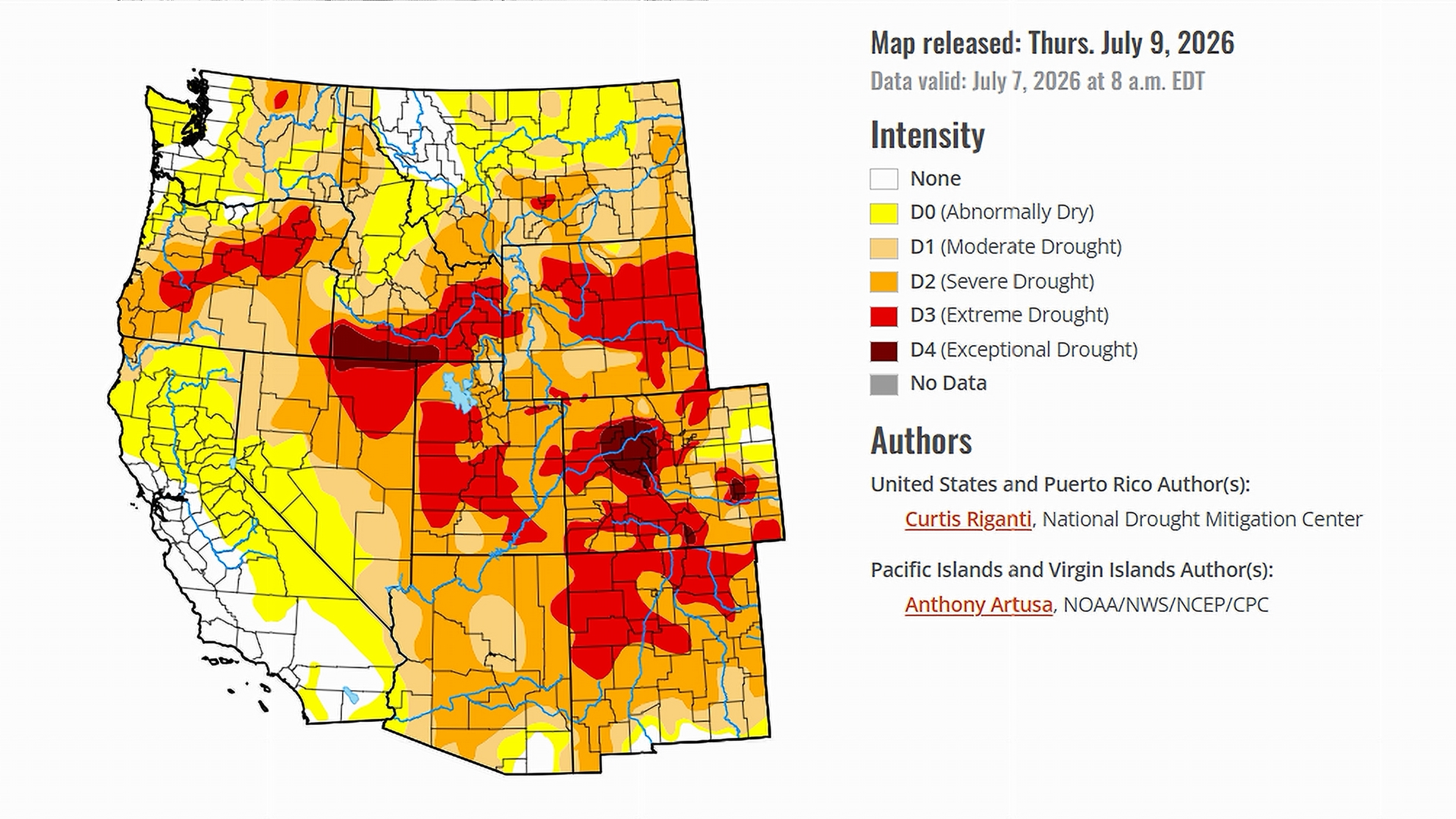
- Severe and extreme drought persisted across large portions of Nevada, Colorado, Wyoming, New Mexico, and Utah as of the July 9 report.
- Multiple large wildfires were burning in parts of central and southwest Colorado, where soils were parched and precipitation deficits had grown large.
- Isolated rainfall brought limited improvements to sections of New Mexico and northeast Colorado, while most of the West remained dry.
- Forecasters expect dry weather to continue west of the Continental Divide through at least mid-July, with only modest relief in sight for the southern end of the basin.
Saturday, July 11, 2026 — The United States entered mid-July 2026 with a patchwork of weather extremes. Heavy rains — some topping five inches — soaked parts of Iowa, Minnesota, Wisconsin, Florida, and the mid-Atlantic states, offering relief to communities that had been watching their soil crack and their rivers thin. In the South, Arkansas and Louisiana saw meaningful improvements. Across the Northeast, localized downpours eased short-term stress in parts of New Jersey, southern New York, and New England.
But the story in the West was starkly different.
While much of the country was wringing out after heavy summer storms, the western United States endured another dry week. Drought either held steady or worsened across a broad swath of the region. For the seven states that share the Colorado River (Arizona, California, Colorado, Nevada, New Mexico, Utah, and Wyoming ), the weekly Drought Monitor report released July 9 painted a picture of continued stress, active wildfire, and little near-term hope for change.
The West Stays Dry.
Across the West, precipitation was largely absent during the drought week of July 1–7, 2026. A few pockets of rain fell along the Idaho-Montana border, in parts of Montana, and in limited areas of northwest Washington. In New Mexico, rainfall totals near 1 inch were recorded in some locations, though heavier totals were mostly confined to the eastern and southeastern parts of the state. Those areas saw conditions reassessed, and some local improvements were noted.
Everywhere else, the region stayed dry.
Temperatures across the West were mostly near or below normal during the week, with anomalies of three to six degrees below average spreading across much of California, Nevada, and parts of Arizona. While cooler air might seem like a silver lining, it did little to offset the deep, long-term moisture deficits that have built up across the basin.
Severe and Extreme Drought Spread Across the Basin.
The headline from this week’s report for Colorado River Basin states is both stark and familiar: widespread severe and extreme drought continued across large portions of the region.
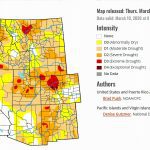
According to the Drought Monitor, severe drought (D2) and extreme drought (D3) covered the eastern half of Nevada, most of Colorado, much of Wyoming, New Mexico, and Utah. These are not new designations — they reflect months of accumulating precipitation deficits, declining soil moisture, and dwindling streamflow.
In Colorado, conditions moved in the wrong direction this week. The central part of the state, particularly near and east of Denver and Colorado Springs, experienced degradation in drought status as precipitation deficits widened. North-central Colorado also saw worsening conditions for the same reasons. In Wyoming, south-central and northwest portions of the state recorded similar deterioration.
A small area of improvement did emerge in north-central Wyoming, where vegetation conditions improved following recent precipitation. That was the exception, not the rule.
Wildfires Add Urgency in Colorado.
Perhaps the most alarming detail in this week’s report concerns Colorado’s wildfire situation. The Drought Monitor noted that conditions worsened in parts of central and southwest Colorado and specifically cited multiple large wildfires burning in areas already suffering from low soil moisture and large precipitation deficits.
Drought and wildfire share a destructive relationship. Dry soils and sparse moisture in vegetation create the conditions under which fires spread quickly and burn intensely. The report did not specify the names or acreage of the fires, but the connection drawn between drought degradation and active wildfire underscores how serious the situation on the ground has become.
A Sliver of Good News in New Mexico and Northeast Colorado.
Not every corner of the seven-state basin saw conditions worsen this week. In New Mexico, rainfall of around one inch fell in some areas, and heavier totals in the east-central and southeastern portions of the state led to reassessment and localized improvements. Those improvements were real, though limited in geographic scope.
In the High Plains discussion, the Drought Monitor also noted improvements in northeast Colorado, where scattered showers and thunderstorms delivered rain that eased drought or abnormal dryness in isolated areas.
These bright spots offer some relief, but they do not fundamentally alter the larger drought picture across the basin.
What the Forecast Holds.
Looking ahead through the evening of Monday, July 13, the National Weather Service’s Weather Prediction Center forecast called for mostly dry conditions west of the Continental Divide. One notable exception: rain amounts exceeding half an inch were expected in southeast Arizona and in some areas near the southern New Mexico-Arizona border. For most of the basin, however, dry weather was the dominant expectation.
The outlook extending from July 14 through July 18 offered slightly more reason for cautious optimism in the southern part of the basin. Forecasters with the Climate Prediction Center indicated that wetter-than-normal weather was favored in parts of the Desert Southwest, particularly in southern Arizona. At the same time, hotter-than-normal temperatures were considered very likely across the broader West, a combination that can quickly erase whatever moisture does manage to fall.
The Larger Picture.
The Colorado River and its tributaries are the lifeblood of the American West, providing water to roughly 40 million people across seven states and sustaining agriculture, cities, and ecosystems from the Rocky Mountains to the Gulf of California. Drought conditions that persist across so much of the basin, particularly the severe and extreme designations that now cover large parts of Nevada, Utah, Colorado, Wyoming, and New Mexico, are a signal that the region’s water supply remains under significant pressure heading into the heart of summer 2026.
The next update from the U.S. Drought Monitor is expected July 16, 2026.

 wpDiscuz