
- Nevada filed a federal lawsuit challenging the new Colorado River operating plan.
- The state says it could lose about 71 percent of its Colorado River allocation under severe shortage conditions.
- The complaint raises six legal claims against federal officials.
- Nevada says important alternatives and impacts were omitted from the federal review.
- The lawsuit also raises concerns about Glen Canyon Dam infrastructure and future water releases.
- Nevada wants the federal decision and operating guidelines thrown out.
Tuesday, August 25, 2026 — Nevada has taken the fight over the future of the Colorado River to federal court, and wants the court to throw the new rules out.
The State of Nevada , Colorado River Commission of Nevada and Southern Nevada Water Authority filed a 31-page complaint yesterday challenging the Department of Interior’s new operating plan for Lake Powell and Lake Mead.
The lawsuit names Interior Secretary Doug Burgum, the U.S. Department of the Interior, Bureau of Reclamation and Principal Deputy Commissioner Aubrey Bettencourt as defendants.
Nevada is asking a federal judge to overturn the August 21 Record of Decision, the July Final Environmental Impact Statement and operating guidelines for 2027 and 2028.
The lawsuit goes far beyond an argument over how much water Nevada might lose.
Nevada alleges that federal officials violated the National Environmental Policy Act, Administrative Procedure Act and what is collectively known as the Law of the River.
Those allegations have not yet been decided by a court.
Nevada Could Face a 71 Percent Cut.
Nevada receives 300,000 acre-feet of Colorado River water each year.
According to the complaint, the federal plan could impose a reduction of 213,556 acre-feet on Nevada when the Lower Basin faces a shortage of 3.6 million acre-feet.
That equals about 71 percent of Nevada’s Colorado River entitlement.
An acre-foot is the amount of water needed to cover one acre of land one foot deep.
The importance of that relatively small allocation becomes clearer in Southern Nevada. According to the complaint, Colorado River water supplies about 90 percent of the water used in the Las Vegas Valley.
Nevada argues that a reduction of this size could have serious environmental, economic, public health and safety consequences.
The State Says It Has Already Cut Water Use.
The complaint spends considerable time describing Nevada’s conservation record.
According to the filing, Nevada reduced its water consumption from 325,000 acre-feet in 2002 to 198,570 acre-feet in 2025, even while the population served increased by 875,000 people.
Nevada also says it has established a conservation goal of 86 gallons per person per day by 2035.
The state says it has stored more than 2.2 million acre-feet for future use, including approximately 900,000 acre-feet in Lake Mead.
Southern Nevada Water Authority General Manager John Entsminger made a similar argument in the state’s August 24 announcement of the lawsuit.
“Conservation has its limits, and there is just no way to meet even the basic needs of this community with the volume of water Interior has proposed,” Entsminger said.
Six Separate Legal Claims.
The lawsuit contains six causes of action:
- The first alleges that federal officials failed to properly interpret and apply the Law of the River.
- The second says the federal environmental review failed to consider a reasonable range of alternatives.
- The third alleges that federal officials failed to adequately consider environmental effects.
- The fourth alleges that the federal government failed to adequately respond to comments submitted during the review.
- The fifth challenges the analysis of measures that could reduce or lessen harmful effects.
- The sixth alleges that federal officials failed to invite Nevada state, regional or local government entities to participate as cooperating agencies in the environmental review.
Nevada argues that those alleged failures make the federal decision unlawful under the National Environmental Policy Act (NEPA) and the Administrative Procedure Act (APA). Because NEPA does not contain its own rules for lawsuits, people sue agencies under the APA.
A Fight Over the Law of the River.
One of Nevada’s central arguments concerns the enormous collection of laws, court decisions, treaties, agreements and regulations governing the Colorado River.
Together, they are commonly called the Law of the River.
The complaint argues that the federal government developed operating rules without resolving important questions about how those laws apply during extreme shortages.
Nevada points to language in the federal environmental review stating that the review was not intended to resolve disputed interpretations of the Law of the River, arguing that this creates a fundamental problem. The state says federal officials must operate the Colorado River according to those laws, but did not adequately explain how the new operating plan complies with them.
The complaint also challenges the allocation of shortages among Lower Basin water users.
Nevada cites federal law stating that Nevada water users cannot be required to bear shortages in a greater proportion because of provisions that shift certain shortage responsibilities between California and Arizona.
Whether the federal government’s approach violates those requirements is now one of the questions Nevada is asking the court to consider.
The Upper Basin-Lower Basin Divide.
The lawsuit also brings the long-running disagreement between the Upper and Lower Basins directly into the case.
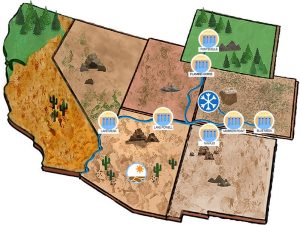
Arizona, California and Nevada make up the Lower Basin.
Colorado, New Mexico, Utah and Wyoming make up the Upper Basin.
Nevada argues that federal officials should have considered an alternative involving both voluntary and mandatory conservation measures and reductions in both basins.
The complaint also says the federal review should have considered ways to reduce water deliveries more equitably between the Upper and Lower Basin states during very low river conditions.
Governor Joe Lombardo stated the disagreement more forcefully in the state’s August 24 announcement. “Under the proposed plan issued by the Department of the Interior, southern Nevada could lose more than 70 percent of its already meager Colorado River allocation while the Upper Basin states of Colorado, Utah, New Mexico, and Wyoming are not required to contribute a drop,” Lombardo said.
That statement represents Nevada’s position in the dispute. The Upper and Lower Basin states have disagreed for years over their respective legal obligations during Colorado River shortages.
Nevada Raises the Possibility of a Compact Call.
The lawsuit also raises the issue of a “compact call” that could become important if Colorado River conditions continue to deteriorate.
The 1922 Colorado River Compact requires the Upper Basin states not to cause the river’s flow at Lee Ferry to fall below 75 million acre-feet during any consecutive 10-year period.
Nevada’s complaint argues that, when obligations to Mexico are included and insufficient surplus water is available, the Lower Basin could request actions by the Upper Basin to maintain at least 82.5 million acre-feet of flow past Lee Ferry over a 10-year period.
Nevada alleges that federal officials failed to adequately consider a reasonably foreseeable compact call and the environmental consequences that could follow.
The complaint does not say that such a call has been made. It argues that the possibility should have been analyzed.
Glen Canyon Dam Becomes Part of the Lawsuit.
The complaint also addresses Glen Canyon Dam.
The federal environmental review identifies an important operating constraint when Lake Powell falls below elevation 3,490 feet.
At those low elevations, water releases must rely on four river outlet works. Nevada’s complaint says extended operation through those outlets could result in cavitation damage, erosion below the dam, and sediment buildup. Those problems could affect the dam’s reliability and its ability to deliver water downstream.
Nevada argues that Reclamation failed to adequately analyze solutions to those infrastructure problems.
The complaint says the federal review should have considered a long-term alternative addressing Glen Canyon Dam’s infrastructure limitations.
It also says officials should have examined an engineered solution that could address those limitations without placing additional burdens on Lower Basin water users.
What About Flaming Gorge, Blue Mesa and Navajo?
Nevada’s arguments extend beyond Lake Powell and Lake Mead.
The complaint discusses the large Upper Basin reservoirs that are part of the Colorado River Storage Project, including Flaming Gorge, Blue Mesa and Navajo reservoirs. Nevada alleges that federal officials failed to adequately consider how those reservoirs could be operated in connection with the broader Colorado River plan.
The complaint argues that operations involving those reservoirs are sufficiently connected to the overall plan that they should have been considered as part of the environmental review rather than addressed through separate future reviews.
That claim is another issue the federal court will have to consider.
Evaporation Losses.
Nevada also raises one of the Colorado River’s less visible losses: evaporation.
The complaint alleges that federal officials failed to adequately and transparently consider the effects of evaporation.
Nevada says the federal review should have examined equitable ways of accounting for evaporation and storage losses under each alternative.
The complaint does not tell the court what the final allocation of those losses should be. Instead, Nevada argues that the issue should have been adequately considered during the federal decision-making process.
Nevada Raises Dead Pool Rights.
The lawsuit contains another issue with potentially significant implications for extreme drought conditions.
Nevada says federal officials failed to consider Nevada’s contractual rights to withdraw water from Lake Mead during “dead pool” conditions.
Dead pool generally describes a reservoir level so low that water can no longer pass through the dam in the normal manner.
Nevada’s complaint does not say Lake Mead has reached dead pool. Instead, it argues that its contractual rights under such extreme conditions should have been included in the federal analysis.

What Happens to Las Vegas?
One of Nevada’s strongest criticisms concerns the economic analysis.
According to the complaint, the federal environmental review examined potential economic losses involving agriculture and river-based recreation.
Nevada argues that it did not similarly calculate the potential losses to municipal and industrial water users.
The complaint lists possible consequences that Nevada believes should have received greater attention, including changes in bond ratings, higher borrowing costs, increased pressure on water rates, loss of urban trees and landscaping, and increased extreme urban heat.
Nevada says Southern Nevada’s economy is roughly $180 billion per year.
The complaint also points to an unusual possibility contained in the federal environmental review: Under some scenarios, municipalities might have to look for alternative water sources or even hauled water.
Nevada argues that the federal socioeconomic analysis did not calculate what such measures could cost.
Groundwater, Health and Tribal Resources.
The state’s environmental claims reach beyond the immediate loss of Colorado River water.
The complaint alleges that federal officials failed to adequately examine public health and safety consequences.
It also says the review did not adequately consider the possibility that Colorado River reductions could cause greater reliance on groundwater.
Nevada also alleges that potential effects on cultural and tribal resources were not adequately considered.
These are allegations contained in the complaint. The court has not determined whether the federal environmental review was legally inadequate.
Nevada Says Important Alternatives Were Missing.
Among other things, Nevada says federal officials should have considered:
- A legally sufficient “no action” alternative;
- The alternative proposed by the Lower Basin states;
- Long-term solutions for Glen Canyon Dam infrastructure;
- An engineered solution for Glen Canyon Dam’s low-water limitations;
- Mandatory and voluntary conservation measures applying to both the Upper and Lower Basins;
- Nevada’s contractual rights to withdraw Lake Mead water during dead-pool conditions;
- More equitable treatment of evaporation and storage losses;
- Conservation opportunities involving Mexico;
- More equitable reductions between the Upper and Lower Basins during low-flow conditions; and
- A phased approach combining short-term and long-term measures.
Nevada alleges that the failure to adequately examine those possibilities violated federal environmental law.
Nevada Also Challenges the Public Review.
The lawsuit raises another procedural issue.
Nevada says it submitted extensive comments on the Draft Environmental Impact Statement on March 2 and additional comments on the Final Environmental Impact Statement on August 12.
The complaint alleges that the federal government’s response to public comments addressed some general themes but overlooked many of Nevada’s comments or failed to respond to them.
Nevada also argues that state, regional and local Nevada government entities should have been invited to participate as cooperating agencies.
The state says those entities possess technical knowledge about Colorado River management and its effects on Nevada that could have contributed to the federal review.
What Nevada Wants the Judge to Do.
Nevada is asking for considerably more than another round of negotiations.
The lawsuit asks the U.S. District Court for the District of Nevada to declare that federal officials violated the Administrative Procedure Act, National Environmental Policy Act, and the Law of the River.
It asks the judge to throw out the August 21 Record of Decision.
Nevada also wants the court to throw out the July Final Environmental Impact Statement and the operating guidelines for 2027 and 2028.
Finally, Nevada wants an injunction preventing federal officials from implementing the challenged Record of Decision and operating guidelines until the government complies with the laws cited in the complaint.
No preliminary hearing had been scheduled as of August 24.
For now, Nevada’s claims remain allegations. The federal government will have an opportunity to respond, and the court will ultimately determine whether the challenged Colorado River operating decisions comply with federal law.
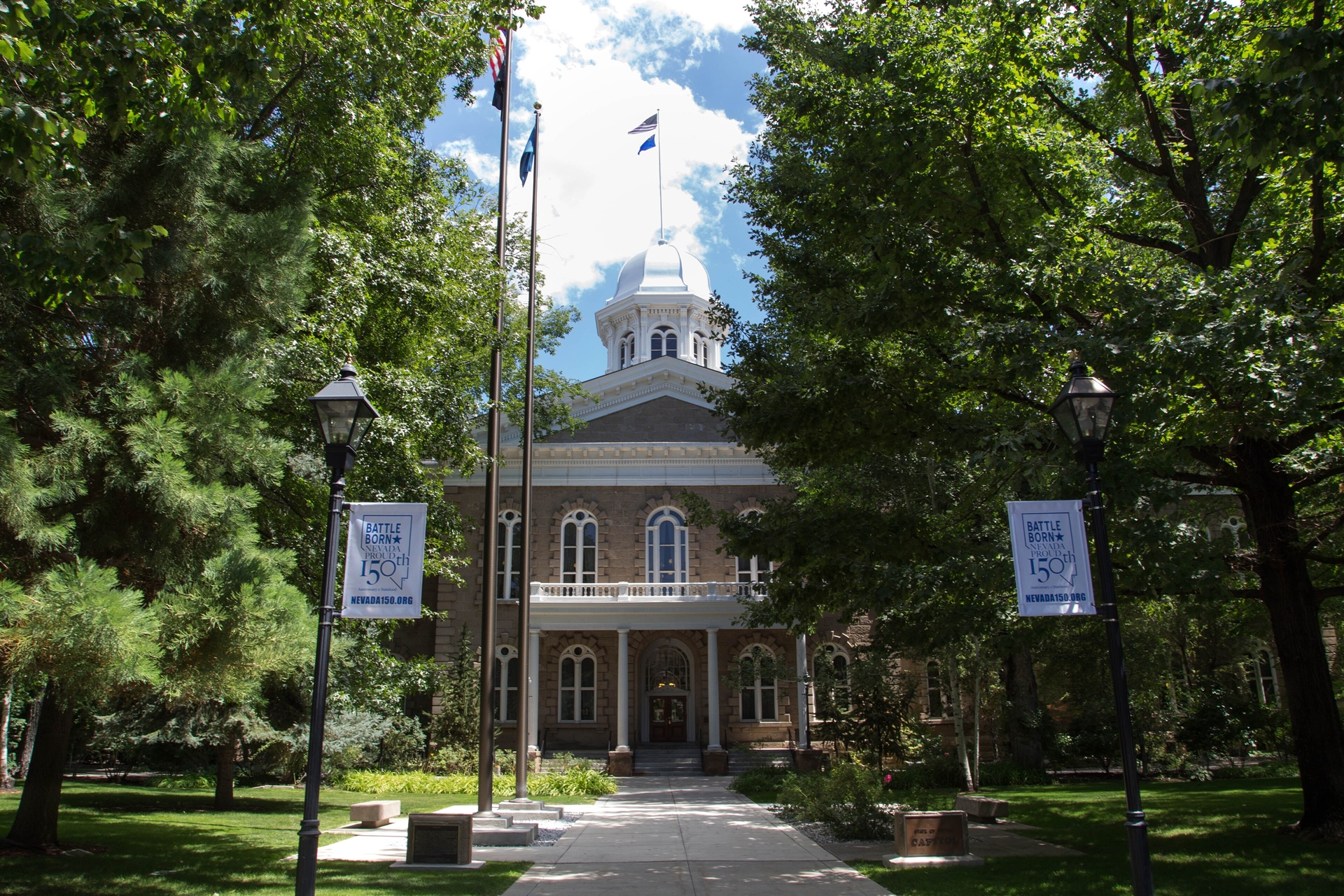
Pictured at the top: Nevada State Capitol , 2014. Bohao Zhao. Licensed under the Creative Commons Attribution 3.0 Unported license.


 wpDiscuz