
- Land in Willcox Basin has sunk more than 11 feet.
- Caused mainly by decades of groundwater pumping.
- Satellite data show the sinking continues despite rainfall.
- NASA’s new satellite may improve monitoring.
Tuesday, November 11, 2025 — Land subsidence in southeastern Arizona’s Willcox Basin remains one of the most extreme examples of aquifer system compaction in the western United States. According to research presented on October 20, 2025, at the Geological Society of America’s Connects 2025 conference , some areas have sunk more than 11 feet since the mid-20th century. The subsidence stems primarily from decades of intensive agricultural groundwater use, resulting in widespread earth fissures, infrastructure damage, and long-term water table decline.
While recent years have brought above-average precipitation, researcher Danielle Smilovsky noted that natural recharge has not been enough to reverse the problem. Satellite data collected through Interferometric Synthetic Aperture Radar (InSAR) show that land in some zones is still sinking at rates exceeding 15 centimeters per year. Despite localized groundwater improvements near the Willcox Playa, the basin continues to face annual groundwater deficits estimated at over 100,000 acre-feet.
New Satellite May Improve Monitoring.
The upcoming NASA-ISRO Synthetic Aperture Radar (NISAR) satellite is expected to significantly improve how scientists monitor subsidence. Using dual-frequency radar capable of detecting small land surface movements through vegetation and dry soil, NISAR will provide more frequent and detailed measurements of basin deformation. Researchers say that such high-resolution data could help Arizona’s water managers track aquifer health and plan for more sustainable groundwater use in the future.
Information derived from the Geological Society of America, “Recharged but Not Recovered: InSAR Observations of Persistent Land Subsidence in Arizona’s Willcox Basin,” presented by Danielle Smilovsky, 2025.
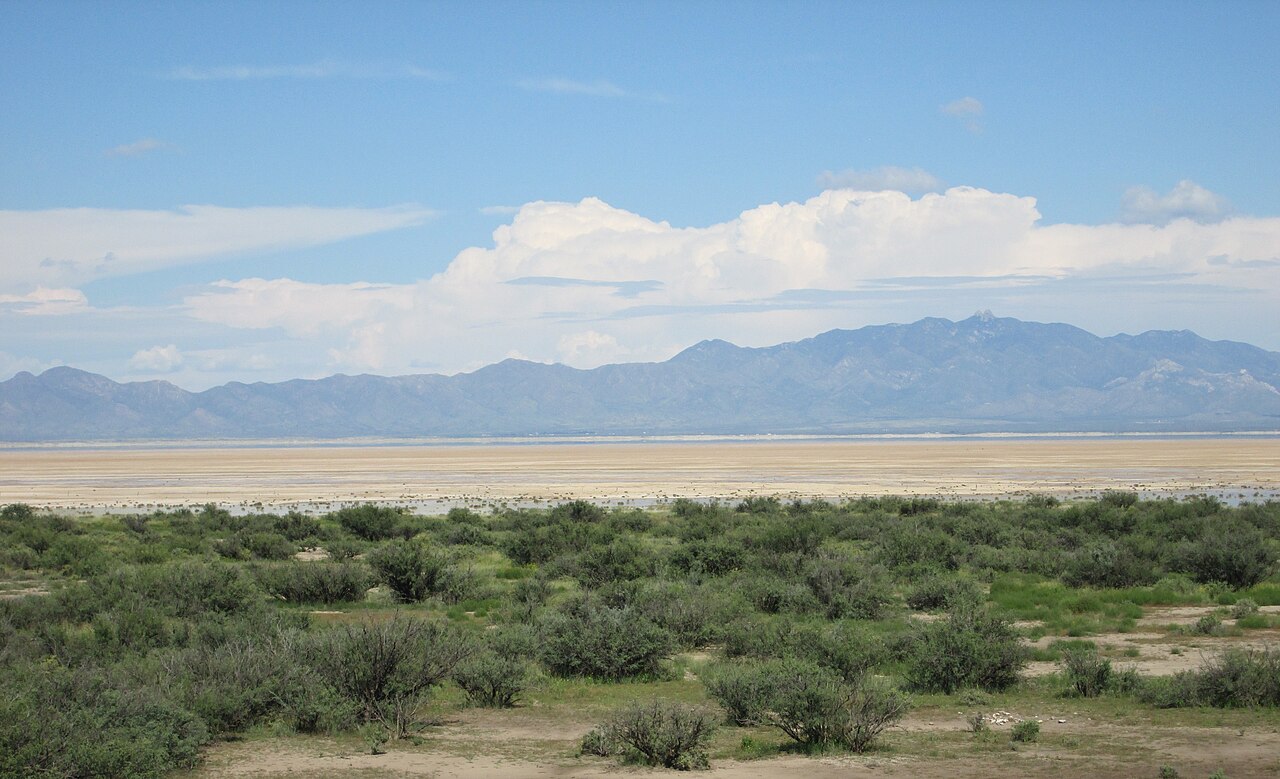
Image: View facing east toward the Dos Cabezas Mountains from a point just east of Cochise, Arizona. In the foreground is desert shrubland surrounding the Willcox Playa , the whitish/tan section in the middle. By The Old Pueblo, September 2014. Licensed under the Creative Commons Attribution-Share Alike 4.0 International license.
FAQ
What causes land subsidence in the Willcox Basin?
The subsidence is caused by long-term groundwater extraction for agriculture, which compacts the aquifer and lowers the land surface.
Has recent rainfall helped the problem?
Rainfall has provided minor and temporary recharge, but not enough to counter decades of groundwater loss.
How much has the land sunk?
Some areas of the basin have sunk more than 11 feet since the mid-1900s.
What is NISAR, and why is it important?
NISAR is a joint NASA-ISRO satellite designed to track land surface changes with greater precision. It will help monitor aquifer health and land deformation in real time.
Why does this matter for Arizona’s water future?
Persistent land subsidence damages infrastructure, reduces aquifer storage, and underscores the urgent need for sustainable groundwater management in rural agricultural regions.