
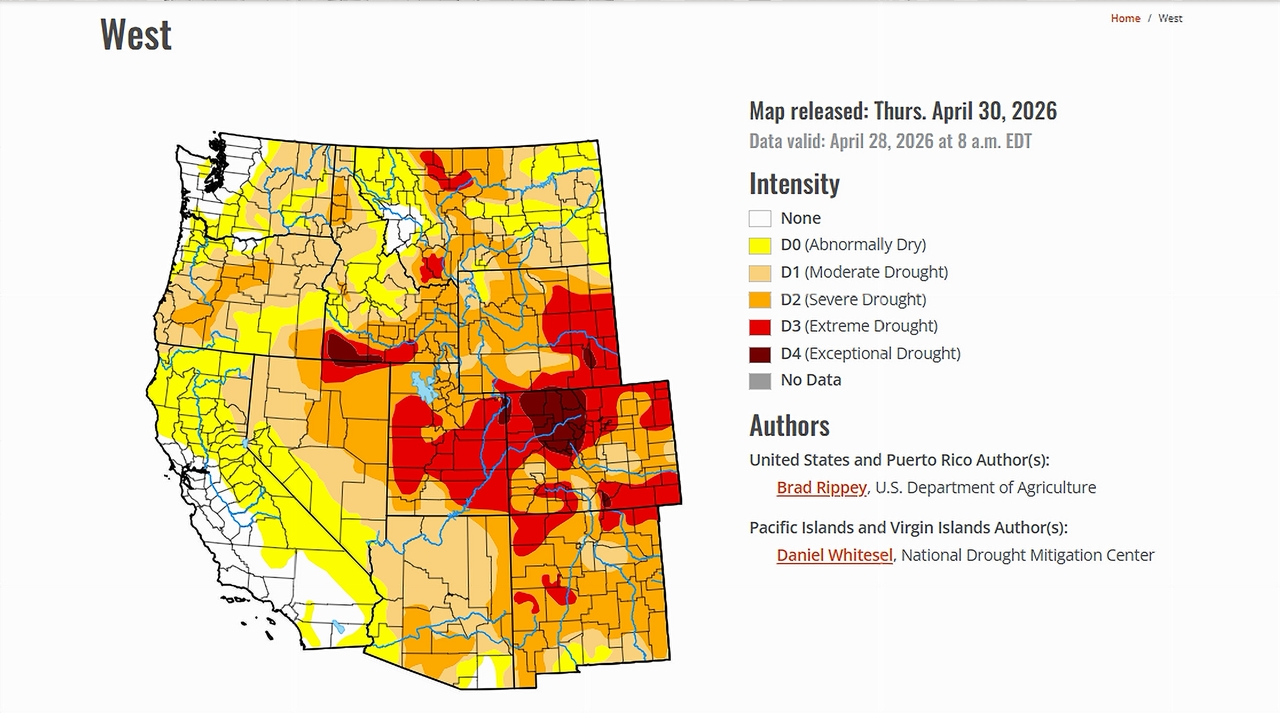
- Dry conditions persist across much of the West.
- Snowpack melt limits water supply gains.
- Colorado River Basin faces ongoing strain.
Saturday, May 2, 2026 — The latest U.S. Drought Monitor Report released on Thursday, April 30, reveals that drought conditions across the United States show a patchwork of extremes. Some regions are seeing relief from steady rain, while others continue to dry out. The eastern Plains and parts of the Midwest have benefited from recent storms, easing concerns about soil moisture. In contrast, areas like the Southeast remain under intense drought pressure, with parched soils and active wildfires.
Out West, the story is more complicated. Periodic showers and cooler weather have brought short-term improvements, but they have not changed the broader outlook. The water supply picture remains strained as the region moves deeper into spring.
Colorado River Basin: A Tight Water Picture.
The Colorado River Basin states—Arizona, California, Colorado, Nevada, New Mexico, Utah, and Wyoming—continue to face water stress. While some recent precipitation has improved surface conditions, it has not been enough to offset deeper concerns tied to snowpack and long-term supply.
Much of the region’s mountain snowpack, which acts as a natural reservoir, has already melted earlier than usual. This early runoff reduces the amount of water available later in the year, when demand is highest. Only parts of the northern Rockies are holding onto meaningful snow at this stage.
This early melt is especially important because snow is not just precipitation—it is storage. When it disappears too soon, the system loses a key buffer that helps carry water through the hot summer months.
Reservoir Pressures and Emergency Moves.
Water managers are already responding to these conditions. In late April, federal officials began releasing water from Flaming Gorge Reservoir to support levels at Lake Powell. At the same time, water that would typically flow downstream to Lake Mead is being held back to stabilize Powell.
These actions reflect growing concern about reservoir levels and the ability to maintain critical functions, including water delivery and hydropower generation.
Limited Relief from Spring Storms.
Recent unsettled weather across parts of the West has provided some benefits. Showers have improved topsoil moisture in localized areas and reduced the need for irrigation in the short term. A few regions, including parts of western Colorado, have even seen slight improvements in drought intensity.
However, these gains are modest. They do not significantly change the broader water supply outlook for the basin. The underlying issue remains: there is less stored water available moving into the summer season.
Summer Challenges.
As spring transitions into summer, the Colorado River Basin enters a critical period. With reduced snowpack storage and ongoing demand, water managers will continue to balance limited supplies across multiple needs.
The current conditions highlight a familiar pattern—short bursts of relief, followed by continued pressure on a system that depends heavily on winter snow and careful management.
It’s kind of shocking how muchof the country is dealing with this right now.