- A federal appeals court ruled last week that the Endangered Species Act applies to the Bureau of Reclamation’s management of the Klamath Project.
- Klamath Project farmers face an estimated shortfall of 169,460 acre-feet of water in 2026, with only 221,000 acre-feet available against a projected demand of more than 390,000 acre-feet.
- As of June 21, 2026, 50 farmers in the Klamath Irrigation District were on a water-order wait list, with wait times expected to stretch to several days by mid-July.
- The Klamath Irrigation District’s voluntary water idling program remains open through July 1, 2026, offering farmers up to $160 per acre to take land off surface water delivery.
- The Klamath River begins in Oregon and runs 263 miles through California, connecting the Klamath Project’s water struggles to a broader West Coast story about rivers, farms, and fish.
Tuesday, June 23, 2026 — Farmers on the Klamath Project are no strangers to hard summers. But 2026 is shaping up to be one of the hardest on record, and last week a federal appeals court handed down a ruling that could shape how that water is managed for years to come.
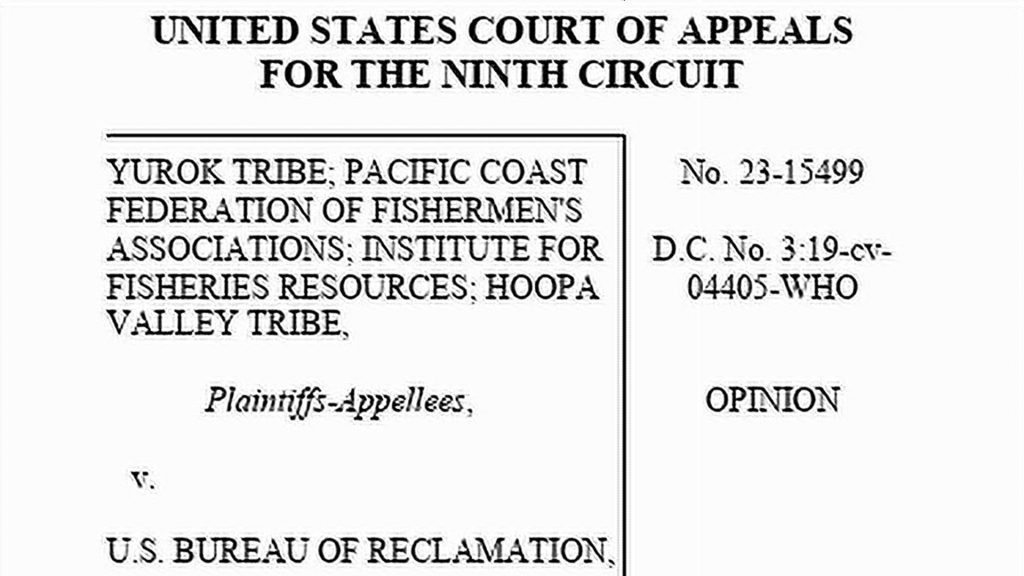
On June 17, 2026, a three-judge panel of the United States Court of Appeals for the Ninth Circuit ruled that the federal Endangered Species Act applies to the Bureau of Reclamation’s operations of the Klamath Project. In plain terms, that means the federal agency that manages water delivery for roughly 158,000 acres of farmland stretching from southern Oregon into northern California must consider the needs of endangered fish species when deciding how much water flows through its canals and into its reservoirs.
The case, Yurok Tribe v. Klamath Water Users Association, was brought by the Yurok Tribe, the Hoopa Valley Tribe, and a coalition of Pacific Coast fishing groups. On the other side stood the Klamath Irrigation District and the Klamath Water Users Association, which argued that the law should not apply as lower courts had said it did.
The majority of the appeals court disagreed.
What the Court Said.
Writing for the majority, Circuit Judge Ronald M. Gould anchored the court’s decision in a 1999 Ninth Circuit precedent known as Patterson, which had previously established that the Endangered Species Act governs Bureau of Reclamation operations at the Klamath Project’s Link River Dam.
The court quoted that earlier ruling directly, noting that the Bureau of Reclamation “has the authority to direct Dam operations to comply with the Endangered Species Act” and that meeting the law’s requirements may “override the water rights of the irrigators.” The majority found that reasoning still valid and still binding.
The Klamath Irrigation District and the Klamath Water Users Association had argued that two more recent court decisions had effectively changed the rules. One was a 2007 United States Supreme Court case involving the Clean Water Act and Endangered Species Act, known as National Association of Home Builders v. Defenders of Wildlife. The other was a 2024 Ninth Circuit ruling known as Haaland, which involved water contracts on California’s Central Valley Project.
The majority read both cases narrowly. The court found that the Reclamation Act, which authorizes the Bureau of Reclamation to operate the Klamath Project, does not impose a specific, mandatory action that directly conflicts with the Endangered Species Act. Because no such conflict exists, the court concluded, the Endangered Species Act continues to apply.
“We discern no reason to deviate from that holding,” the majority wrote, referring to the Patterson precedent.
A Dissent Worth Reading.
Not everyone on the panel agreed. Circuit Judge Ryan D. Nelson filed a dissent arguing that the majority had misread the legal landscape.
Judge Nelson contended that under the Home Builders and Haaland decisions, courts must examine whether the specific contracts between the Bureau of Reclamation and irrigation districts give the agency genuine discretion to act for the benefit of protected species. In his view, those contracts do not. The shortage clauses in the contracts, he argued, are essentially “force majeure” provisions that limit the government’s financial liability when water runs short. They do not, he wrote, grant the agency room to redirect water toward fish rather than farms.
“Under Home Builders and Haaland, the generalized holding in Patterson that the Endangered Species Act applies to the Klamath Project is no longer good law,” Judge Nelson wrote. “Because the majority misreads our precedent, I respectfully dissent.”
Judge Nelson said the case should have been sent back to a lower court for a closer look at the contract language before any broad ruling was issued.
The Fight Over Federal Court Jurisdiction.
The court also addressed two procedural arguments the irrigators had raised. The Klamath Irrigation District and the Klamath Water Users Association argued that a federal district court should not have taken the case in the first place. They contended that Oregon’s state court system, which was already managing a lengthy process to determine water rights across the entire Klamath Basin, had exclusive authority over the matter.
The Ninth Circuit rejected that argument. It found that the federal question of whether the Endangered Species Act applies to Bureau of Reclamation operations is a separate issue from the state’s water rights adjudication process. The federal court, the panel ruled, had proper jurisdiction.
The court also rejected the argument that its own ruling amounted to a “judicial taking,” a legal term for when a court decision effectively strips someone of property they own without compensation. Because the court was only deciding whether a federal law applies to federal agency operations, not adjudicating water rights themselves, no such taking occurred, the majority held.
On the Ground: Not Enough Water to Go Around.
While the legal battle was unfolding in the courthouse, the situation on the ground was already dire.
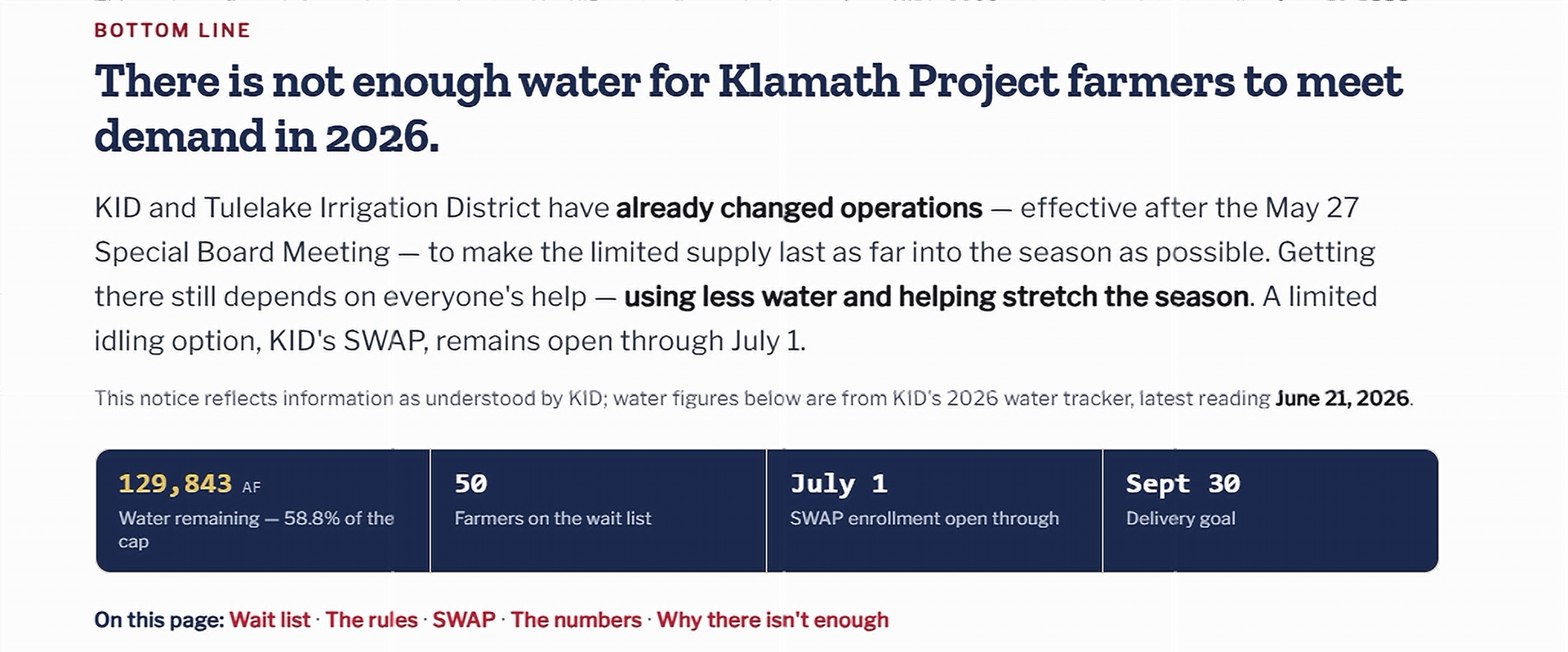
As of June 21, 2026, the Klamath Irrigation District reported that the Klamath Project had only 221,000 acre-feet of water available for the entire 2026 irrigation season, a cap set by the Bureau of Reclamation in its 2026 Operations Plan. Think of an acre-foot as enough water to cover a football field about a foot deep. One acre-foot is roughly what two average American families use in a year.
The problem is that farmers need far more than 221,000 acre-feet. The District estimated the total 2026 demand at 390,460 acre-feet, based on historical comparisons to dry years in 1981 and 2018. That leaves the Project an estimated 169,460 acre-feet short, even if every available drop is delivered.
The watershed’s snowpack hit only 4 percent of its long-term median this past winter, and water-year precipitation reached just 78 percent of normal, according to data from the Natural Resources Conservation Service.
To put those numbers in perspective, the Klamath Irrigation District noted in its June 2026 water update that under natural conditions, a single former lakebed, Lower Klamath Lake, would have lost an estimated 267,000 acre-feet to evaporation alone in 2026.
“Reclamation’s 2026 Operations Plan has failed,” the District wrote in its update, adding that conflicting guidance from the Bureau of Reclamation had created confusion during a critical period of the irrigation season. The District noted that the conflicting directives had since been withdrawn.
Wait Lists, Rules, and a Tight Deadline.
As of June 21, 50 Klamath Irrigation District farmers were on a water-order wait list, with some having waited since June 12. The wait list includes holders of the district’s 1905 priority water rights, known as Article 13(a) or “A contract” holders.
Water rights in the Klamath Project follow the principle of “first in time, first in right,” meaning older water rights get filled before newer ones. The most senior right dates to 1883, held by a ditch company called Van Brimmer Ditch Company. The next oldest runs to 1884. Farmers holding water rights from 1905 and later, under what are called Warren Act contracts from 1911, fall further down the priority list.
The District projects that wait times could grow to several days by mid-July. To stretch the remaining 129,843 acre-feet of water from June 21 through the September 30 seasonal goal, the District said it is holding its daily draw from Upper Klamath Lake as low as conditions allow, targeting a steady rate of roughly 650 cubic feet per second.
Farmers are being asked to follow strict water-use rules. Orders must be placed 24 hours in advance and must be called both on and off. Once water is released from Upper Klamath Lake, it can take more than 96 hours to travel to the far end of some canals, so the District cannot retrieve it if a farmer fails to call it off. Fines for misuse can reach $5,000, and repeat violations can result in a full shut-off of water delivery.
A Program That Pays Farmers to Step Back.
With the season running short, the Klamath Irrigation District has opened its Surface Water Abatement Program, known as its voluntary water-saving program, to farmers who can take acres completely off surface water delivery for the rest of the year.
Farmers who have taken no surface water at all this season can receive up to $135 per acre in cash or a $160-per-acre credit toward their 2027 assessment. Payment amounts decrease for acres that have already received some surface water, and farmers who have already received one acre-foot or more per acre are not eligible.
The program has a cap of 1,500 acres and runs on a first-come, first-served basis. The enrollment deadline is July 1, 2026.
A separate federal idling program run by the Klamath Project Drought Response Agency had offered three types of paid idling, including options for no irrigation, limited irrigation, and a five-year program. That application window closed June 15, 2026.
California’s Connection.
The Klamath Project‘s struggles do not stop at the Oregon state line. The Klamath Irrigation District operates primarily around Klamath Falls, Oregon, but its infrastructure and contractual obligations extend south into Modoc County in northern California. The adjacent Tulelake Irrigation District, which is also part of the Klamath Project, lies entirely within California.
The Klamath River itself begins at Upper Klamath Lake in Oregon and flows 263 miles through the Cascade Mountain Range and the temperate rainforests of California’s north coast before emptying into the Pacific Ocean. That means the fish at the center of the court case, including endangered sucker species in Upper Klamath Lake and threatened coho salmon in the Klamath River, are part of a shared ecosystem that touches both states.
For California, where water managers in the Colorado River Basin and across the state have long wrestled with the intersection of agricultural water rights and endangered species law, the Ninth Circuit’s June 17 ruling carries weight beyond the Klamath Basin. The decision reinforces that federal environmental law can reach into the water contracts that govern delivery to farms, a legal reality that irrigators from the Klamath to the Colorado are watching closely.
What Comes Next.
The Klamath Irrigation District said it is operating within the Bureau of Reclamation’s 2026 constraints, not as an endorsement of the plan, but as a practical necessity.
“Working within this plan is not an endorsement of Reclamation’s Operations Plan,” the District stated in its June update. “It is simply how we are choosing to operate given the limitations imposed on the Project’s water supply for the 2026 irrigation season.”
The District said it intends to continue pressing, through its contracts and proper legal channels, for the water it believes its patrons are owed.
Meanwhile, the Ninth Circuit’s ruling stands. Barring a further appeal to the full appeals court or to the United States Supreme Court, the Endangered Species Act will continue to govern how the Bureau of Reclamation manages water in one of the West’s most contested river basins.
Farmers, tribes, and fishermen are all watching the same set of rivers. The water those rivers carry, and who gets it, remains an open question.
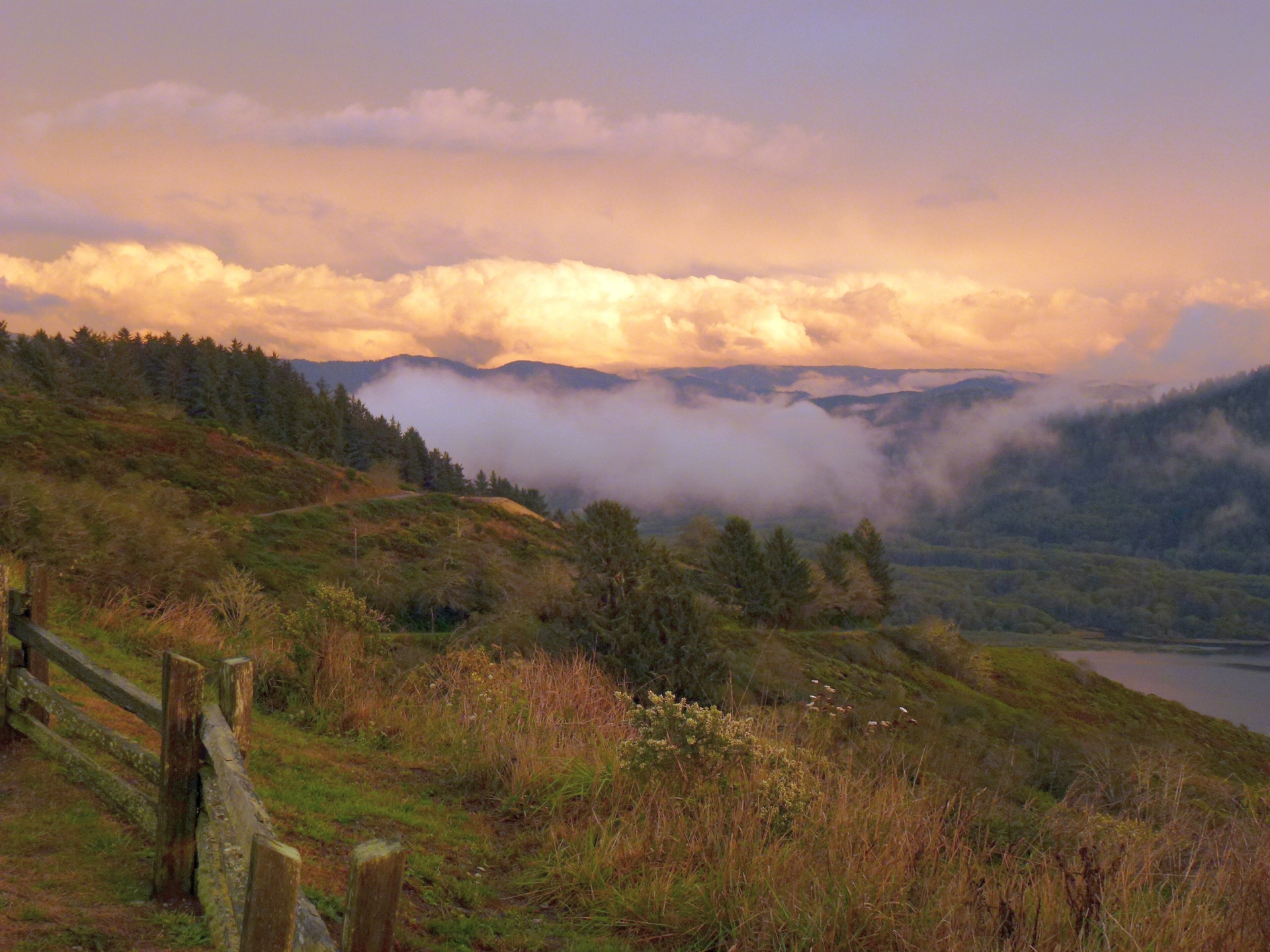
Pictured at the top: Sunset from the Klamath River Overlook near Klamath . September 2014, by Little Mountain 5. Licensed under the Creative Commons Attribution-Share Alike 4.0 International license.