
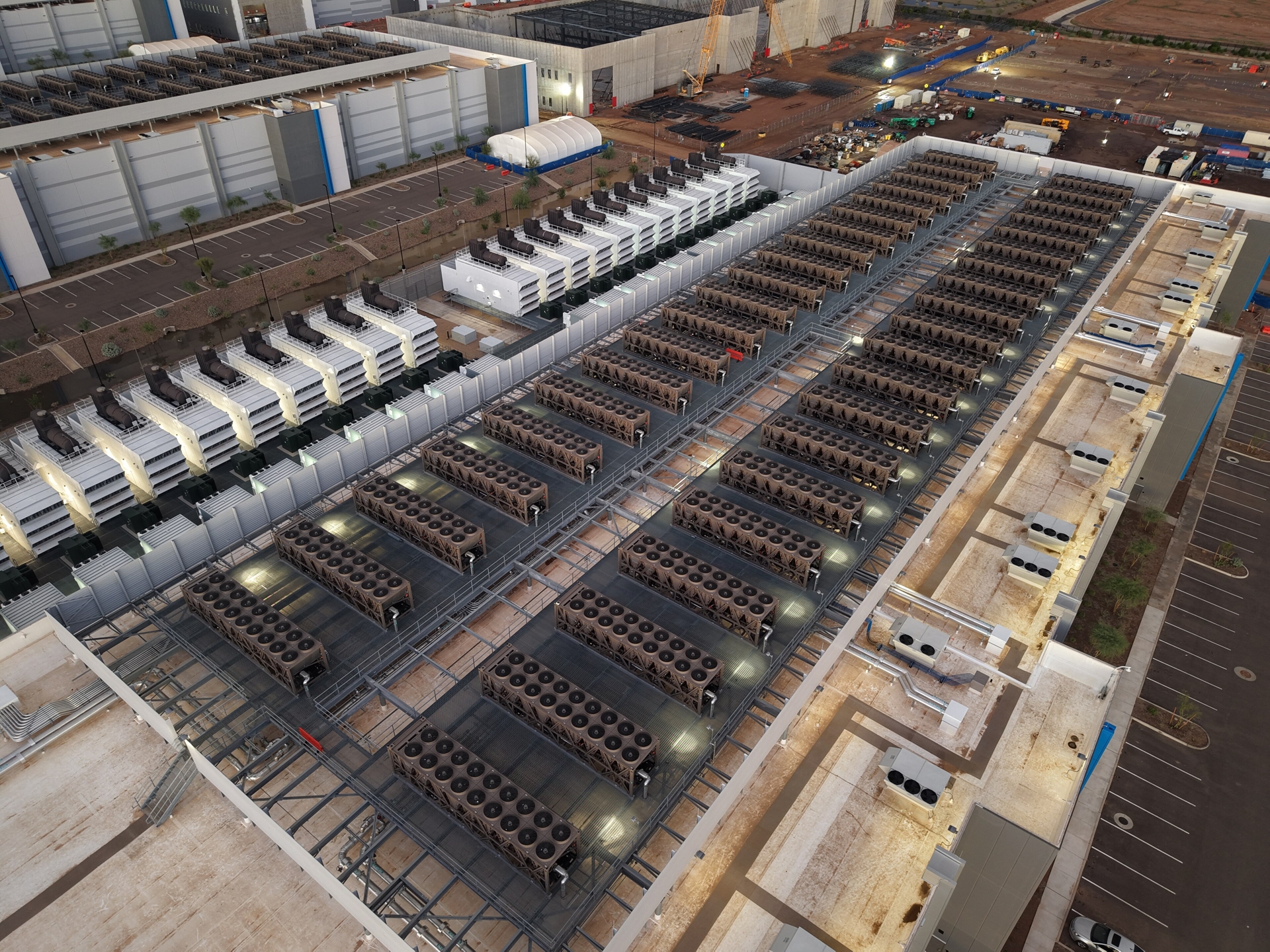
- U.S. data centers directly used about 17 billion gallons of water in 2023.
- Municipal water systems supply an estimated 97% of data centers’ on-site water needs.
- A large data center can directly consume as much water each day as about 2,600 households.
- Arizona data centers may indirectly use Colorado River water delivered through the Central Arizona Project.
- States and local water providers remain central to decisions about whether water is available for data centers.
- Congress is considering proposals involving water reporting, recycling and data center development.
Friday, August 7, 2026 — The rapid growth of artificial intelligence has brought an old piece of infrastructure into a much brighter spotlight: the data center.
Behind online searches, artificial intelligence programs, cloud storage and countless other digital services are buildings packed with computers. Those computers produce heat. Keeping them cool can require water, sometimes a great deal of it.
A July 31, 2026, report from the Congressional Research Service examines what is known, and what remains unknown, about data centers and water. The report was prepared for members and committees of Congress as questions grow about the effect of expanding data center development on local water supplies.
The national numbers require some perspective. Direct water use by data centers is estimated at about 2% of total U.S. water consumption. But the Congressional Research Service notes that national percentages do not necessarily describe what happens in an individual community. A single large facility can represent a substantial new local demand.
Why Data Centers Need Water.
Computers generate heat when they operate. The harder the machines work, the more heat must be removed to keep them functioning properly.
Data centers generally rely on air cooling, liquid cooling or combinations of different technologies. The type of cooling system depends on factors such as the size of the facility, its computing workload, the local climate and the availability of water.
Artificial intelligence is adding another wrinkle. Training artificial intelligence models and operating those models can require powerful computer processors. Greater computing demands can also mean greater cooling needs.
Water use varies significantly depending on the cooling system. Some systems rely on evaporation. Others use air and consume little or no water, although the Congressional Research Service notes an important trade-off: air-cooled chillers generally use more energy than evaporation-based cooling systems.
In other words, reducing water use does not automatically eliminate environmental or infrastructure considerations. A cooling system that saves water may require more electricity.
Water Use Has Been Growing.
One study cited by the Congressional Research Service estimated that U.S. data centers directly used approximately 17 billion gallons of water in 2023.
That compares with about 5.6 billion gallons in 2014.
The size of an individual facility also matters. The International Energy Agency estimated that a 100-megawatt U.S. data center may directly consume about as much water each day as 2,600 households. That estimate covers direct water consumption at the facility, rather than water used elsewhere to generate its electricity.
The Congressional Research Service report focuses primarily on this direct water use. Water consumed at power plants that supply electricity to data centers is outside the report’s main scope.
Most Data Centers Get Water From Local Utilities.
Despite their enormous computing capacity, most data centers obtain water the same basic way homes and businesses do: from a public water system.
An analysis cited in the congressional report estimated that public water systems supplied about 97% of U.S. data centers’ onsite water needs as of 2025. Other possible sources include reclaimed wastewater and direct withdrawals from rivers, lakes or groundwater.
Using public water has practical advantages. Drinking water has already been treated to meet water-quality standards. Poorer-quality water may contain minerals or other substances that can cause scaling, corrosion, or biological growth in cooling equipment.
Reclaimed water can also be used, but its availability depends partly on local infrastructure. A data center may need access to a separate non-drinking-water pipeline, sometimes called a purple pipe. Reclaimed water may also have other competing users.
Hot Weather Can Mean Higher Water Demand.
Location matters.
Data centers using evaporative cooling generally require more water during hotter parts of the day and hotter times of the year. That means their peak demand can occur at the same time households, businesses, power producers and other water users are also placing greater demands on a water system.
The Congressional Research Service says the significance of a new data center’s demand depends on local and regional circumstances, including available supplies, weather, seasonal conditions and existing needs from households, agriculture, industry, energy production and environmental uses.
That distinction is important. The report does not provide a single national answer to whether data centers use “too much” water. Their effect depends heavily on where they are built, how they are cooled and where their water comes from.
States Still Hold Much of the Authority.
Water allocation remains largely a state and local matter.
Congress has generally deferred to state authority over water allocation within state boundaries. State laws determine access to freshwater, and those laws can differ considerably for groundwater and surface water.
For a data center connected to a municipal utility, the water provider generally carries responsibility for complying with applicable state water-right and supply requirements. A company attempting to pump its own groundwater or divert surface water may face state or local permitting and water-right requirements directly.
The Congressional Research Service also notes that shared water supplies can involve interstate compacts and river basin organizations because an upstream withdrawal can affect water available downstream.
That issue is particularly familiar in the West, where water commonly crosses political boundaries before reaching its users.
Arizona: Data Centers and Colorado River Water.
Arizona receives particular attention in the report.
A 2026 Arizona State University study cited by the Congressional Research Service identified 66 data centers completed or under construction in Central Arizona.
That included data centers within areas served by municipal water suppliers for Tucson, Phoenix, Scottsdale and Mesa. The report listed nine in the Tucson area, 25 in Phoenix, five in Scottsdale and eight in Mesa.
Those cities receive significant portions of their water supplies from the federally managed Colorado River through the Central Arizona Project. Phoenix, Scottsdale and Mesa also receive significant shares of their supplies from the Salt River Project.
That means some Arizona data centers can indirectly receive federally developed water even though the data center operator does not have a direct water contract with the federal government.
Marana Takes a Different Approach.
The report also highlights Marana, Arizona.
In December 2024, the town adopted an ordinance stating:
“The Marana water department will not provide potable water to a data center (principal or accessory use) for its cooling system, humidity control, and other similar operations.”
For a proposed data center in Marana, the Congressional Research Service reported that the Cortaro Marana Irrigation District was expected to provide nonpotable water for industrial, irrigation and fire-suppression purposes.
The example illustrates how local governments and water providers can influence not only whether water is supplied to a project, but what kind of water may be used.
California: Agricultural Water and a Data Center Dispute.
The report identifies another western example in Imperial County, California.
According to the Congressional Research Service, a developer reportedly sought to fallow agricultural land and transfer the conserved water to data center operations through a change-of-purpose application.
The local irrigation district denied the request to use untreated irrigation canal water for industrial cooling. The developer subsequently sued the irrigation district.
The report does not describe comparable individual data center water disputes in Colorado, Nevada, New Mexico, Utah or Wyoming.
However, all five states, along with Arizona and California, are among the 17 western states where the Bureau of Reclamation owns and operates water infrastructure.
Federal Water Can Reach Data Centers Indirectly.
The federal government plays a complicated role.
The Bureau of Reclamation owns and operates reservoirs, dams and other infrastructure that deliver water for purposes including irrigation and municipal and industrial uses.
The U.S. Army Corps of Engineers also operates reservoirs where water supply may be one of several authorized purposes.
But the Congressional Research Service reported that, based on its research in early July 2026, it had not identified data center developers or operators that had directly entered into water-supply agreements with either agency to withdraw water stored at federal facilities.
That does not mean federal water never reaches data centers.
It can arrive indirectly through cities and utilities. Central Arizona provides one example. Municipal systems receiving Colorado River water through the Central Arizona Project can, in turn, serve data centers within their service areas.
Could Recycled Water Reduce Demand?
Water reuse is one option receiving attention.
The Congressional Research Service defines water reuse as capturing wastewater, stormwater, saltwater or graywater and treating it as necessary for another beneficial purpose.
Some data centers are already installing systems that treat wastewater and recycle it for cooling. Others can obtain reclaimed water from nearby wastewater treatment facilities.
According to the Environmental Protection Agency information cited in the report, many data center operators are interested in switching to recycled water for cooling but face an unclear permitting pathway for that particular use.
There is no single federal law or regulation governing water reuse. States generally hold primary regulatory authority, and requirements can differ depending on the source of the recycled water and how it will be used.
The Water Numbers Are Still Surprisingly Hard to Find.
One of the report’s clearest findings is how much remains unknown.
Facility-specific data center water-use information is limited. Utilities may collect the information, but it is not always made public. Water used by an individual data center may simply be combined with water used by all other customers within a utility’s service area.
Self-supplied facilities may face fewer reporting requirements, depending on state and local law.
The federal government also has not conducted a systematic nationwide assessment of data center water use, according to the Congressional Research Service.
The United States Geological Survey has collected national, state and county water-withdrawal estimates for decades, but data centers have not been maintained as a separately reported national category.
That makes it difficult to answer what sounds like a simple question: How much water are America’s data centers actually using?
Congress Is Looking at the Issue.
Members of the 119th Congress have introduced a range of proposals addressing data center water use.
As of July 30, 2026, most of the bills identified by the Congressional Research Service had not advanced beyond the introduction stage. Proposals include collecting and publishing more information about water use, encouraging water recycling, studying water and energy demands, and either facilitating or limiting some data center development.
One proposal, the Advancing Water Reuse Act, would provide a 30% investment tax credit for qualifying water-reuse projects, including certain on-site recycling systems at data centers.
Another, the Unleashing Low-Cost Rural AI Act, calls for a study that would examine data center growth and its effects on energy, land, water and consumer costs.
The Data Center Tax Accountability and Disclosure Act of 2026 would require covered data centers to report information including annual water use, water sources, average water-use efficiency, and water rights, permits or long-term supply agreements. The proposal also includes provisions for making reports publicly available.
At least one water-related data center provision had already become law by July 30. The National Defense Authorization Act for Fiscal Year 2026 requires estimates of additional electricity and water use, along with anticipated effects on surrounding communities, for certain construction or expansion of data centers on military installations.
A Growing Water Question.
The Congressional Research Service report does not present data centers as a single nationwide water problem. Instead, it describes an industry whose water demands vary widely by facility, cooling technology, climate and water source.
Nationally, direct data center consumption represents a relatively small share of U.S. water use. Locally, however, a large facility can represent a substantial new customer, particularly where supplies are constrained or peak cooling demand coincides with hot-weather demand from other users.
For Colorado River Basin states, the report offers two concrete examples, Arizona and California, while also pointing to the larger western framework: state water laws remain central, federal water projects can indirectly supply data centers, and detailed information about individual facilities remains limited.
As data center construction continues, Congress is considering whether more information should be collected and whether water reuse and other practices should receive federal support. For now, many of the decisions about where the water comes from, how much is available and under what conditions it can be used remain largely in state and local hands.


 wpDiscuz