
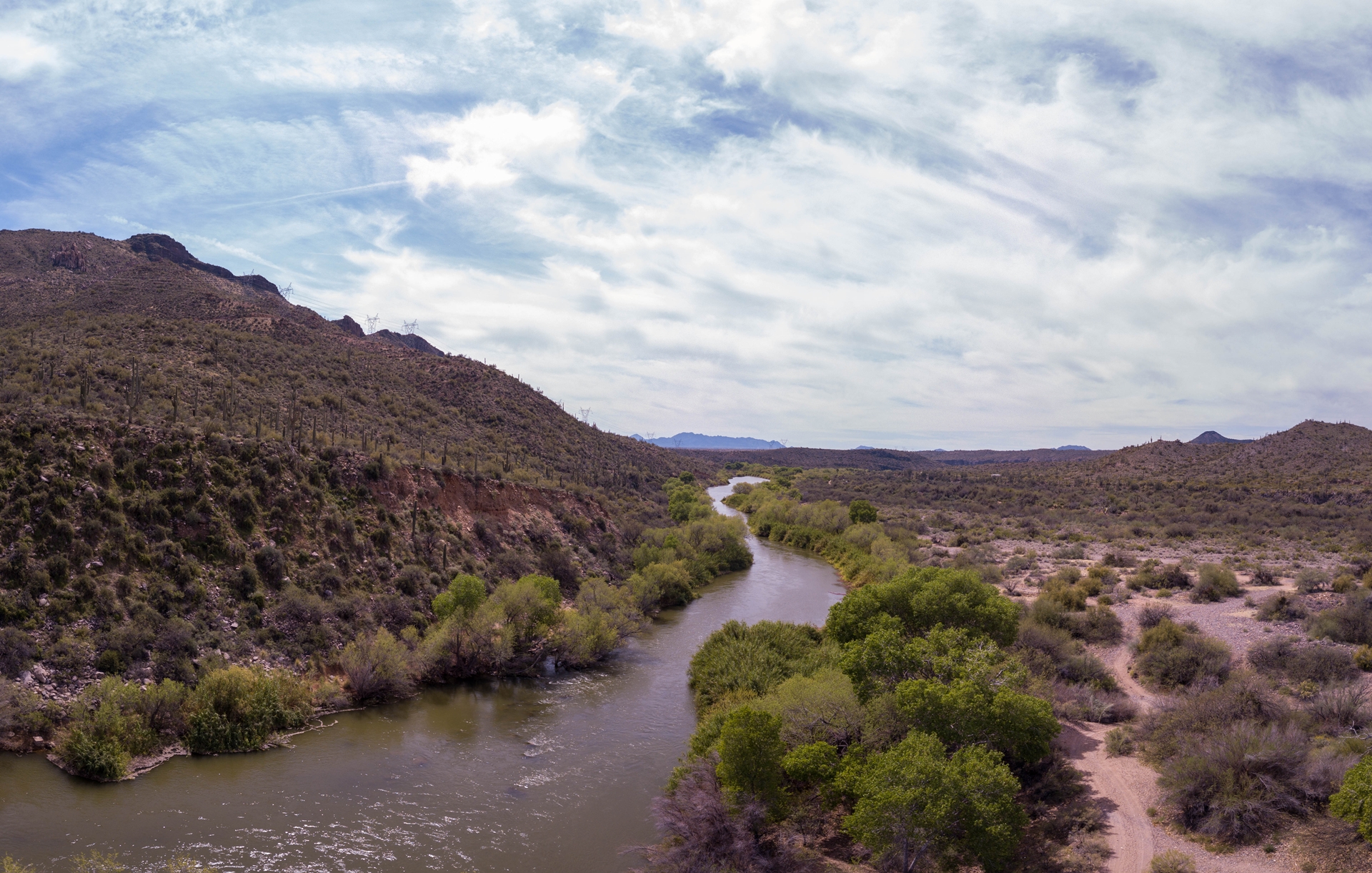
- A major new report finds that more than 95% of Arizona’s rainfall evaporates before it can be used or stored underground.
- Researchers modeled water budgets for all 51 of Arizona’s groundwater basins and identified more than 50 strategies to capture and recharge water.
- The Mogollon Rim region holds the greatest potential for large-scale water capture because it receives far more rain and snow than it loses to evaporation.
- In the Phoenix metro area alone, dry wells and retention basins already capture roughly 94,000 acre-feet of stormwater runoff each year.
- The three-and-a-half-year study proposes a new land management concept called Opportunistic Recharge Enhancement that could boost groundwater supplies with minimal extra cost.
Friday, June 19, 2026 — A team of researchers from Arizona’s three state universities released on Wednesday what may be the most detailed picture ever assembled of where the state’s water goes and how to keep more of it in the ground.
The Arizona Tri-University Recharge and Water Reliability Project , known as ATUR, spent more than three years building water budgets for every one of Arizona’s 51 groundwater basins. The result is an 84-page report, backed by satellite data, climate models, machine learning tools and field experiments, that lays out a scientific foundation for stretching the state’s strained water supplies.
“We have taken a major step forward in understanding water supply conditions in Arizona with a level of precision never before available,” said Giuseppe Mascaro, the lead ATUR researcher for Arizona State University.
The Evaporation Problem.
The central finding is both striking and sobering. More than 95% of the precipitation that falls on Arizona never reaches an aquifer, a river or a faucet. It evaporates or is pulled back into the atmosphere by plants through a process scientists call evapotranspiration, or ET. Less than 3% of the state’s annual precipitation filters down to recharge groundwater.
Those numbers vary sharply by region. In the low deserts of southwestern Arizona, natural recharge can dip below 1% of annual rainfall. Along the forested Mogollon Rim in central Arizona, some basins convert more than 10% of their precipitation into groundwater recharge.
The report’s authors say even small reductions in evaporation losses could translate into meaningful gains for the state’s water supply.
A State Running Low on Stored Water.
Arizona’s total water in storage has been declining for at least two decades, the report found. Using a combination of ground-based models and NASA’s GRACE satellite measurements, ATUR researchers documented consistent drops in what scientists call terrestrial water storage between 2000 and 2020. That measure includes both surface water and groundwater.
The researchers attribute much of the decline to rising temperatures, which increase evaporative demand across the landscape. Groundwater pumping, particularly in areas outside the state’s Active Management Areas (AMAs) where pumping is less regulated, has also contributed.
Arizona’s 1980 Groundwater Management Act set up AMAs in the Prescott, Phoenix, Pinal and Tucson regions to curb overdraft. But the majority of the state still lies outside those management zones, and several new management areas have been created in recent years as depletion has spread.
Meanwhile, deliveries from the Colorado River through the Central Arizona Project (CAP) have been significantly curtailed. Arizona holds the lowest priority among states drawing from a river that was over-allocated based on historically inaccurate flow estimates. Climate change continues to reduce flows, and negotiations over the river’s future management remain ongoing.
“Given the current concerns about the reliability of Colorado River deliveries to Arizona, this is a critical time to be thoroughly exploring our water supply options,” said Katharine Jacobs, a recently retired University of Arizona professor of environmental science and the project’s principal investigator.
Climate Change Is Making Things Worse.
The ATUR team ran 14 global climate models, bias-corrected for Arizona’s landscape, to project conditions through the end of the century. Under a relatively high emissions scenario, the models project continued temperature increases alongside decreasing runoff and groundwater recharge.
Winter precipitation at high elevations, the primary source of snowmelt that feeds Arizona’s recharge, is expected to decline. Snowpack-dominated areas are already experiencing reduced snow accumulation and earlier peak runoff.
Fall precipitation may increase in some areas because of more frequent extreme weather events linked to hurricanes and tropical cyclones. But higher temperatures will cause more of that moisture to evaporate before it can soak into the ground.
The report also warns that extreme events, including heat waves, drought, floods and wildfires, will likely grow more intense over time.
Where the Opportunities Are.
The report does not stop at documenting problems. It identifies specific landscapes and strategies where Arizona can capture water that would otherwise vanish into the atmosphere.
The Mogollon Rim. The forested Transition Zone along the Mogollon Rim stands out as the area with the highest potential for generating large volumes of water for capture and storage. It receives significantly more precipitation than it loses to evaporation, making it the state’s most promising target for recharge projects.
Forest thinning. Selectively thinning overcrowded ponderosa pine forests can reduce both evapotranspiration and snow sublimation, the process by which snow evaporates directly into the air without melting first. Of Arizona’s 1.4 million hectares of ponderosa pines, about 46% is rated as highly suitable for thinning that could also enhance recharge. Roughly 2.4%, or about 76,500 acres, is rated very highly suitable.
Thinning also reduces wildfire risk, and the report suggests pairing fire management work with recharge goals could deliver the greatest benefits at the lowest added cost.
Karst and fractured rock. Limestone formations and areas laced with geological faults and fractures offer some of the highest natural recharge rates in the state. In one field experiment near Flagstaff, ATUR researchers found that water injected into a karst system reached the regional aquifer within days. But these same features also make aquifers vulnerable to contamination, creating a tradeoff that managers would need to address.
Urban stormwater. As Arizona’s cities grow, more pavement and rooftops generate more stormwater runoff. In the Phoenix AMA, drywells and retention basins already capture an estimated 94,000 acre-feet per year, more than 35% of the total runoff generated in the area, according to ATUR estimates covering 2010 to 2020. That water is not currently claimed under existing water rights and would otherwise largely evaporate.
The report projects that urbanization through 2100 in the Phoenix, Pinal and Tucson AMAs will create even more runoff, particularly during winter months, opening new windows for capture.
Floodwater partnerships. Working with Arizona’s Flood Control Districts could allow managers to hold floodwater longer in retention basins, boosting the amount that soaks into the ground. Current practice often calls for draining basins quickly to control mosquitoes, but the report notes that longer holding times are likely to increase recharge rates.
A New Framework for Thinking About Recharge.
One of the report’s signature contributions is a concept the team calls Opportunistic Recharge Enhancement, or ORE. The idea is straightforward: instead of building new, expensive recharge infrastructure from scratch, weave recharge goals into land management activities that are already happening.
Road construction, forest thinning, land development, flood control projects and fire management all move water across the landscape. With relatively minor design adjustments, changes to land use ordinances, or shifts in how projects are managed, these activities could channel more water underground.
“Getting water underground before it has a chance to evaporate is an important path towards enhancing recharge,” said Abe Springer, the lead ATUR researcher for Northern Arizona University.
The report also includes a Decision Support Framework, a step-by-step screening tool for water managers evaluating where and how to pursue recharge projects. Alongside it, a Recharge Opportunities Matrix catalogs more than 50 specific approaches to collecting and recharging water.
The Legal Disconnect.
One of the report’s more pointed observations touches on Arizona water law. About 32% of the state’s surface water flows originate as groundwater that seeps into streams as base flow. At the same time, surface water recharges groundwater basins in other locations. The two systems are deeply connected.
But Arizona’s legal framework treats surface water and groundwater as separate resources. The report notes that this fundamental aspect of how water moves in Arizona “is not well recognized by the public or by our existing legal system.”
Gaps Still to Fill.
The researchers are candid about what they do not yet know. Arizona is a big state with a relatively thin network of monitoring stations. The report calls for expanded monitoring of groundwater levels, real-time tracking of surface water flows in more locations, and better measurement of evaporation across different land cover types.
“The water supply information that is provided in the Basin Profiles section of this report provides a great starting point for more detailed water supply and demand planning activities,” said Marlana Hinkley, a University of Arizona master’s student who compiled basin-level profiles from multiple data sources.
The ATUR data, produced at resolutions of roughly 1 to 4 kilometers for historical water balances and about 9 kilometers for climate projections, is best suited for regional screening rather than site-level decisions. Local projects would need additional field investigation.
Partnerships and What Comes Next.
The report emphasizes that federal agencies and tribal nations, which collectively manage the largest share of Arizona’s land, will need to be directly engaged in any effort to scale up recharge across the state.
The ATUR team held nearly 90 meetings and workshops with more than 80 organizations and individuals over the course of the project, including local, state, tribal and federal land and water managers, scientists and nonprofit organizations.
“This project has built a solid scientific foundation for maximizing water supplies that are currently lost to the atmosphere, in order to support communities and natural habitats across the state,” Jacobs said.
The project ran from January 2023 through June 2026. Fifteen faculty members across the three universities and more than 25 students and postdoctoral researchers contributed to the work. It was funded by the Arizona Board of Regents’ Technology and Research Initiative Fund at the request of the Arizona Department of Water Resources.
The project began under the direction of Thomas Meixner, then head of the University of Arizona’s Department of Hydrology and Atmospheric Sciences. Meixner died the day after he first presented the project proposal to the Department of Water Resources.
“Our team made a decision early on to continue this work, both motivated by, and in honor of Dr. Meixner’s legacy as a groundbreaking scientist whose work continues to inform and benefit all of Arizona,” said Neha Gupta, ATUR project manager at the University of Arizona.