
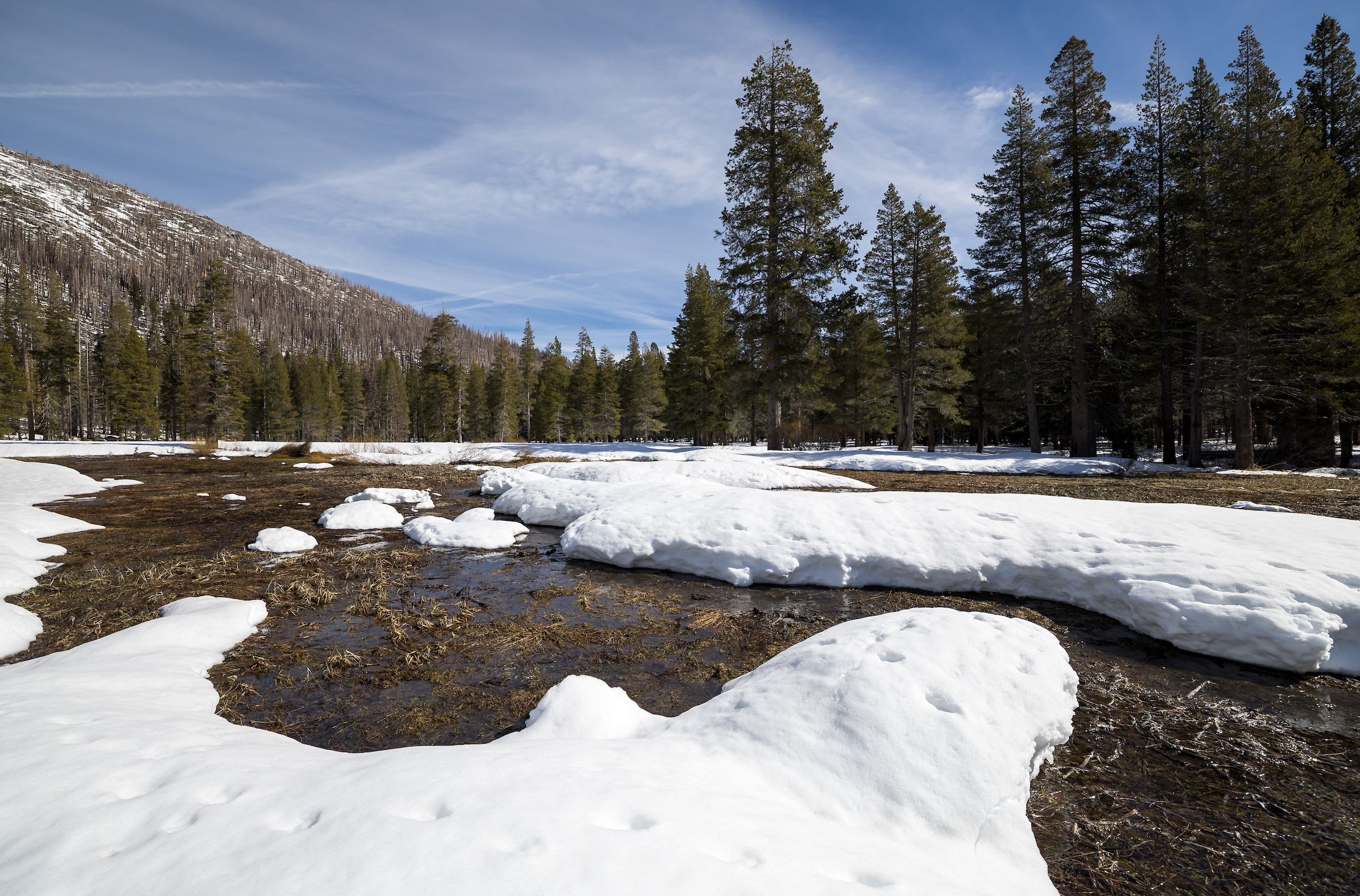
- February storms improved snowpack but totals remain below normal.
- Statewide snowpack measured about two-thirds of the seasonal average.
- Northern Sierra Nevada snow levels remain especially low.
- Reservoir storage across California remains above normal levels.
Tuesday, March 3, 2026 — A series of winter storms in February 2026 delivered a much-needed boost to California’s snowpack, though state water officials say the totals still fall short of what is normally expected at this time of year.
During the third snow survey of the season on February 27, 2026, the California Department of Water Resources measured conditions at Phillips Station in the Sierra Nevada. Surveyors recorded 28 inches of snow depth and a snow water equivalent of 11 inches. Snow water equivalent measures how much liquid water is contained in the snowpack and is a critical indicator used to forecast future water supplies.
The February 27 measurement represented about 47 percent of the long-term average for that location.
Across the entire Sierra Nevada, the statewide snowpack measured about 66 percent of average for the date.
Recent Storms Ended a Long Dry Stretch.
The improvement followed a string of cold winter storms that arrived in mid-February 2026. Those storms ended a five-week dry period that had significantly reduced snow accumulation earlier in the winter.
Andy Reising, manager of the Snow Surveys and Water Supply Forecasting Unit for the California Department of Water Resources, said the storms helped but did not close the gap.
“Although the storms we saw in mid-February were some of the coldest and best snow-producing storms we have seen since 2023, they were not enough to get us back to average conditions,” Reising said on February 27, 2026.
Reising noted that the snowpack improved compared to the previous month, but the winter accumulation season is nearing its end.
“The snowpack is in better shape than it was one month ago, but we only have a month left of our snow-accumulation season and time is rapidly running out to catch up,” he said. “Statewide, we are only about 57 percent of where we hope to be by April 1.”
Snowfall Uneven Across the Sierra Nevada.
Snowfall has not been evenly distributed across California’s mountain ranges this winter.
The Southern Sierra Nevada has accumulated about 90 percent of average snowpack for the date, while the Northern Sierra Nevada has reached only about 46 percent of normal levels.
That difference is important because several of California’s largest water supply reservoirs receive runoff from the northern part of the range.
A Changing Water Cycle.
State officials say California’s water supply is becoming increasingly dependent on a small number of large winter storms.
Karla Nemeth, director of the California Department of Water Resources, said the recent pattern highlights the challenges facing the state’s water system.
“Water supply in California increasingly depends on a small number of big storms,” Nemeth said. “We face higher drought risk when they do not arrive and greater urgency to modernize infrastructure to capture water when they do.”
Nemeth also noted that the winter has produced dramatic swings between wet and dry conditions, which scientists increasingly associate with rising temperatures and a changing climate.
Reservoir Storage Currently Above Average.
Despite the below-average snowpack, California’s major reservoirs remain in relatively strong condition.
As of late February 2026, statewide reservoir storage stood at about 122 percent of average for this time of year. Water managers say that strong storage levels provide an important buffer while the remainder of the winter season unfolds.
Water stored in the Sierra Nevada snowpack is one of the most important components of California’s water supply. On average, melting mountain snow provides about 30 percent of the state’s total water needs.
Because snow stores water naturally until spring and early summer, the Sierra Nevada snowpack is often referred to as California’s “frozen reservoir.”
Why Snow Surveys Matter.
The California Department of Water Resources conducts manual snow surveys each winter near Phillips Station, located in the Sierra Nevada. These surveys typically occur once a month between January and April.
The measurements help state water managers forecast runoff and determine how much water can be delivered through the State Water Project, which provides water to millions of people and large agricultural regions.
The next snow survey is scheduled for April 1, 2026, when snowpack levels historically reach their seasonal peak before the spring melt begins.
Image from the California Department of Water Resources.