
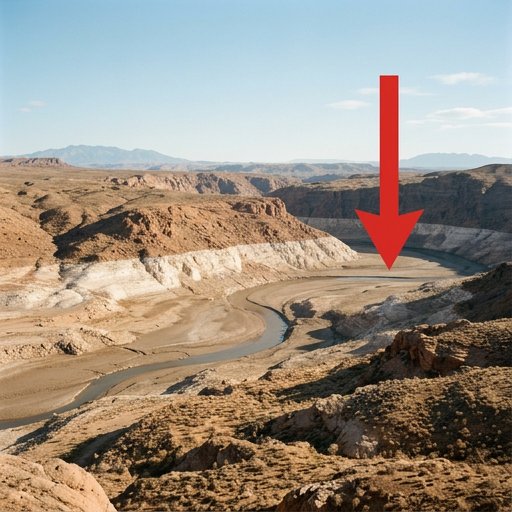
- March 1 water supply forecasts across the Colorado River Basin are well below normal.
- The winter of 2025–2026 was the warmest on record in many parts of the basin.
- Snowpack in several areas is the lowest seen since at least 1981.
- Warmer temperatures caused more winter precipitation to fall as rain instead of snow.
Tuesday, March 10, 2026 — The Colorado Basin River Forecast Center reported on March 1, 2026 , that seasonal water supply forecasts across much of the Colorado River Basin are well below normal. Snowpack and soil moisture are two of the most important factors determining how much water flows into rivers and reservoirs during the spring runoff season. Future weather remains uncertain, but current conditions suggest a difficult year ahead for water supplies across the basin.
The forecast region includes the Upper Colorado River Basin, the Lower Colorado River Basin, and the Eastern Great Basin. These areas feed many of the rivers and reservoirs that support communities, agriculture, and cities throughout the western United States.
Record Warmth and Unusual Weather Patterns.
The winter season from December through February during the 2025–2026 water year brought unusually warm conditions across much of the region. According to the March 1 discussion from federal forecasters, the winter was the warmest on record for large portions of the forecast area.
Some long-term weather stations, including those in Salt Lake City and Phoenix, recorded average winter temperatures about two degrees Fahrenheit higher than previous records. Persistent high pressure contributed to the warm and dry pattern, limiting the number of storms that reached the basin.
Earlier in the water year, however, conditions looked very different. During October 2025, several storms associated with weakening tropical systems delivered heavy rainfall to parts of Arizona, southern Utah, and southwest Colorado. Some locations experienced flooding and recorded one of the wettest Octobers on record.
Despite that early rainfall, precipitation totals since October have varied widely across the basin. Some areas have received above-normal precipitation, while others remain well below average.
Snowpack Conditions Near Historic Lows.
Snowpack in the Rocky Mountains serves as one of the most important sources of water for the Colorado River system. When temperatures rise in the spring, melting snow feeds streams and reservoirs across the West.
During the winter of 2025–2026, the combination of warm temperatures and limited snowfall produced what scientists describe as a snow drought. In many locations, precipitation that would normally fall as snow arrived as rain. Storm tracks also shifted away from the mountains that typically build the basin’s winter snowpack.
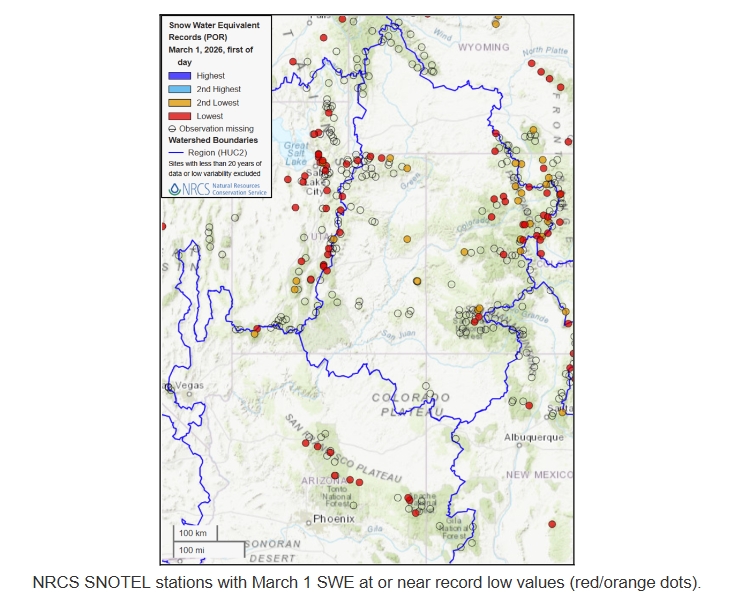
As of March 1, snow water equivalent, a measurement that estimates how much water is stored in the snowpack, ranged between roughly 40 percent and 90 percent of normal across the Upper Colorado River Basin. Several snow monitoring stations in western Colorado recorded levels at or near the lowest values observed in more than four decades.
One of the few areas with somewhat better conditions is the Upper Green River headwaters, where snowpack levels remain close to normal but still slightly below average.
Across Utah and the Great Basin, conditions are even more concerning. Many monitoring stations reported snowpack levels below the tenth percentile of historical records. Satellite observations also show that snow-covered area across the Upper Colorado River Basin is about 40 percent of the typical early-March coverage, the lowest level recorded since satellite measurements began in 2001.
Soil Moisture Shows Mixed Signals.
Soil moisture is another important factor affecting how much snowmelt becomes river flow.
When soils are dry, early snowmelt tends to soak into the ground before it reaches streams. When soils already contain moisture, runoff tends to move more efficiently into rivers and reservoirs.
According to the March 1 discussion, soil moisture levels during November 2025 were below normal across much of the basin after a warm and dry year. Over the winter months, conditions improved somewhat in several areas. Rainfall and partial snowmelt helped replenish moisture in some basins.
However, conditions remain uneven across the region. Soil moisture will continue to influence the timing and strength of the spring runoff season.
Weather Outlook for Early Spring.
Weather patterns in early March brought a small amount of additional snowfall to parts of the Upper Colorado River Basin. A cold low-pressure system moved through the region, producing modest precipitation and slightly cooler temperatures.
Forecasts beyond that period suggest a return to warmer and drier conditions across much of the West. Such conditions could limit further snow accumulation and may lead to earlier snowmelt in some mountain areas.
Why Snowpack Matters.
Mountain snowpack functions as a natural reservoir across the western United States. During winter, snow stores water that gradually melts during the spring and early summer months. This slow release of water supplies rivers, reservoirs, farms, and cities across the region.
When snowpack is low, rivers receive less runoff during the critical spring season. Water managers throughout the Colorado River Basin watch snowpack levels closely because they help determine how much water will be available for agriculture, communities, and environmental needs in the months ahead.
The March 1, 2026 water supply discussion highlights how temperature, precipitation patterns, and snowpack conditions together shape the water outlook for the Colorado River Basin each year.