
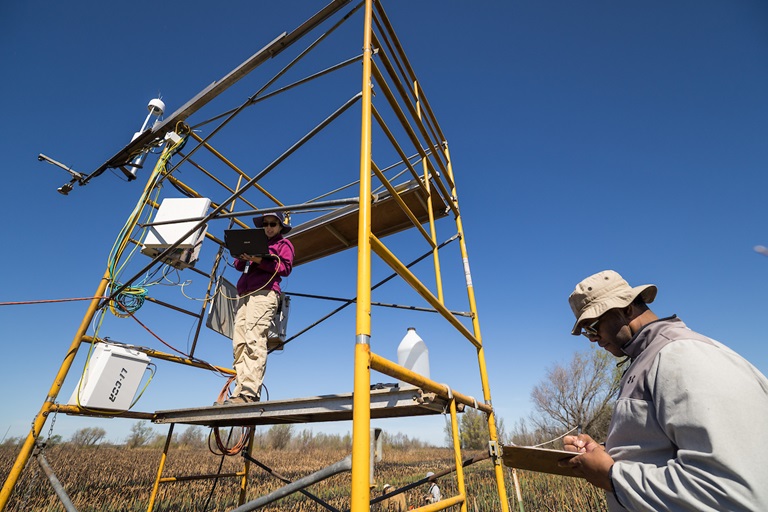
- A pilot burn at Twitchell Island tested cultural fire practices.
- Scientists are studying how wetlands can store more carbon.
- Restored wetlands may help slow land sinking and emissions.
- Carbon credits could create funding for long-term restoration.
Wednesday, April 29, 2026 — A new experiment in California’s Sacramento-San Joaquin Delta brought together scientists and Indigenous knowledge to test an old idea in a modern setting. A carefully planned burn on Twitchell Island is helping researchers understand how wetlands might store more carbon in the soil.
Before farming reshaped the Delta, the region was filled with wetlands. These wetlands followed a natural cycle. Plants grew, died, and returned to the soil. Fire, often set intentionally by Native communities, played a role in keeping that cycle healthy.
That balance changed in the late 1800s. Wetlands were drained and diked for agriculture. The soil, rich in peat, was exposed to air. Over time, it began to break down, releasing carbon dioxide and causing the land to sink.
Why Fire Is Being Studied Again.
The recent burn is part of a growing effort to bring back natural processes . Cultural burning removes dead plant material and encourages new growth. It also creates a layer of char in the soil, which may help trap carbon over time.
Researchers believe that while fire releases some carbon in the short term, the stronger plant growth that follows could pull more carbon out of the atmosphere in the long run.
This idea is rooted in Traditional Ecological Knowledge. Indigenous communities have used fire as a land management tool for thousands of years. Now, scientists are studying how those practices can fit into modern climate strategies.
Measuring What Happens Below the Surface.
To understand the impact, scientists are collecting soil samples before and after the burn. These samples are taken at different depths and tested for carbon and nitrogen levels.
By comparing burned and unburned areas, researchers hope to see whether fire improves the soil’s ability to store carbon over time.
The work also looks at another issue tied to the Delta. As peat soils break down, the land sinks. Restoring wetlands and rebuilding organic soil could help slow or even reverse that process.
A Possible Economic Angle.
There is also a financial side to this work. Projects that remove carbon from the atmosphere can generate carbon credits. These credits can be sold to companies looking to offset emissions.
If Delta wetlands prove effective at storing carbon, they could become part of this market. That could bring in funding for restoration and long-term maintenance.
However, the success of that model depends on reliable data and strong demand for credits. Researchers are still in the early stages of understanding how well these systems work.
Looking at Indigenous Practices.
The pilot burn at Twitchell Island is only a first step. It brings together scientists, state agencies, and Indigenous practitioners to study how land once managed by tradition might help address modern environmental challenges.
The Delta has changed greatly over the past 150 years. This effort suggests that some of the answers may lie in practices that existed long before that change began.
Image via California Department of Water Resources: California State University, East Bay, research technician Daphne Szutu (left), and graduate student research assistant Brandon Broach — both with the Department of Earth, Environmental and Sustainability Sciences — gather data from eddy covariance flux towers as colleagues take core samples of biomass on Twitchell Island after a pilot-scale burn coordinated by Division of Multibenefit Initiatives scientists on land managed by the California Department of Water Resources in the Sacramento-San Joaquin River Delta, Sacramento County. Photo taken March 11, 2026.