
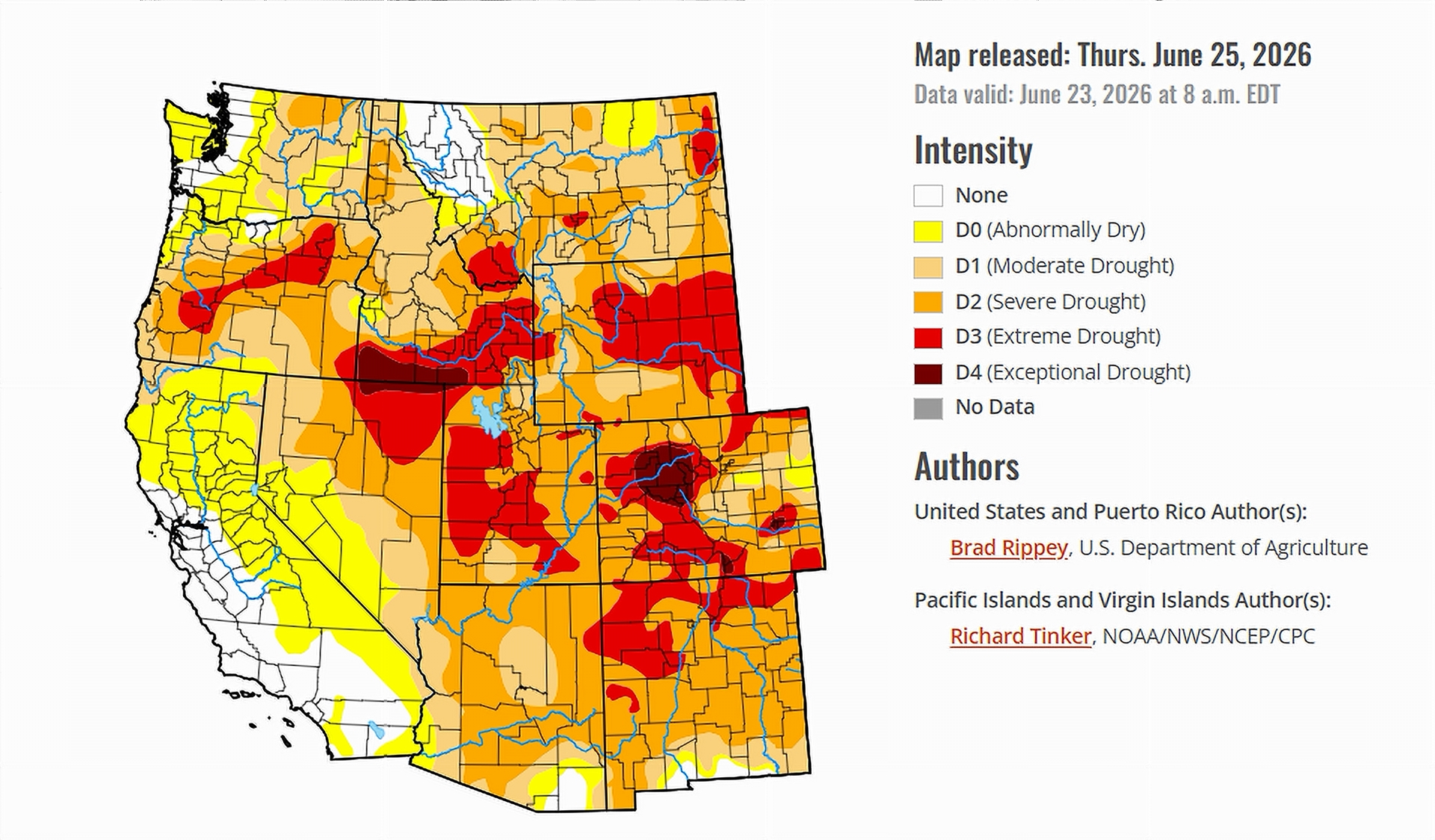
- Hot, dry weather has deepened drought across much of the seven Colorado River Basin states, straining water supplies and pushing wildfire danger to elevated levels.
- By June 24, at least five large active wildfires had burned more than 10,000 acres each across Utah and Nevada alone.
- Federal agriculture data show that rangeland and pastures are rated 75% very poor to poor in Arizona — the worst figure reported among Western states in this week’s drought assessment.
- Little relief is on the horizon for California and the Desert Southwest, with forecasters calling for drier-than-normal conditions across the Great Basin and portions of the Intermountain West through early July.
Saturday, June 27, 2026 — The American West is no stranger to summer heat, but the conditions gripping the Colorado River Basin this week are drawing serious attention from water managers, ranchers, and fire crews alike.
According to the June 25, 2026, U.S. Drought Monitor report , hot and mostly dry weather has dominated the western United States, fueling heavy irrigation demands and pushing wildfire risk to broadly elevated levels. Drought has worsened across roughly the northern half of the West, where significantly above-normal temperatures and mounting water-supply concerns have compounded an already difficult situation.
The report notes that water supplies in the region are highly basin-dependent and often complicated by water rights and other local, state, or regional regulations — a familiar reality for anyone who follows Colorado River policy.
Extreme Drought Stretches Into the Four Corners.
Some of the most severe drought conditions in the country are now concentrated in the West. The Drought Monitor report identifies a broad zone of extreme to exceptional drought — rated Extreme Drought (D3) to Exceptional Drought (D4), the two most severe categories on the five-point scale — stretching from Oregon to Wyoming and southward into portions of the Four Corners states, a region that includes Arizona, Colorado, New Mexico, and Utah.
That swath cuts directly through the heart of the Colorado River Basin.
Wildfires Spread Across Utah and Nevada.
The drought’s most visible consequence this week has been fire.
By June 24, at least half a dozen active Western wildfires had each burned more than 10,000 acres of vegetation. Three of those fires were burning in Utah, and two were in Nevada — both Colorado River Basin states. (This information is based on the Drought Monitor Report. See our updated wildfire report published this morning.)
The week’s most significant blaze was the Iron Fire, located near Eureka, Utah. It ignited on June 19 and rapidly consumed more than 37,000 acres of grass and chaparral, according to the report. The speed and scale of that fire reflect just how dry and combustible the landscape has become after weeks of hot, rainless weather.
Rangelands Are Struggling.
The drought’s toll on the land is equally stark when measured in agricultural terms.
The U.S. Department of Agriculture, as cited in the Drought Monitor report, assessed statewide rangeland and pasture conditions as of June 21. The numbers paint a grim picture across the basin:
-
In Arizona, 75% of rangeland and pastures were rated very poor to poor — the highest such figure reported among any Western state in this assessment.
-
In Colorado, 63% of rangeland and pastures carried that same very poor to poor rating.
-
In Wyoming, 60% of rangeland and pastures were rated very poor to poor.
Colorado’s struggles extended to its winter wheat crop as well. Some 63% of that crop was rated very poor to poor, reflecting the cumulative damage from an extended dry period. The report also notes that drought conditions have continued to worsen in parts of both Colorado and Wyoming.
What’s Ahead for the Basin.
There is some reason for cautious optimism in the northern reaches of the West. The Drought Monitor’s forward-looking section notes that markedly cooler air is expected to sweep across the region, with increasingly showery weather developing from the Pacific Northwest down to the northern Rocky Mountains.
However, that relief is not expected to reach much of the Colorado River Basin. The report specifically states that dry weather will continue across much of California and the Desert Southwest in the coming days.
Looking further out, the National Weather Service’s six- to ten-day outlook, covering June 30 through July 4, calls for below-normal temperatures across much of the West — a welcome shift after weeks of punishing heat. But the same outlook projects drier-than-normal conditions for the Great Basin and portions of the Intermountain West, suggesting that meaningful drought relief for the core of the Colorado River Basin is not yet on the horizon.

 wpDiscuz