
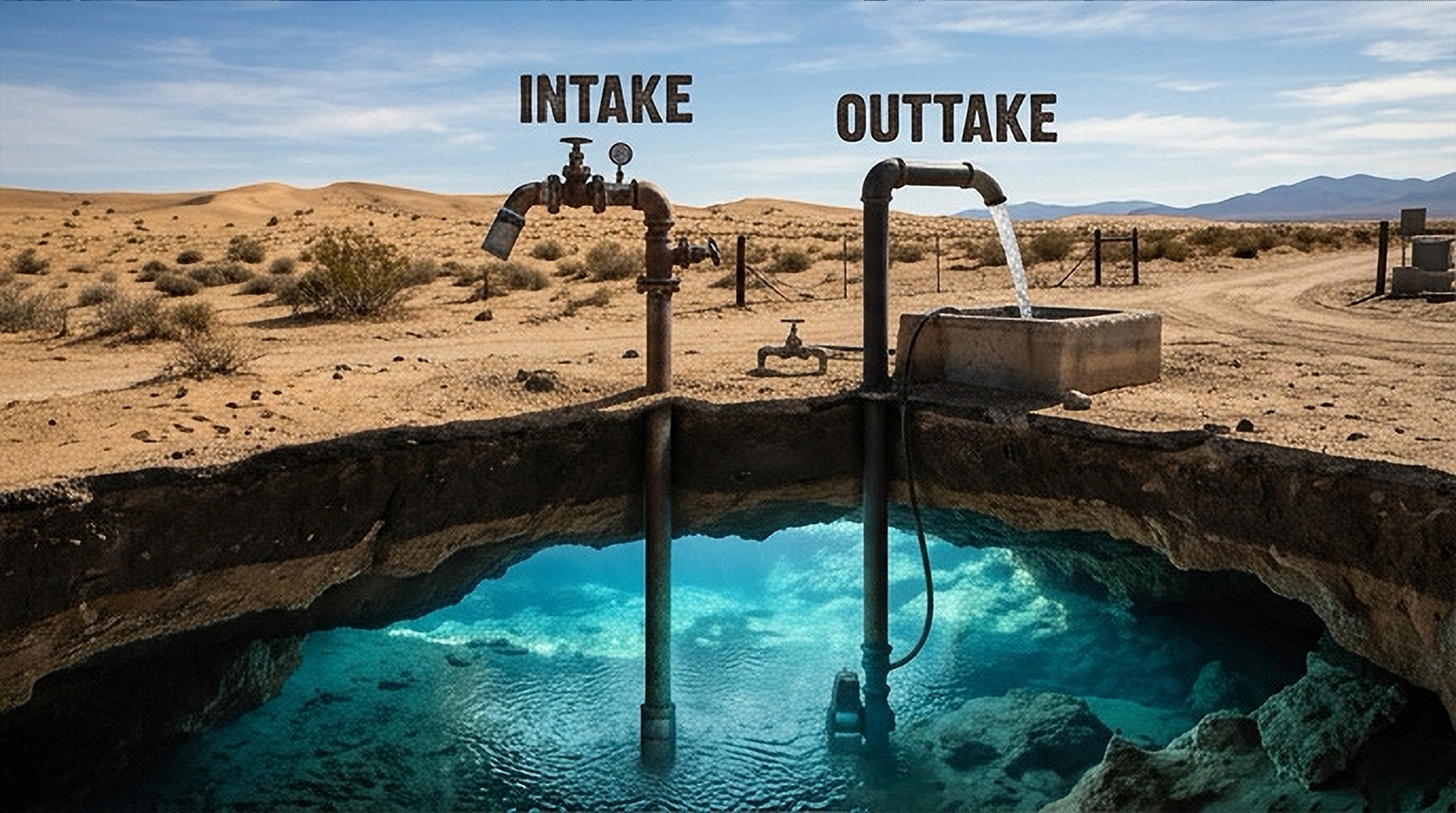
- A new study finds water banking can ease droughts but cannot guarantee full supplies.
- How well an aquifer holds water shapes how much can be pulled back out later.
- Rules in many places ignore that natural retention rate.
- Case studies span Arizona, California, and Australia, with records up to 67 years.
- Short recovery time limits can weaken banking as a drought tool.
Tuesday, August 11, 2026 — Storing water underground during wet years can soften the blow of drought, but it cannot promise a full supply when a dry spell drags on. That is the central finding of a study published in the August 2026 issue of the journal Groundwater for Sustainable Development. The University of Arizona Water Resources Research Center announced the research on August 7, 2026, last week.
The paper was co-authored by Sharon B. Megdal, director of the Water Resources Research Center, and by Rebecca Bernat, the recently appointed executive director of the Arizona Water Banking Authority. The lead author is Peter Dillon of Flinders University in Australia, working with a team from the United States and Australia.
A Savings Account Made of Water.
The study looks at a practice called managed aquifer recharge. In plain terms, that means deliberately putting water into the ground when supplies are plentiful. An aquifer is an underground layer of rock, sand, and gravel that holds water, a little like a giant sponge.
Water banking takes that idea a step further. Instead of storing water for just a few months, a water bank saves it underground for years. When a drought hits, the operator pulls the water back out. The paper compares this to a household savings account, or to a home solar battery that keeps a reserve for a power outage.
There is one key difference the authors point out. A family owns its battery outright. An aquifer, by contrast, is a shared resource, so a water bank needs clear legal rules to make sure the stored water can be recovered later.
Two Numbers Behind the Bank.
The research centers on two figures that decide how much banked water an operator can claim.
The first is a policy number, set by people. It is the share of the recharged water that the rules allow an operator to recover. Managers can raise or lower it. The paper labels this value alpha.
The second is a natural number, set by the ground itself. It measures how much of the stored water an aquifer holds onto each year, rather than letting it drain away to streams or leak into other aquifers. The paper labels this value beta, and calls it the aquifer’s retention rate.
Here is the catch the study highlights. A review of current rules found that storage retention, the beta value, is not written into the credit rules in any of the places examined. In other words, the natural leakiness of the ground often goes uncounted, even though it can decide whether the water is really there when a drought arrives.
Where the Rules Fall Short.
The researchers ran a simple spreadsheet model on one made-up example and four real water banks. Records for those sites stretch as far back as 67 years, and all of them show signs of a changing climate.
One problem the study flags is time limits. Some places cap how long a stored credit can be held before it expires. Several Australian jurisdictions set that window at only one to four years. According to the paper, such short windows can quietly turn a drought reserve into a yearly balancing act, which removes much of the reason to bank water in the first place.
As the authors put it, water banking is “not failsafe under a non-stationary climate.” A non-stationary climate simply means the weather patterns of the past are no longer a reliable guide to the future.
Lessons From Five Water Banks.
In the made-up example, the model tested a steadily drying climate. When yearly recharge fell by two percent each year, the bank ran dry within 20 years no matter which policy was used. When the decline was gentler, at one percent a year, the bank held on. The study concludes that “no recovery policy can compensate for prolonged lack of recharge,” and adds that “it takes time for a water bank to build reserves to weather a drought.”
The four real sites showed how much the ground matters.
In Salisbury, South Australia, the City of Salisbury built a system in 2003 that captures stormwater and injects it into a brackish limestone aquifer. Monitoring showed the aquifer held onto only about 84 percent of its stored water each year. The study found the site works well for short-term, within-year storage, but not as a long-term water bank.
In Perth, Western Australia, highly treated recycled water is banked in a large, tightly sealed freshwater aquifer. There, pairing water banking with seawater desalination cut costs by 31 to 37 percent compared with desalination alone.
The Arvin Edison Water Bank in California’s Central Valley was built in 1966. It sits in a closed basin, which means stored water stays put. Its underground savings climbed to a peak of about 1.09 cubic kilometers around the year 2000, then fell to roughly 0.57 cubic kilometers by 2023 as severe droughts came more often. The model showed that if this aquifer had been even slightly leakier, little or no bankable water would have remained.
In Arizona, water banking helps manage Colorado River supplies. About 36 percent of the water used in Arizona comes from the Colorado River. Groundwater pumping had drawn the state’s aquifers down by roughly 60 cubic kilometers by the late 1970s. After the Central Arizona Project aqueduct was completed in 1993, the state built up underground reserves. Between 1989 and 2021, about 11.0 cubic kilometers of water soaked into the ground at the state’s 104 underground storage facilities, about 4.1 cubic kilometers were pumped back out, and about 6.9 cubic kilometers stayed stored as credits. The Arizona Water Banking Authority, created in 1996, holds about 2.4 cubic kilometers of those credits. The study reports that only about five percent of the credits have been recovered so far, partly because water users across the Lower Colorado River Basin, which includes Arizona, conserved 3.76 cubic kilometers of water between 2023 and 2025.
A Drier Future Raises the Stakes.
The study describes a pattern seen across many semi-arid areas of the western United States and Australia. Average rainfall is falling in drier regions, and hotter temperatures pull more moisture out of the soil. That combination cuts the amount of water that naturally seeps down to refill aquifers.
At the same time, the heaviest rainstorms are getting stronger. That gives operators occasional big chances to capture floodwater and steer it underground. The authors note that aquifers, unlike open reservoirs, do not lose water to evaporation, which makes them attractive places to park water during a drying climate.
What the Researchers Suggest.
The authors offer several ideas for water managers, framed as suggestions rather than firm rules.
They recommend favoring sites where aquifers are known to hold water well and are kept separate from streams, when the goal is long-term storage. They suggest setting clear reliability targets for drought supply. And they call for crediting rules that can be updated as monitoring reveals how an aquifer actually behaves over time.
The paper also draws a distinction between public and private water banking. Where water that leaks out of an aquifer flows into streams and benefits the wider environment, the authors write, publicly funded banking has advantages over private banking, which focuses only on the credits an operator keeps.
The study stops short of predicting any single outcome. Its bottom line is that water banking can shift water from wet times to dry times and buffer droughts, yet its success rests on the ground beneath each site and on rules that reflect how that ground works.
Citation.
Dillon, P., Scanlon, B.R., Bernat, R., Gonzalez, D., Seidl, C., Page, D., Doble, R., Radcliffe, J., Hutchinson, A., and Megdal, S.B. (2026). Testing water banking recovery policies to secure drought water supply in semi-arid areas with a changing climate. Groundwater for Sustainable Development, Volume 34, Article 101661. https://doi.org/10.1016/j.gsd.2026.101661
The image is an AI-generated image to visualize the concept of water banking.



 wpDiscuz