
- Lake Mead’s stored water fell below 7 million acre-feet, the lowest level in records that go back to 1937.
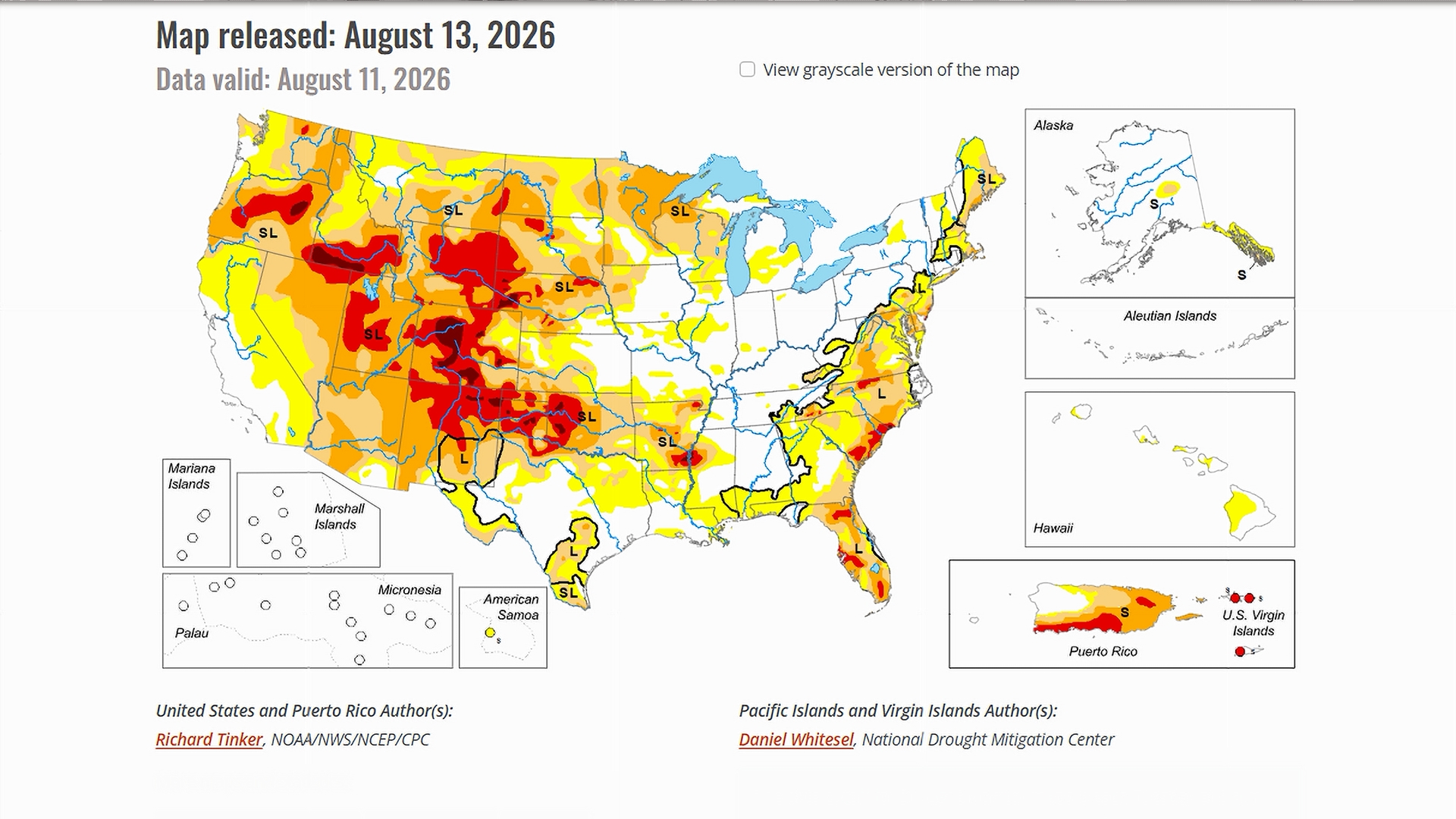
- Extreme and exceptional drought now covers a large part of Utah and the nearby Great Basin.
- Colorado and Wyoming face severe to exceptional drought, and their rangelands are badly stressed.
Saturday, August 15, 2026 — The latest United States Drought Monitor shows a country divided by rainfall. Heavy storms soaked the eastern part of the nation over the past week. Parts of Indiana, Ohio, West Virginia, and Pennsylvania picked up more than 2 inches of rain, and a few spots recorded 5 to 7 inches. Those rains eased dry conditions across much of the East.
The story was different farther west and south. Drought spread and deepened across Oklahoma, the Texas Panhandle, and the northern Plains. Parts of New Hampshire and Maine also grew drier. Across the western states, little rain fell, and long-running drought held firm.
Dry Conditions Hold Across the West.
The seven states that share the Colorado River Basin are Arizona, California, Colorado, Nevada, New Mexico, Utah, and Wyoming. Most of this region stayed locked in drought last week.
The summer monsoon brought the only real relief. Much of Arizona and New Mexico received between half an inch and 3 inches of rain. Farther north, Utah and the Great Basin saw just a few tenths of an inch, with a few isolated spots topping an inch. The rest of the western states stayed dry.
Even with the monsoon rain, the overall drought picture changed little. Extreme drought (D3) and exceptional drought (D4), the two most severe categories the Drought Monitor uses, are common across a large section of Utah and the nearby Great Basin. Heat has made matters worse. Over the past 30 days, temperatures in Utah and parts of the Southwest averaged 4 to 8 degrees above normal.
The strain shows up on farms and ranches. In Utah, 33 percent of the winter wheat crop is in poor or very poor shape, compared with a five-year average near zero. Across Arizona, New Mexico, and Utah, one-half to three-quarters of rangelands are rated poor or very poor, well above the usual level for this time of year.
Colorado and Wyoming Feel the Heat.
Conditions are also harsh across Colorado and Wyoming. Higher elevations in Colorado caught more than half an inch of rain last week, with a few heavier pockets. Outside those high country areas, though, most of both states saw well below normal rain over the past month.
Large sections of Colorado and Wyoming now sit in severe drought (D2) through exceptional drought (D4), the harshest category. The worst conditions fall across parts of Colorado. Heat has piled on here too. Over the past 30 days, temperatures ran 6 to 9 degrees above normal across central and western Colorado and western Wyoming, with the biggest jump in western Wyoming.
Ranchers are feeling the squeeze. In Colorado, 64 percent of pastures and rangelands are in poor or very poor condition, more than double the five-year average of 23 percent. In Wyoming, that figure climbs to 75 percent, against a five-year average of 38 percent. Colorado crops are struggling as well, with 46 percent of corn and 57 percent of sorghum rated poor or very poor.
Lake Mead Reaches a New Low.
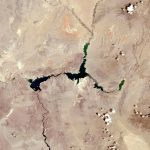
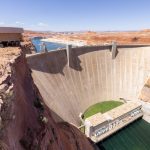
Years of below normal precipitation have drained some of the West’s largest reservoirs. Lake Mead, one of the biggest reservoirs in the West, now holds the least water on record since daily tracking began in 1937. By August 10, its storage slipped below 7 million acre-feet. The reservoir can hold more than 28 million acre-feet when full.
What Forecasters Expect Next.
The outlook offers a few bright spots for the basin. Around the middle of the month, forecasters expected moderate to heavy rain across the Colorado Rockies and scattered parts of the Four Corners region and the Great Basin. The heaviest totals, 3 inches or more, were expected over the northeastern quarter of Colorado. Lower elevations across the Great Basin and the central and southern Rockies were likely to stay mostly dry.
Cooler air was also on the way. Daily high temperatures were forecast to run 3 to 6 degrees below normal across much of California and the Great Basin. Looking about a week further out, the Drought Monitor favored above normal rainfall from the Rockies to the West Coast. Even so, warmer than usual weather was expected to cover most of the country, with the central West Coast and the nearby Great Basin among the few exceptions.

 wpDiscuz