
- A Napa County Civil Grand Jury report released June 24, 2026, found that water rates in St. Helena rose roughly 183% between 2011 and 2025, yet the water system continued to worsen.
- Water leaving the Bell Canyon Water Treatment Plant tests clean, but it arrives at customer taps with persistent taste, odor, and color problems.
- The grand jury identified decades of deferred maintenance, chronic leadership turnover, and poor governance as primary drivers of the city’s water troubles.
- A five-year capital improvement plan identifies more than $51 million in needed water projects, but nearly 39% of that funding has not yet been secured.
- The city acknowledges the report’s concerns while pointing to millions of dollars already invested in recent infrastructure improvements.
Wednesday, July 1, 2026 — Nestled in the heart of California’s Napa Valley wine country, the city of St. Helena is known for its rolling vineyards, upscale dining, and small-town charm. But for many of its roughly 5,200 residents, turning on the tap has become a source of frustration rather than confidence. The water coming out sometimes looks discolored, smells strange, or tastes off — and it has for years.
Last week, a formal investigation confirmed those frustrations have roots that go far deeper than a few broken pipes.
The 2025-2026 Napa County Civil Grand Jury released its final report on June 24, 2026, titled “Lapsed Leadership: St. Helena’s Problematic Pipes and Murky Waters.” The report describes a water system battered by decades of neglected maintenance, shaky leadership, and money that was promised to fix problems but never quite got there.
What the Grand Jury Actually Found.
The grand jury is a group of citizen volunteers authorized under California law to investigate local government operations. Over the course of its investigation, jury members interviewed city officials, toured water facilities firsthand, reviewed years of financial records, and attended community meetings.
What they found was not a single villain or a single catastrophic failure. It was something slower and perhaps more troubling: a long pattern of poor decisions piling up over time.
“No one person, department, or entity is the sole culpable party,” the report states . “Dysfunctional conflict has prohibited much-needed progress.”
The investigation was sparked by a complaint filed by a St. Helena resident who reported persistent taste, odor, and color problems with their drinking water. That complaint was backed up with photographs, news articles, and social media posts. The grand jury noted it was not the first time these issues had been formally examined. A previous Napa County Civil Grand Jury also investigated St. Helena’s water troubles back in 2018-2019.
Clean at the Plant, Dirty at the Faucet.
One of the report’s key findings is a puzzling disconnect in the water delivery chain. Jury members physically toured the Bell Canyon Water Treatment Plant — the facility where raw water is treated before being sent to homes and businesses — and verified that the water coming out of that plant is “clean, clear, and healthy.”
The problem, investigators believe, is what happens after the water leaves the plant and travels through nearly 46 miles of aging underground pipes to reach customers. City staff and engineering consultants now suspect that decades of accumulated silt, debris, and sediment sitting inside those old pipes is the main culprit behind the taste, odor, and color complaints.
In other words, the water is being treated properly. It is the delivery system — the mains and pipes running beneath the streets — that appears to be contaminating it.
Despite this, the grand jury found that the city’s approved list of capital improvement projects — the official plan for spending money on infrastructure repairs — contains no projects specifically dedicated to rehabilitating that underground pipe network. No formal assessment of the scope or severity of the pipe problems has ever been completed. Without such an assessment, the city has no solid estimate of what repairs would cost or how long they would take.
Rates Went Up. Infrastructure Did Not.
Perhaps the most stinging part of the grand jury’s findings involves money. Between 2011 and 2025, St. Helena’s water rates increased by approximately 183%. To put that in plain terms, a customer paying $100 per month for water in 2011 was paying close to $283 per month by 2025.
Those rate increases were approved by the City Council in 2011, 2016, and 2023, each time with promises that the money would be used to fix the aging water system. The grand jury found that many of the same capital improvement projects were cited as justifications in all three rate studies — yet most of those projects were never started, let alone finished.
The 2011 water rate study acknowledged as much at the time, noting in plain language: “because of the City’s desire to keep the required water rate increase to the level needed to meet debt covenants, not all the planned capital improvement programs will be funded during the planning period.”
By August 2023, the situation had become critical enough that the then-City Manager declared a formal “State of Emergency” for St. Helena’s water system. Reserves were nearly depleted. Debt coverage requirements were not being met. A major new round of rate increases was approved, with rates set to climb an additional 8% annually through fiscal year 2027-2028.
Looking ahead, a five-year capital improvement plan covering fiscal years 2026 through 2030 identifies over $51 million in water-related projects. However, nearly 39% of the funding needed to pay for those projects has not yet been identified.
The Revolving Door Problem.
The grand jury spent considerable time examining why so many promised projects never got done. A major part of the answer, investigators concluded, lies in relentless turnover at the top of city government.
Between 2011 and 2026, St. Helena cycled through 19 different City Council members across eight election cycles, 8 City Managers (three of them serving in interim roles), and 5 Public Works Directors. As of June 24, 2026, the city was in the process of hiring yet another City Manager.
The churn does not stop there. Approximately 60% of the Public Works Department employees have less than five years on the job. Every single employee currently working within the St. Helena Water Enterprise has been there for less than three years.
When people leave so quickly, they take institutional knowledge with them. There is no one left to remember why certain decisions were made, what projects were started, or where the documentation was filed.
The grand jury attributed the instability to a mix of factors: high cost of living in the Napa Valley, competition from nearby municipalities offering better pay and career opportunities, and a climate of “dysfunctional conflict” within the City Council itself. The report notes that several council members faced scrutiny over potential conflicts of interest tied to personal and business relationships. One council member was removed from office for lack of attendance as recently as April 2026.
The grand jury also found that, beyond mandatory ethics and open-meeting law training, there is no formal governance training required or offered to City Council members or senior city management. Jury members pointed to the League of California Cities’ Mayors and Council Members Academy as one option that could help fill that gap.
Outside Customers, Inside Costs.
The report also flags a lesser-known financial issue: the city provides water to more than 30 customers located outside of its city limits, under agreements known as Outside Service Area Agreements. These customers — a mix of residential and commercial users that includes well-known properties like Meadowood Resort — collectively account for roughly 24% of St. Helena’s total annual water consumption, or about 302 acre-feet of water per year (equal to nearly 98.6 million gallons).
Before 2016, those outside customers paid surcharges to offset the extra cost of delivering water to them, particularly those located at higher elevations where pumping water requires more energy and expense. In 2016, the City Council voted to eliminate those surcharges, effectively spreading those extra costs across all water customers, including people living inside the city limits who had no say in the matter.
The grand jury also raised concerns about Measure H, a bond measure passed by St. Helena voters in June 2022 that authorized up to $19.15 million in bonds to pay for infrastructure repairs. The cost of repaying those bonds — roughly $14.82 per $100,000 of assessed property value annually — falls only on properties located within city limits. Outside service area customers benefit from the infrastructure improvements funded by those bonds but bear none of the repayment burden.
Similarly, the report notes that a water tank known as the Holmes Tank — a large, aging concrete structure that requires significant ongoing maintenance — serves just six households, all of them at high elevation. The extra costs of maintaining that tank are currently spread across all water customers rather than charged specifically to those six households.
The City’s Response.
The City of St. Helena issued a public statement last week acknowledging the report and accepting its core premise.
“The report raises legitimate concerns about the City’s aging water distribution system and reinforces what the City has consistently acknowledged: significant work remains to modernize aging infrastructure, improve water quality, and ensure long-term system reliability,” the city stated.
At the same time, city officials pushed back on what they described as an incomplete picture. Officials pointed to a list of recent investments they said the report did not fully recognize, including construction of a new $18.8 million Membrane Bioreactor Wastewater Treatment Facility, installation of advanced filtration technology at the Water Treatment Plant, modernization of the city’s water monitoring and control systems, and deployment of nearly 3,000 smart water meters.
City officials also noted that a high-velocity water main flushing pilot program was launched in June 2026 to begin clearing decades of accumulated sediment from the distribution pipes, a direct response to the very problem the grand jury identified.
Interim City Manager Jim McCann addressed both the criticism and the progress in a public statement.
“The Civil Grand Jury’s report raises important issues that deserve thoughtful consideration,” McCann said. “We welcome constructive oversight and share the goal of providing the highest quality water service possible. We also believe it is important for the public to understand the significant work that has already been completed, the measurable improvements already achieved, and the substantial investments that address longstanding deficiencies in our water system.”
What Happens Next.
The grand jury’s report includes five formal recommendations, each with a specific deadline. The City Manager has been asked to complete a comprehensive assessment of the underground pipe network and report the findings to the City Council by September 30, 2026. A full plan to address the failing distribution system, including project costs, funding sources, and a timeline, is due by December 31, 2026. The city has also been asked to expand its customer complaint tracking system to produce quarterly data reports, implement a rate structure that charges different rates based on customer type and location, and require governance training for council members and senior management.
Under California law, the St. Helena City Council has 90 days from the report’s release to submit a formal written response to each finding and recommendation.
In the meantime, the city has pledged to continue a series of public meetings called “Water Table” discussions, which began in March 2026 at the St. Helena Public Library. Those sessions allow residents to hear directly from city staff and technical experts, ask questions, and stay informed about water system projects and progress.
The full report is available through the Napa County Superior Court website.
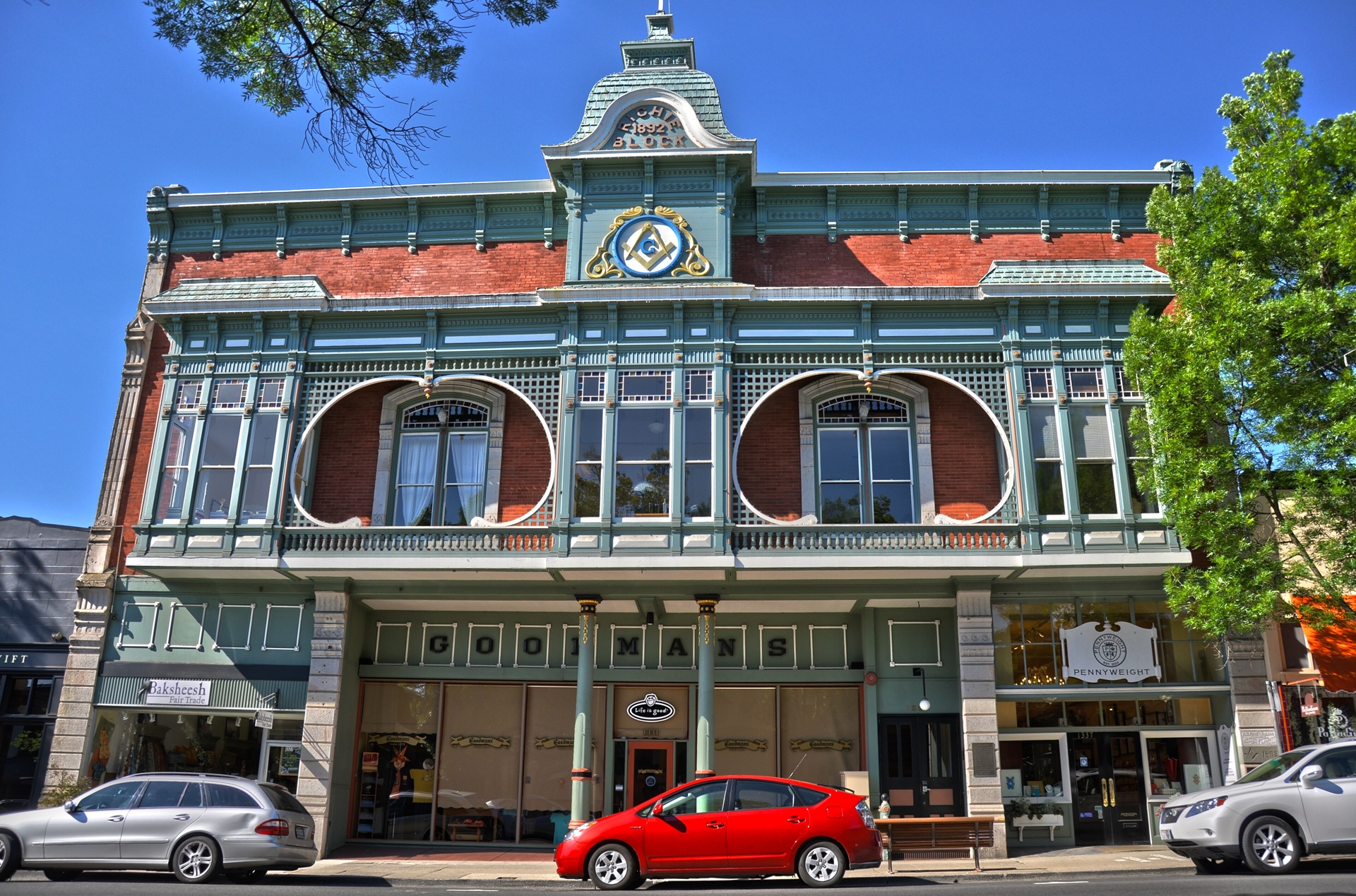
Pictured: The Richie Block building in St. Helena, September 2014 by M. Licensed under the Creative Commons Attribution-Share Alike 4.0 International license.