
- A 94,000-acre wildfire near Beaver, Utah, stands as the largest of more than a dozen active Western fires that have each burned more than 10,000 acres.
- Three federal firefighters lost their lives on June 28 in the Knowles Fire burning west of Grand Junction, Colorado.
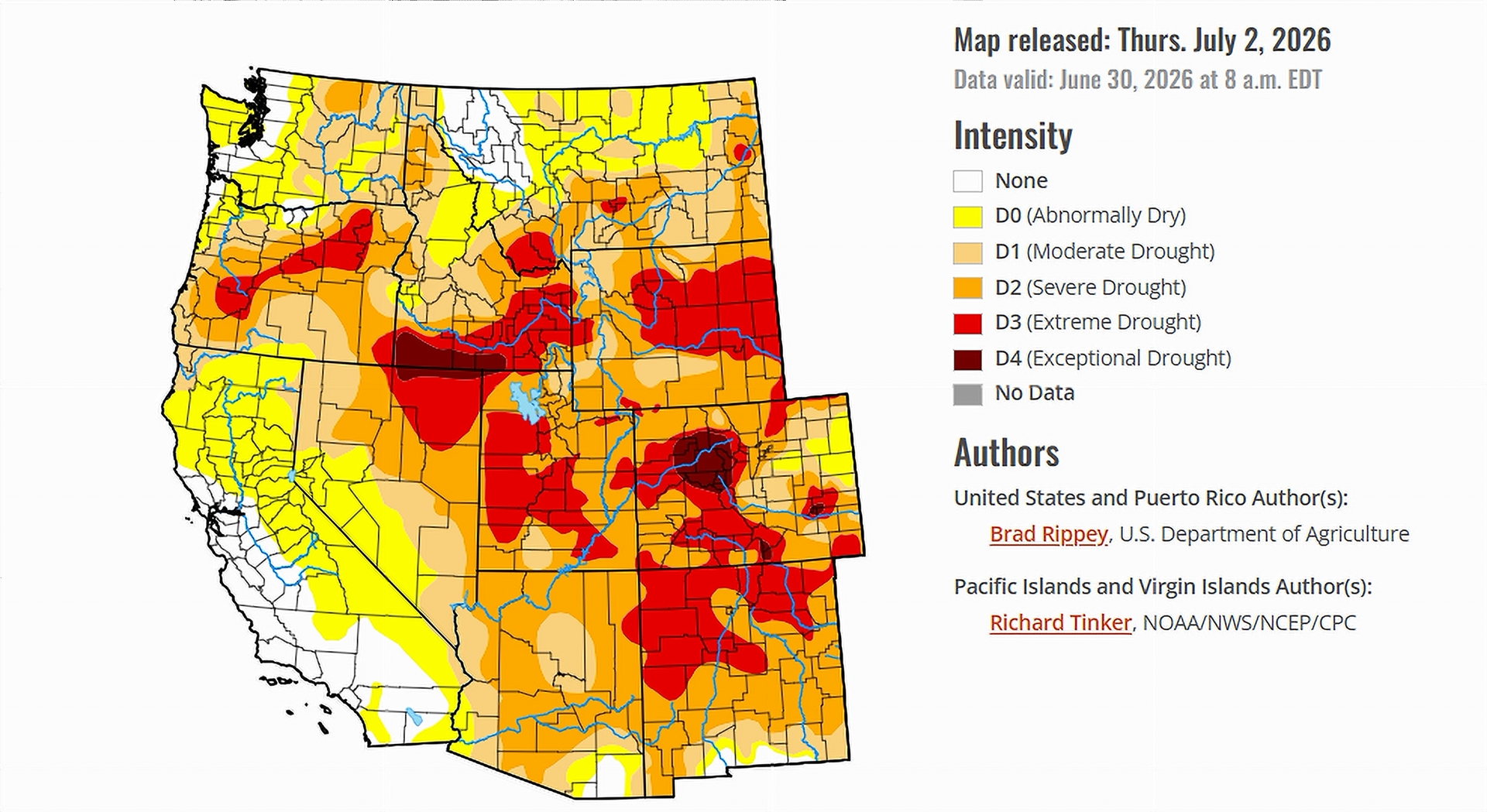
- Extreme drought expanded across the northern half of New Mexico as conditions across the Four Corners region continued to deteriorate.
- Colorado reported the most stressed agricultural soils in the West, with 89 percent of the state’s topsoil rated very short to short on moisture.
Saturday, July 4, 2026 — For much of the country this past week, rain was the headline — sometimes far too much of it. Heavy downpours from the southern Plains into the Ohio and Tennessee Valleys brought flash flooding, swollen rivers, and at least five flood-related deaths in Kentucky and Tennessee. The southern Midwest logged soil moisture surpluses. Corn and soybeans were thriving across the heartland.
But travel west of the Rockies and the story flips entirely.
While the eastern half of the nation was wringing out, the West was burning. Fueled by record-dry vegetation, low humidity, and gusty winds, wildfires spread rapidly across portions of the eastern Great Basin and the Four Corners States — the rugged intersection of Utah, Colorado, Arizona, and New Mexico that sits at the geographic heart of the Colorado River Basin. According to the U.S. Drought Monitor report released  on July 2, 2026, more than a dozen active Western wildfires had each scorched more than 10,000 acres by the close of June.
Fire and Grief in the Basin.
The largest blaze is the Cottonwood Fire, burning near Beaver, Utah, which has consumed roughly 94,000 acres. It is a sobering number — an area larger than many American cities reduced to ash and char.
More sobering still is what happened on June 28 west of Grand Junction, Colorado. Three federal firefighters perished in the Knowles Fire, a loss that underscores the life-or-death stakes of fighting blazes in extreme drought conditions. Dry thunderstorms, record-setting fuel dryness, and erratic wind patterns made the fires across the region particularly dangerous and difficult to contain.
The Drought Monitor report notes that fire ignition and spread were aided by a combination of factors: near-record to record-setting dry fuels, low humidity, and gusty winds that arrived during a volatile weather transition — a brief but dangerous window as the region shifted from a prolonged stretch of hot, dry weather to cooler conditions.
Drought Deepens Across the Basin States.
The wildfire danger does not exist in a vacuum. It is the visible surface of something much deeper: a drought that has been tightening its grip across the Colorado River Basin for months.
The Drought Monitor’s latest update documents worsening conditions in the Four Corners States, with a notable expansion of extreme drought, the second-most severe category on the five-point scale, across the northern half of New Mexico. That represents a significant deterioration for a state already under considerable stress.
The agricultural data tells a stark story. According to the U.S. Department of Agriculture figures recorded June 28, Colorado led the West in soil moisture distress, with 89 percent of the state’s agricultural topsoil rated very short to short on moisture. Wyoming followed at 81 percent, Utah at 69 percent, New Mexico at 68 percent, and Nevada at 65 percent. These are not minor shortfalls. They represent conditions in which crops struggle, livestock operators face hard decisions, and water managers watch reservoir levels with growing unease.
The land itself is in rough shape. Arizona reported 70 percent of its rangeland and pastures in very poor to poor condition. Colorado came in at 63 percent. For ranchers and farmers across the basin, those numbers translate to thin grazing, higher feed costs, and reduced herd sizes.
A Brief Cool Spell, but Little Relief.
A change in weather patterns late in the monitoring period brought cooler temperatures to the West and delivered meaningful precipitation — including high-elevation snow — to parts of the Northwest, particularly central Idaho and portions of Montana. That was welcome news for those areas.
For the Colorado River Basin states, however, the benefit was limited. The same pattern shift that cooled temperatures also generated the gusty, erratic winds that fanned the fires.
What Comes Next.
The near-term forecast offers little comfort for the basin. The Drought Monitor’s outlook indicates that the West is heading into a warming trend over the next five days, with little to no precipitation expected. Looking further ahead, the National Weather Service’s six to ten-day outlook for July 7 through July 11 calls for drier-than-normal conditions across the Great Basin and surrounding areas — a forecast that covers much of the Colorado River Basin’s geographic footprint.
Hot, humid conditions are expected to dominate the eastern United States through the Independence Day weekend, while the West bakes under a returning heat pattern. For a region already strained by historic drought and scarred by fire, the forecasts suggest the pressures on the Colorado River Basin are far from letting up.



 wpDiscuz