
- Construction has begun on two major projects designed to stop raw sewage from flowing into the Tijuana River and reaching San Diego’s beaches.
- Two emergency collapses of a critical sewer pipeline in May 2026 were repaired within days, and U.S. operators successfully kept contaminated water from crossing the border.
- Mexico has surpassed its 2026 funding commitment, and six rehabilitation projects are now in construction or procurement.
- California opened $46 million in new grants on June 11, 2026, targeting cross-border water pollution on the Tijuana and New Rivers.
- A binational real-time monitoring system is in development to track sewage flows and strengthen accountability between the two countries.
Friday, July 3, 2026 — For decades, raw sewage has flowed north from Tijuana into the United States through the Tijuana River, closing San Diego beaches, sickening residents, and fouling the air along one of the busiest border corridors in the world. On June 30, 2026, the U.S. Environmental Protection Agency released its second quarterly progress report of the year , detailing what it described as historic steps toward permanently ending that crisis.
The report lands against a broader backdrop of pressure from multiple directions. On June 11, 2026, California Governor Gavin Newsom announced $46 million in new state grants for cross-border water pollution projects, calling on the Trump administration to honor its commitments and “finally deliver the lasting solutions this community deserves.” On June 23, 2026, Tijuana’s own City Hall approved a formal measure demanding that Mexico’s National Water Commission carry out immediate cleaning and maintenance along the Tijuana River channel, with city councilmember Miguel Loza calling the deteriorating conditions “a reality that affects us all.” Meanwhile, questions have swirled around a $2.5 million no-bid federal contract awarded to an Ohio company to test experimental bubble-based water treatment technology on the river, a project that ended when an October 2025 storm swept away the company’s equipment and that drew criticism from environmental groups over a lack of transparency.
How the Two Countries Got Here.
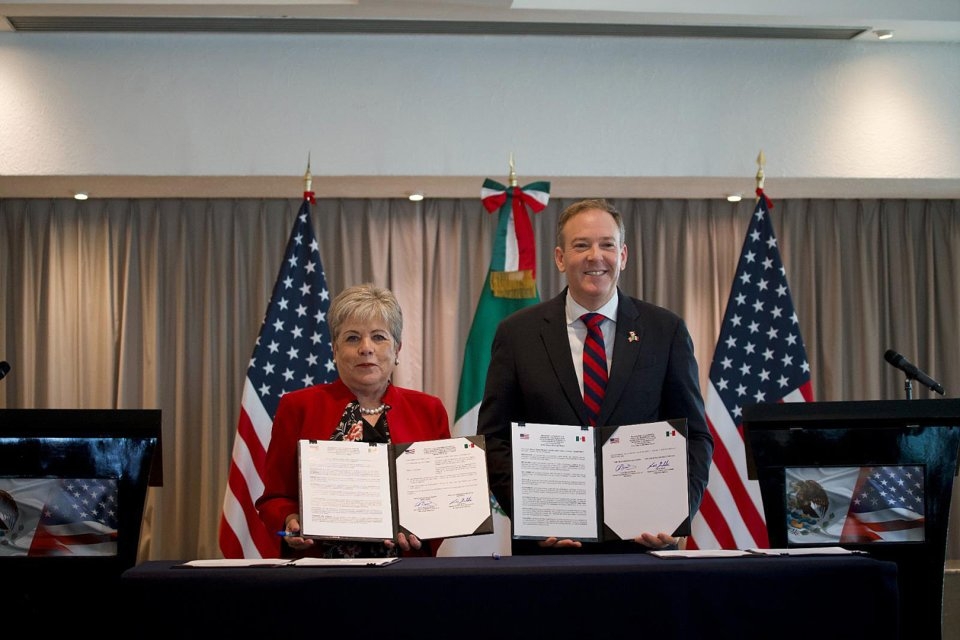
In July 2025, U.S. Environmental Protection Agency Administrator Lee Zeldin and Mexico’s Secretary of the Environment and Natural Resources, Alicia Bárcena Ibarra, signed a Memorandum of Understanding in Mexico City (pictured above). The agreement set three main goals: securing Mexico’s financial participation, speeding up construction timelines, and adding enough capacity to handle future population growth in Tijuana.
In December 2025, the two countries went further, agreeing to what is known as Minute 333, a formal document laying out additional construction projects, research studies, and long-term planning for operating and maintaining critical infrastructure along the border.
The June 30, 2026 quarterly report is required under the Memorandum of Understanding, which calls for clear, coordinated, and at least quarterly public updates.
“At the Trump Environmental Protection Agency, we practice what we preach,” Administrator Zeldin said in the report. “When we promise an urgent and permanent 100% solution to this crisis, we deliver one. And when we promise radical transparency along the way, that’s exactly what you get.”
Construction Under Way.
The centerpiece of the June 30, 2026 report is the start of construction on two projects that officials say will make a direct dent in sewage flows.
Pump Station 1, known in project documents as PB-1, broke ground on April 27, 2026. When complete, it will eliminate the risk of catastrophic discharges and boost the area’s total pumping capacity to 80 million gallons of wastewater per day. Completion is expected in November 2027.
The Tijuana River Gates project is designed to prevent at least 5 million gallons of sewage per day from entering the Tijuana River. Phase 1 is expected to wrap up by mid-July 2026. Phase 2 is in the procurement stage, with full project completion targeted for the end of January 2027.
The U.S. International Boundary and Water Commission also reported continued progress toward expanding the South Bay International Wastewater Treatment Plant, a federal facility in the San Ysidro area that treats river flows before they reach the ocean, to a capacity of 50 million gallons per day. Early work packages, including site preparation and ordering of long-lead equipment, are under way to keep the project on schedule.
Pipeline Collapses, Fast Repairs.
Not everything has gone smoothly. In May 2026, a key piece of infrastructure called the Parallel Gravity Line, a large sewer pipe running along the border designed to keep sewage out of U.S. canyons, collapsed twice in roughly two weeks.
Mexico reported the first collapse on May 14, 2026. Emergency repairs were completed two days later. A second collapse followed on May 31, 2026, with repairs finished by June 4, 2026.
Both failures sent excessive flows toward the South Bay International Wastewater Treatment Plant. The U.S. International Boundary and Water Commission responded by deploying additional staff and equipment to treat more than 40 million gallons per day. According to the June 30 report, those efforts successfully kept contaminated water from reaching San Diego-area residents.
Commission head Chad McIntosh contacted his Mexican counterpart, Commissioner Adriana Reséndez, to press for around-the-clock repair work and urge Mexico to do everything possible to keep wastewater out of the Tijuana River.
The full rehabilitation of the Parallel Gravity Line, intended to prevent future ruptures, is expected to be completed in August 2026.
Mexico Surpasses Its Funding Commitment.
According to the June 30 report, Mexico has surpassed its 2026 funding commitment under the Memorandum of Understanding. With those funds, Mexico is advancing construction and procurement on several rehabilitation projects:
-
The Insurgentes Collector rehabilitation was set to begin construction on June 29, 2026.
-
Two pump stations, known as PB-Matadero and Laureles PB-2, are in the procurement phase.
-
Three additional projects, the Poniente Interceptor, Oriente Interceptor, and Carranza Collector rehabilitations, are all under construction with completion expected in December 2026.
Mexico also completed a sediment basin at Matadero Canyon in May 2026, meeting a goal set ahead of the rainy season. The basin reduces the amount of sediment and debris flowing into the river system.
Planning for the Long Term.
Beyond bricks and pipes, both countries are working to build systems that will keep the infrastructure running and the data transparent for years to come.
A binational operation and maintenance workgroup is developing long-term strategies to keep critical border infrastructure in working order as Tijuana’s population continues to grow.
A separate binational work group under Minute 333 is advancing a real-time monitoring system to track water flows into and out of the Tijuana River. Officials say the system will strengthen accountability between the two countries. The same group has also reviewed engineering and financial feasibility studies for an ocean outfall at the San Antonio de los Buenos Wastewater Treatment Plant in Mexico and prepared a plan for a comprehensive analysis of how water moves through the entire Tijuana water system.
What Comes Next.
The Tijuana River crisis has been building for decades, and a permanent fix requires sustained cooperation between two national governments, multiple agencies, and communities on both sides of the border that have been waiting a very long time.
What the June 30, 2026, report makes clear is that construction is moving, emergency repairs are happening quickly, and both countries are, at least on paper, meeting their commitments. What remains to be seen is whether that momentum holds and whether it ultimately translates into cleaner water.


 wpDiscuz