- Back-to-back storms brought severe flood damage across seven Western states.
- Arizona Governor Katie Hobbs declared a statewide emergency on November 2, 2026.
- Las Vegas and Henderson saw intense flash floods that took one life.
- The San Juan River in New Mexico topped a 117-year record water level.
- Roads washed out, and sewage systems failed in several tribal communities.
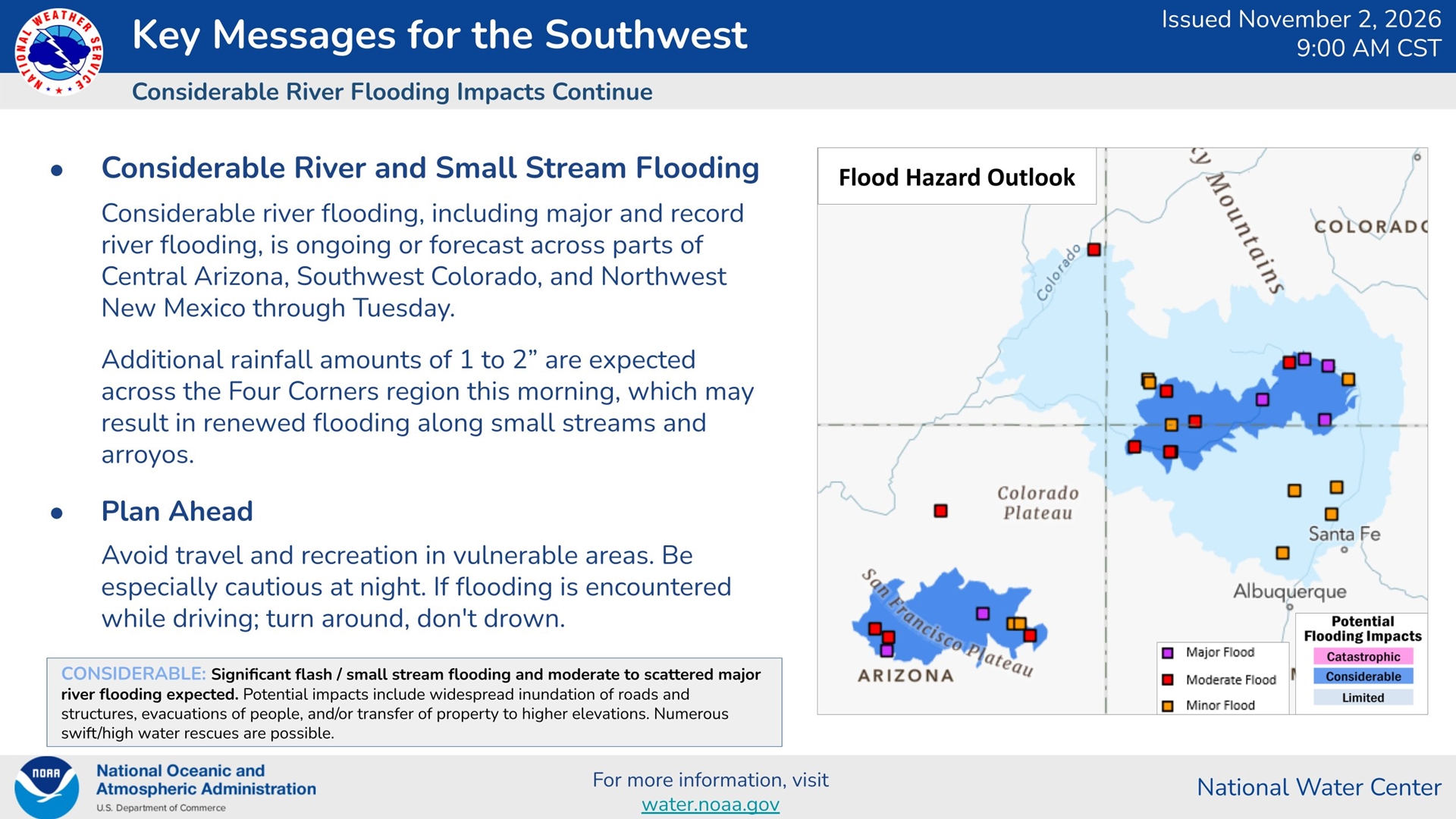
Tuesday, November 3, 2026 — A rare combination of tropical moisture and autumn storms pushed waterways to historic levels across all seven Colorado River Basin states. An initial wave of heavy rain soaked the region in late October. Before rivers could recede, a second atmospheric disturbance swept in over the weekend, dumping more rain onto ground that was already completely saturated.
The resulting runoff rushed down canyons, overwhelmed storm drains, and pushed creeks and rivers well beyond their banks from the desert lowlands to the high mountain headwaters.
Arizona Declares a Statewide Emergency.
On Monday afternoon, November 2, 2026, Arizona Governor Katie Hobbs issued a formal statewide State of Emergency. The declaration immediately released $200,000 in emergency funding to assist local towns and authorized the State of Arizona Emergency Response and Recovery Plan.
The crisis touched at least seven counties and five tribal nations across Arizona. County emergency declarations were issued in Apache, Gila, and Yavapai counties, alongside local emergencies in Camp Verde, Prescott, and Sedona.
In Sedona, surging waters along Oak Creek prompted evacuations and led to two separate municipal sewage overflows directly into the creek. Flooding on the Verde River also triggered evacuations in Cottonwood and Camp Verde. Transportation officials reported that cleanup needs exceeded regular capacity, forcing the closure of major routes including State Route 87 near Winslow and State Route 89A between Sedona and Kachina Village.
Here are some preliminary 48 hour rainfall totals through early Monday morning across the Southwest and Four Corners Region. https://t.co/l20eRIpnzk
— NWS Weather Prediction Center (@NWSWPC) November 2, 2026
Flash Floods Strike Las Vegas and Henderson.
The Lower Basin experienced extreme urban flooding in Clark County, Nevada. On October 30, 2026, severe thunderstorms dumped months of typical rainfall over the Las Vegas Valley in just a few hours.
Swift-water rescue squads conducted multiple emergency operations in Henderson, where officials confirmed at least one flood-related death. Runoff filled streets across the Las Vegas Strip, Paradise, and the Fremont Street area. At Harry Reid International Airport, standing water on runways and active lightning triggered ground stops that disrupted hundreds of flights during a peak travel weekend. Electrical substations were submerged, leaving thousands of utility customers temporarily without power.
Further south, desert washes in eastern California sent runoff into irrigation corridors near the Colorado River. Water managers conducted emergency flushing operations along intake gates to clear heavy silt and desert debris.
Record Crests and Highway Collapses in the Upper Basin.
The Four Corners area saw some of the highest flood levels ever recorded. At Farmington, New Mexico, the San Juan River crested at 14.1 feet, breaking a historical record of 12.3 feet that had stood since 1909. Between 1,500 and 2,000 buildings were damaged or isolated in Farmington, Bloomfield, and Shiprock. The flood also breached the Bloomfield Water Reclamation Facility, spilling untreated municipal wastewater into the river.
In southwestern Colorado, Governor Jared Polis issued disaster emergency declarations covering 12 counties. Highway infrastructure suffered significant damage:
-
A bridge on U.S. Highway 160 near South Fork collapsed, cutting off a key east-west travel route.
-
Colorado Highway 151 experienced major roadbed buckling between Pagosa Springs and Ignacio.
-
In South Fork, rushing water tore through riverside sites, washing away cabins and recreational vehicles.
In southeastern Utah, high water isolated remote settlements along the San Juan River corridor, including Bluff, Mexican Hat, Montezuma Creek, and Aneth. Farther north in Wyoming, warm rains caused sudden snowmelt in the Green River headwaters, eroding riverbanks and washing out culverts on rural ranching roads.
The Animas River in Durango rose from 1500 cfs yesterday to 13,000 cfs by 10:45 a.m. today. Just an insane amount of water. https://t.co/0b7SkIqWZP
— CPW SW Region (@CPW_SW) November 3, 2026
Severe Losses Across Tribal Nations.
Tribal lands faced serious logistical and public health challenges due to fragile roads and utility infrastructure.
The Hopi Tribal Council declared a State of Emergency after rushing water washed out bridges and unpaved secondary roads, cutting off access to several villages. On the Navajo Nation, floodwaters damaged utility systems in Kayenta, Arizona, leading to a major sewage spill into local drainage washes. Near Shiprock, New Mexico, the Navajo Tribal Utility Authority reported severe damage to wastewater processing operations.
In southern Utah, emergency crews struggled to navigate impassable mud and washed-out dirt roads to deliver clean drinking water to residents in White Mesa and surrounding chapter communities. Because ordinary property insurance rarely covers overland flood damage, tribal officials and community leaders are looking toward federal disaster assistance to rebuild critical water lines, roads, and homes.
Citations:
-
Office of the Arizona Governor. (2026, November 2). Governor Katie Hobbs Declares Statewide State of Emergency. https://azgovernor.gov/office-arizona-governor/news/2026/11/governor-katie-hobbs-declares-statewide-state-emergency

-
FOX 10 Phoenix. (2026, November 2). Gov. Hobbs declares state of emergency following weekend storms in Arizona. https://www.fox10phoenix.com/news/gov-hobbs-declares-state-emergency-following-weekend-storms-arizona
-
Courthouse News Service. (2026, November 2). Torrential rains spell disaster across Southwest. https://www.courthousenews.com/torrential-rains-spell-disaster-across-southwest/
-
IQAir Staff. (2026, November 2). Indoor Air Quality Alert: Four Corners Flooding, USA. https://www.iqair.com/id/newsroom/indoor-air-quality-alert-four-corners-flooding-11-2-2026
-
Cotality Hazard HQ. (2026, November 2). Second historic flood hits the Four Corners region. https://www.cotality.com/hazard-hq/second-historic-flood-hits-the-four-corners-region
-
Wherobots. (2026, October 30). Farmington Flood: San Juan River’s Biggest Flow Since 1957. https://wherobots.com/todays-news/san-juan-river-flooding/
-
The Colorado Sun. (2026, October 27). What Officials Know So Far About Major Flood Impacts in Southwestern Colorado. https://coloradosun.com/2026/10/27/colorado-major-flood-impacts-so-far/
-
Travel Tourister. (2026, October 31). Las Vegas Flash Floods: Harry Reid Airport Ground Stop Delays Flights. https://www.traveltourister.com/news/las-vegas-flash-flooding-october-30-2026-harry-reid-airport-ground-stop-delays-halloween-weekend-guide/
Image from NOAA – https://water.noaa.gov/