- San Diego County approved a plan to develop a U.S.-side system for capturing and treating polluted Tijuana River flows.
- The initiative will move through three phases, beginning with an 18-month evaluation and planning process.
- Supervisors approved $1.8 million for the first phase of the project.
- A separate project would replace failing culverts beneath Saturn Boulevard.
- One supervisor opposed the treatment initiative, raising concerns about costs and whether the county should take the lead.
Thursday, September 3, 2026 — San Diego County is moving forward with a plan to capture and treat polluted water from the Tijuana River after it crosses into the United States.
The County Board of Supervisors approved the Tijuana River Capture and Cleanup Initiative in a 4-1 vote on September 2 . The proposal was brought forward by Supervisors Terra Lawson-Remer and Paloma Aguirre.
The idea is straightforward, although carrying it out will be far more complicated: Build infrastructure on the U.S. side of the border capable of capturing polluted river water and sending it through treatment before it reaches downstream communities and beaches.
The county says existing facilities do not solve that particular part of the problem.
A Gap in the Existing System.
Current facilities capture wastewater in Mexico and convey it for treatment. But according to the county, the South Bay International Wastewater Treatment Plant does not treat polluted flows already moving through the main channel of the Tijuana River.
That leaves sewage, polluted runoff and other contaminants capable of crossing the border in the river.
County officials say more than 200 billion gallons of polluted water crossed into the United States through the Tijuana River between 2018 and 2026.
The contamination is not limited to sewage. The county board letter says industrial chemicals, pesticides, heavy metals and “forever chemicals” have also been found in the river.
Federal officials have already committed more than $650 million to increase the capacity of the South Bay International Wastewater Treatment Plant. San Diego County supports those improvements but says another piece of infrastructure is needed to deal specifically with polluted river flows.
The new county initiative is intended to address that gap.
Three Steps Before a Treatment System Is Built.
The county is not immediately breaking ground on a new treatment plant.
Instead, the project will move through three phases.
The first phase will evaluate possible solutions. Engineers will examine such questions as where facilities could be located, what level of treatment would be needed, how much different options would cost, how the system could operate and how it could be financed.
That work is expected to take about 18 months. The results will return to the Board of Supervisors so members can select a preferred project.
The second phase would move the selected project into preliminary engineering and develop a funding strategy.
The third phase would include final design, environmental review, permits and construction.
The county also plans to consider ways of speeding up permitting, including seeking emergency declarations and possible state legislation.
Supervisors approved $1.8 million for the first phase.
Future phases will require additional money. The county board letter says new dedicated revenue and funding partnerships will be needed for design, construction and long-term operation of the system.
One Supervisor Votes No.
Supervisor Joel Anderson cast the only vote against the treatment initiative.
Anderson questioned whether San Diego County should move forward without first building a broader coalition to share responsibility for what could become an expensive project.
“My concern is this is not our lane,” Anderson said during the meeting.
Lawson-Remer said the county does want partnerships but does not want to delay moving forward.
Other supervisors also made clear that they still expect Mexico and the federal government to remain involved.
Supervisor Jim Desmond supported the initiative but said he ultimately wants Mexico to address the pollution problem and meet milestones under federal agreements.
Saturn Boulevard Project Also Moves Forward.
Supervisors separately gave unanimous support to work involving failing box culverts beneath Saturn Boulevard near the Tijuana River.
The area has become an important part of the pollution problem because contaminated water flowing through the area can release hydrogen sulfide into the air.
Hydrogen sulfide is the gas associated with the familiar rotten-egg smell of sewage. County documents say recent spikes near Saturn Boulevard have exceeded 500 parts per billion, more than 16 times California’s 30-parts-per-billion standard.
A permanent replacement of the culverts is intended to allow water to flow more freely through the channel. County officials say that could reduce turbulence that releases gases into the air while also improving flood protection and access to the Tijuana River Valley Regional Park.
A separate $2.5 million project to repair existing culvert pipes has already been approved, with completion expected in 2027.
Aguirre and Lawson-Remer requested another $4 million for design, environmental review and permitting for the permanent replacement project.
A Long-Term Project Begins With Planning.
The September 2 decision does not establish the final location, design or cost of a new U.S.-side treatment system.
Those questions are part of the work that now begins.
Phase 1 will examine potential treatment options, locations, land rights, costs, financing, permits and operating arrangements before returning to supervisors with choices.
The county also plans to turn its temporary Tijuana River sewage subcommittee into a permanent standing committee to oversee the initiative as it develops.
For San Diego County, the larger change is where officials are proposing to intercept the pollution.
Instead of relying entirely on wastewater infrastructure that captures sewage before it enters the river, the county is beginning to develop a system to capture and treat polluted water already flowing through the Tijuana River on the U.S. side of the border.
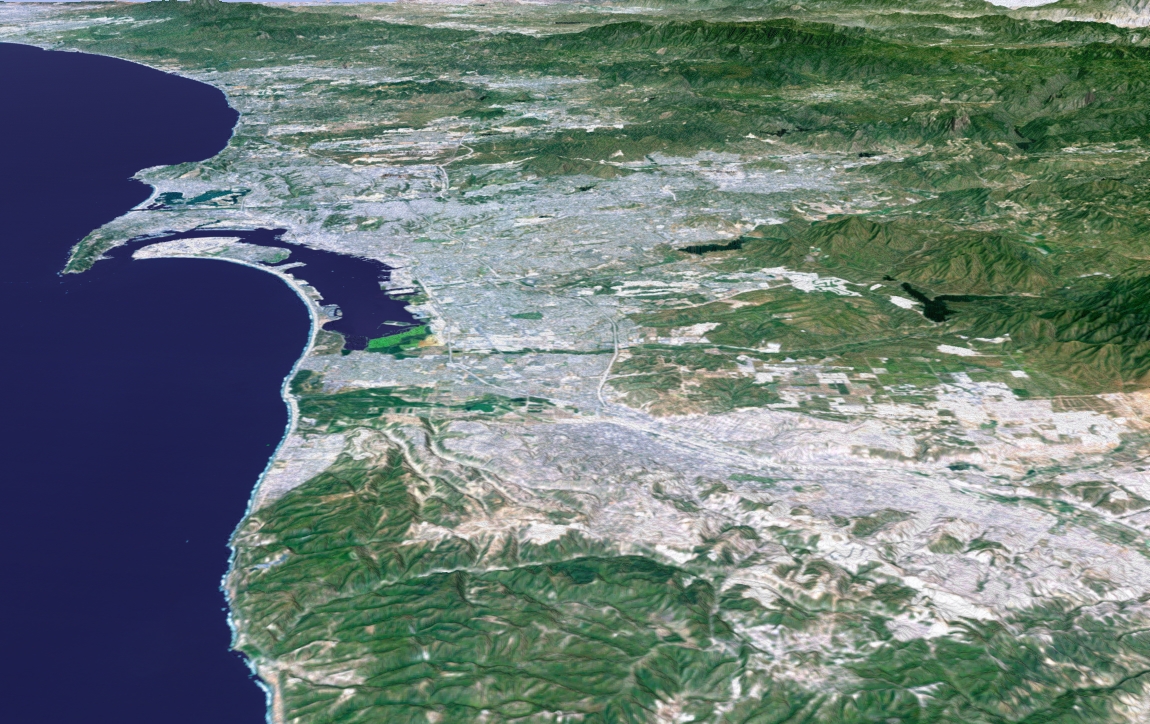
Pictured: San Diego-Tijuana Metro 3D Map (NASA).