- California is testing summer flooding in Suisun Marsh to produce food for native fish.
- Shallow wetlands are producing large numbers of tiny organisms called zooplankton.
- The state must target production of up to 13,000 pounds of zooplankton annually for three years.
- Researchers are also watching for predators, water-quality changes and effects on waterfowl.
- Private duck clubs and landowners are participating in the project.
Friday, September 25, 2026 — California water managers are experimenting with a surprisingly simple way to help struggling native fish in the Sacramento-San Joaquin Delta: grow more of the tiny creatures they eat.
The California Department of Water Resources is testing whether managed wetlands in Suisun Marsh can become small food factories for the surrounding aquatic ecosystem.
The idea involves flooding wetlands during summer, allowing algae and other plant material to support large numbers of zooplankton. These tiny, shrimp-like organisms are an important food source for fish.
The zooplankton-rich water can then be released from the wetlands into nearby waterways.
“Normally these sites are dry in the summer, which means production is zero,” Department of Water Resources environmental program manager Rosemary Hartman said. “Now that these sites are wet, there are zooplankton out there, and they are at way higher densities than you get in the surrounding sloughs.”
Putting Summer Water to Work.
Most wetlands in Suisun Marsh are flooded during winter, when they provide food and refuge for migrating waterfowl.
That flooding also produces zooplankton. Ducks do not eat the tiny organisms, but fish do.
According to the Department of Water Resources, a similar food-producing process once occurred naturally during summer as tides moved through the area. Development of the Delta for agriculture changed those conditions.
The state is now experimenting with bringing water back onto some wetlands during summer.
“We want to flood these wetlands in the summer and let nature take its course,” Hartman said.
The approach has similarities to the Nigiri Project in the Yolo Bypass, where juvenile salmon are directed onto a floodplain rich in food before they continue toward the Pacific Ocean.
There is an important difference in Suisun Marsh. The fish are not expected to enter the wetlands themselves.
“I think the biggest difference is that we don’t expect the fish to be on the wetlands, just benefit from food exported from the wetlands,” Hartman said.
How a Wetland Becomes a Fish Food Factory.
The process starts by flooding shallow wetlands with warm water.
Decomposing plants and fast-growing algae provide the foundation for a rapidly developing food web. Zooplankton feed and multiply in the wetland.
When enough zooplankton are present, water is released through devices called flap gates and into nearby waterways where Delta smelt can feed.
Hartman describes the process as “salting the soup.”
The concept is to add a relatively small amount of food-rich water to the surrounding aquatic environment, potentially improving conditions for Delta smelt, a tiny fish that is nearly extinct in the wild.
A New Approach to Helping Delta Smelt.
The experiment is part of a broader change in how California is managing habitat for Delta smelt.
In 2025, an amendment to the Department of Water Resources’ State Water Project operating permit replaced a fall water-flow requirement known as “X2” with an approach focused on improving food production and habitat for Delta smelt.
The California Department of Fish and Wildlife now requires the Department of Water Resources to target production of as much as 13,000 pounds of zooplankton per year for three years.
Managed wetlands are being studied as one possible way to reach that level of production.
More Food Could Also Attract Predators.
Researchers are not assuming that producing more zooplankton will automatically improve conditions for Delta smelt.
More food could come with trade-offs.
Scientists are using hook-and-line surveys to determine whether predatory fish, primarily striped bass, gather near wetland outlets. Researchers compare those locations with other sites to determine whether the wetlands are increasing food for Delta smelt while also attracting their predators.
The research extends beyond fish.
Scientists are studying water quality, dissolved oxygen, mosquito management, waterfowl food production, and the movement of carbon and nutrients through the food web.
Once they collect the information, researchers from several agencies and universities will evaluate the ecological benefits and possible costs. Those findings will help determine whether to expand the program to additional locations.
Duck Clubs and Landowners Are Part of the Experiment.
The project also depends on cooperation from private landowners and duck clubs in Suisun Marsh.
Participating landowners receive financial incentives. However, keeping wetlands flooded during summer can affect the way those properties are managed for waterfowl.
Future years could therefore involve rotating participating wetlands to balance fish-food production with the needs of waterfowl and landowners.
“This is a huge collaborative effort,” Hartman said. “We’re bringing together agencies, universities and partners to answer a simple but important question: Can managed wetlands produce food for fish without sacrificing habitat for waterfowl and, if not, how can we change management to balance waterfowl and fish food in Suisun Marsh?”
For now, that question remains under study. Researchers are gathering the information needed to determine how much food the wetlands can produce and what else changes when summer water returns to the marsh.
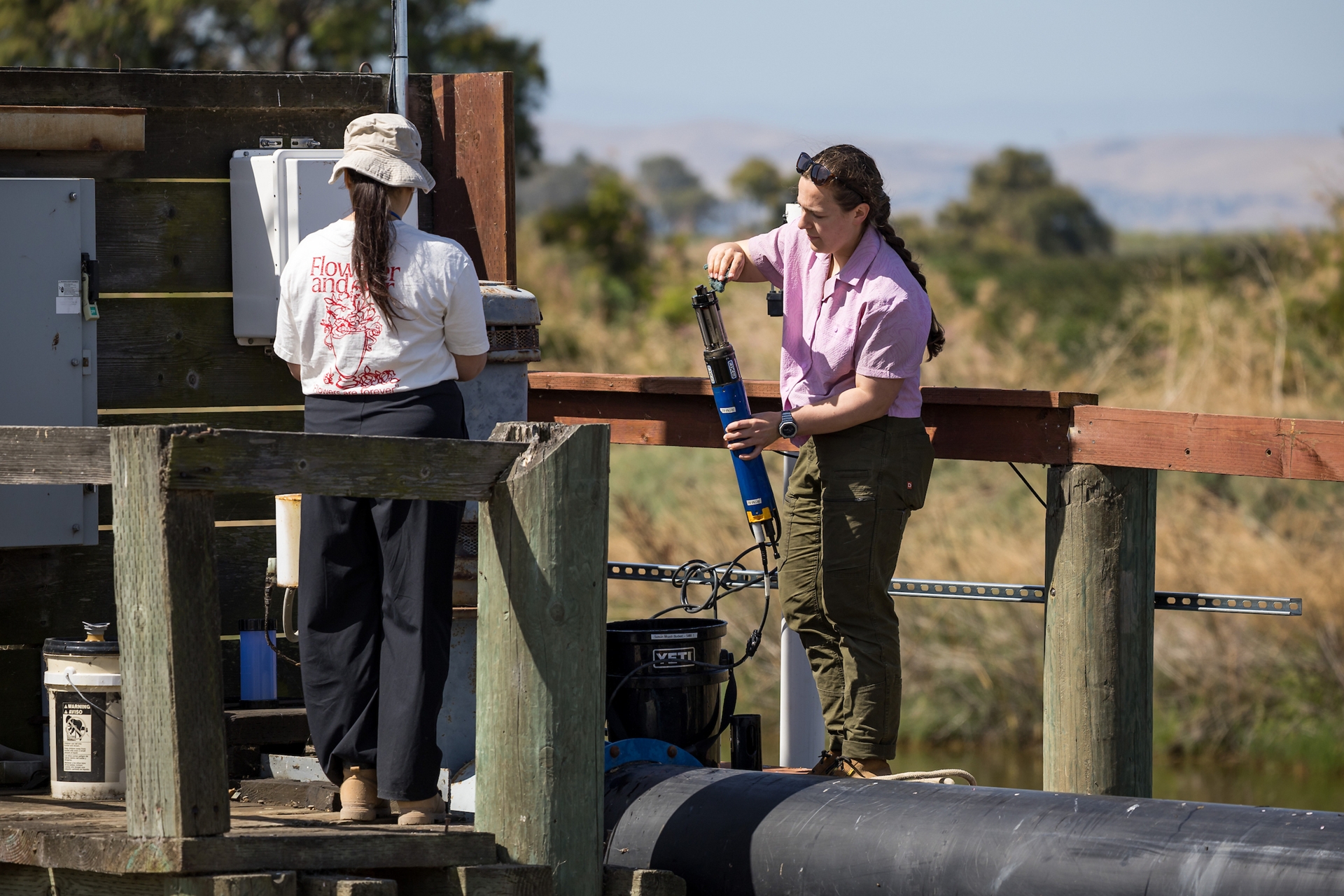
Pictured: California Department of Water Resources Water Quality Scientist Vivian Klotz (right), with the Division of Integrated Science and Engineering, conducts a sonde exchange as Scientific Aid Francheska Torres observes at Meins Landing on Montezuma Slough in Suisun Marsh, Solano County. Sondes measure the water’s temperature, pH (acidic or basic level of hydrogen), dissolved oxygen (oxygen levels available to aquatic organisms), and turbidity (the clarity of water). The activity precedes a managed wetlands project in Suisun Marsh to produce food for Delta smelt in the summer and fall. Photo taken July 1, 2026. Xavier Mascareñas / California Department of Water Resources