- California approved the final water-right permit for Sites Reservoir on November 5, 2026.
- The planned reservoir will store up to 1.5 million acre-feet of water.
- Federal environmental approval was completed on January 23, 2026.
- The Bureau of Reclamation previously announced $780.15 million in federal contributions.
- Federal negotiations have experienced delays, and construction financing remains unfinished.
Friday, November 6, 2026 –– California has cleared another major hurdle in its decades-long effort to build the state’s largest new reservoir in more than 50 years.
On November 5, 2026, the State Water Resources Control Board approved the final water-right permit for Sites Reservoir , a proposed water storage project in Glenn and Colusa counties in Northern California.
The decision follows a separate federal approval issued earlier in the year by the Bureau of Reclamation.
Together, the decisions move the project closer to construction, although financing and federal partnership agreements are still being worked out.
Sites Reservoir would store up to 1.5 million acre-feet of water, enough to supply more than 4.5 million homes for one year, according to Governor Gavin Newsom’s office.
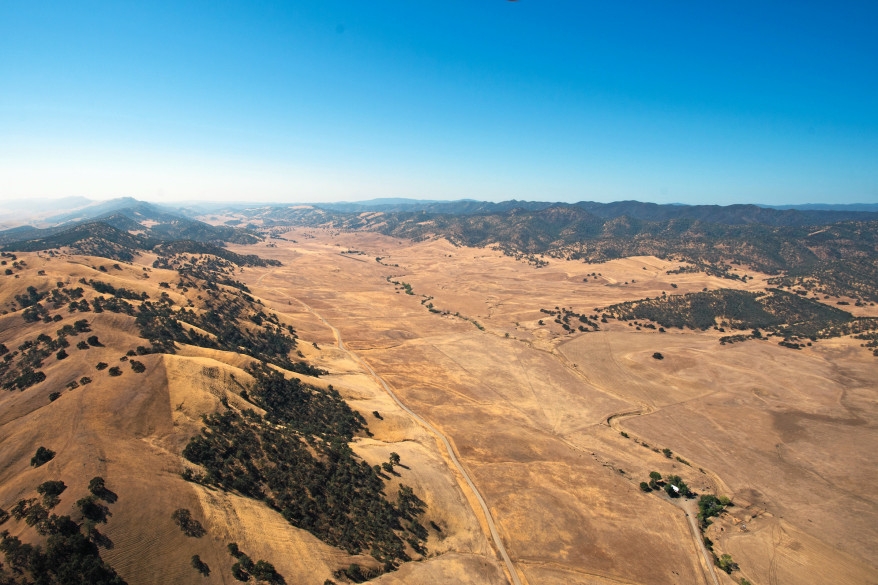
Unlike a reservoir built directly across a river, Sites Reservoir would sit away from the Sacramento River. Water would be moved into storage during qualifying high-flow periods and saved for dry years.
Federal Environmental Approval Came in January.
The November 5 state decision follows an important federal milestone reached nearly ten months earlier.
On January 23, 2026, the Bureau of Reclamation issued its Record of Decision for Sites Reservoir, completing the federal environmental review process under the National Environmental Policy Act.
That federal law requires agencies to examine the environmental effects of major projects before making certain decisions.
The review included a final Environmental Impact Statement, an examination of potential effects on historic and cultural resources, and requirements under the Endangered Species Act.
The federal decision followed years of environmental studies and planning.
“This milestone decision reflects years of rigorous analysis, collaboration, and a shared commitment to advancing a project that balances our water supply needs with protecting the environment,” said Fritz Durst, chair of the Sites Project Authority Board of Directors, in a January 23 announcement.
The federal decision selected a project design with 1.5 million acre-feet of storage capacity and the possibility of federal participation in up to 25% of project costs.
It also changed the location of a smaller water-regulating reservoir associated with the project. Reclamation determined that the change would reduce impacts on wetlands and geological resources compared with the original design.
The Record of Decision did not itself provide a water right or finalize federal funding agreements.
Those matters require separate actions.
How Sites Reservoir Will Store Water.
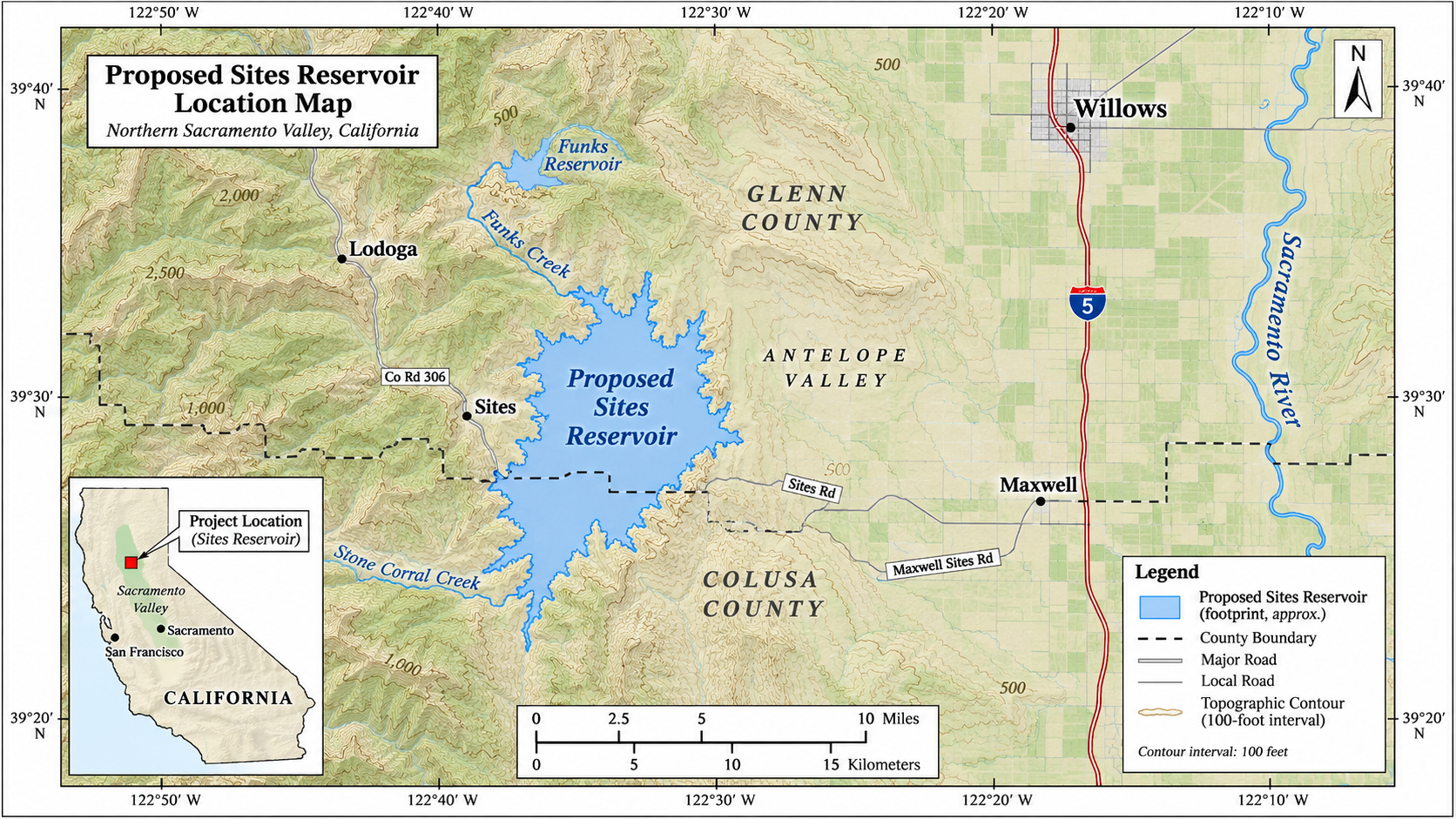
Sites Reservoir would be built in the Sacramento Valley, approximately 10 miles west of Maxwell.
Water would be diverted from the Sacramento River using existing facilities near Red Bluff and Hamilton City.
The water would travel through canals and pumping facilities before entering the new reservoir.
During dry periods, participating water agencies and other designated users could receive stored water.
The project would also be coordinated with California’s existing state and federal water systems.
According to the Bureau of Reclamation, stored water could provide additional flexibility for operations involving Shasta Reservoir and Lake Oroville.
The new reservoir is not intended to replace those facilities. Instead, it would provide another location to store water and manage deliveries.
Because Sites Reservoir would be located away from the Sacramento River, its dams would not directly block fish migration along the main river.
However, the project would still affect land and waterways where its dams, pipelines, roads, and other facilities are built.
Reclamation’s environmental review estimates that the selected reservoir design would cover approximately 13,200 acres in Antelope Valley.
Water Diversions Will Have Limits.
A reservoir capable of holding 1.5 million acre-feet does not necessarily collect or deliver that amount every year.
The amount of water available for storage will depend on river flows, existing water rights, environmental requirements, and the conditions of the new permit.
In September 2026, the State Water Resources Control Board described a revised draft permit that would allow up to 986,000 acre-feet of water to be diverted annually.
That proposed limit is different from the reservoir’s total storage capacity.
The draft permit also contained conditions intended to protect existing water-right holders, water quality, and fishery flows.
The November 5 announcement confirms the final permit’s approval but does not reproduce all its operating conditions.
Those conditions will help determine when water can be diverted from the Sacramento River.
Federal Government Has Committed Substantial Funding.
The Bureau of Reclamation has been involved in Sites Reservoir planning and development for years.
On April 4, 2025, the agency announced an additional $134 million for the project.
At that time, Reclamation reported that the project had previously received $389.65 million and had been authorized another $256.5 million under the Infrastructure Investment and Jobs Act.
Those amounts brought Reclamation’s reported federal contributions to $780.15 million.
The federal funding supports a project the Sites Project Authority is developing, with participation from state and local water agencies.
California has also committed substantial financial support.
In June 2026, Governor Newsom announced nearly $269 million in additional state funding, bringing the project’s total eligible state funding to approximately $1.36 billion.
These are federal and state funding figures reported at different times and under different programs. They do not indicate that all construction financing is complete.
Federal Negotiations Have Faced Interruptions.
Although the Bureau of Reclamation approved the project’s federal environmental review in January, negotiations over federal participation have been interrupted.
Reclamation canceled scheduled negotiating sessions for July 1, August 26, and September 28, 2026, concerning agreements for federal participation and the use of federal water facilities.
The agency did not publicly explain the cancellations.
On October 30, Reclamation announced that negotiations were continuing, with another public session scheduled for November 17.
The negotiations concern an Excess Capacity Contract, which would establish terms for moving water associated with Sites Reservoir through existing federal water facilities.
The agencies are also negotiating a broader Partnership Agreement covering federal participation in the project.
The November 17 session is scheduled to take place at the Sites Project Authority office in Maxwell, with opportunities for public attendance and comment.
Although the project has received federal environmental approval, the remaining agreements demonstrate that federal involvement is not yet fully settled.
These negotiations are separate from the environmental and water-right approvals already issued.
Wildlife and Environmental Benefits.
Sites Reservoir is expected to serve communities, farms, and wildlife.
According to California officials, the project will provide water to several wildlife refuges, including the Sacramento National Wildlife Refuge Complex, Upper Butte Basin Wildlife Area, and San Luis National Wildlife Refuge.
The project also includes provisions for up to 200,000 acre-feet of water during officially declared drought emergencies.
Reclamation’s federal review identifies additional potential benefits, including more flexibility in managing water for fish and wildlife.
The agency specifically examined opportunities to support fish that migrate between rivers and the ocean, provide additional water for wildlife refuges, and improve conditions in the Sacramento-San Joaquin Delta.
The project would also involve construction of dams, pumping facilities, pipelines, roads, and recreational areas.
Its environmental review examined both the proposed benefits and the effects of that construction.
Preparing for More Extreme Wet and Dry Years.
California officials say Sites Reservoir is becoming increasingly important as the state’s weather patterns change.
From 2020 through 2022, California experienced its driest three-year period on record.
That period was followed by nine atmospheric rivers in just three weeks.
Atmospheric rivers are long bands of moisture that can bring heavy rain and snow.
California officials expect rising temperatures to reduce mountain snowpack and increase pressure on existing water supplies.
State projections indicate California could lose 10% of its water supply by 2040 because of hotter and drier conditions.
Reliability of the State Water Project could also decline by as much as 23%.
Sites Reservoir would provide additional storage during wet periods, making water available for later use.
“Our water system was built for a climate that no longer exists,” said California Secretary for Natural Resources Wade Crowfoot.
Construction Is the Next Major Step.
With the November 5 water-right approval, California officials say Sites Reservoir has obtained the regulatory approvals needed to begin construction.
However, the Sites Project Authority and participating water agencies must still advance financing arrangements.
Federal partnership and water transportation agreements are also under negotiation.
The November 5 announcement did not establish a firm construction start date.
Once completed, the reservoir is expected to provide additional water storage for cities, farms, wildlife refuges, and drought emergencies.
After decades of planning, environmental studies, and regulatory proceedings, Sites Reservoir has moved closer to becoming part of California’s water supply system.
Sources and Citations:
1. California Governor’s Office, November 5, 2026.
California Expands Water Storage Infrastructure, Largest New Reservoir in More Than 50 Years Clears Final Permit.
2. U.S. Bureau of Reclamation, January 23, 2026.
Sites Reservoir Project, Record of Decision.
The official federal decision documenting environmental review, project alternatives, and potential federal participation.
https://www.usbr.gov/mp/nepa/includes/documentShow.php?Doc_ID=57349
3. Sites Project Authority, January 23, 2026.
Bureau of Reclamation Issues Record of Decision, Marking Environmental Milestone for Sites Reservoir Project.
4. U.S. Bureau of Reclamation, April 4, 2025.
Reclamation Announces Additional Funding to Create New Water Storage in California.
Documents the $134 million award and reported total of $780.15 million in federal contributions and authorizations.
https://www.usbr.gov/newsroom/news-release/5131
5. U.S. Bureau of Reclamation, June 25, 2026.
Changes to Sites Reservoir Public Negotiation Schedule.
Announces cancellation of the July 1 negotiating session.
https://www.usbr.gov/newsroom/news-release/5357
6. U.S. Bureau of Reclamation, August 19, 2026.
Changes to Sites Reservoir Public Negotiation Schedule.
Announces cancellation of the August 26 negotiating session.
https://www.usbr.gov/newsroom/news-release/5391
7. U.S. Bureau of Reclamation, September 16, 2026.
Changes to Sites Reservoir Public Negotiation Schedule.
Announces cancellation of the September 28 negotiating session.
https://www.usbr.gov/newsroom/news-release/5414
8. U.S. Bureau of Reclamation, October 30, 2026.
Reclamation Continues Sites Excess Capacity Contract and Partnership Agreement Public Negotiation Sessions.
Announces continued federal negotiations and a November 17 public session.
https://www.usbr.gov/newsroom/news-release/5432
9. California State Water Resources Control Board, September 3, 2026.
State Water Board Revises Draft Water Right Decision for Proposed Sites Reservoir, a Major California Water Project.
Explains proposed annual diversion limits and protections for existing water rights, water quality, and fisheries.
10. U.S. Bureau of Reclamation, Sites Reservoir Project Information.
Federal project information, environmental documents, and background materials.
https://www.usbr.gov/mp/nodos/
Top Image from Bureau of Reclamation: “Sites Reservoir is a proposed 1.5 million acre-foot offstream reservoir in Northern California that will increase the state’s water storage capacity, improve water supply reliability, and enhance ecosystem benefits. Located in the Sacramento Valley west of the town of Maxwell, the reservoir is designed to store water diverted from the Sacramento River during high-flow periods for use in dry years. Led by the Sites Project Authority, Reclamation is a federal partner working with the Authority and other local and state stakeholders to advance the project.”