- Colorado denies violating the South Platte River Compact.
- The state wants one of Nebraska’s three claims dismissed.
- Colorado has filed counterclaims accusing Nebraska of taking water belonging to Colorado.
- The dispute includes groundwater pumping, river flows and the proposed Perkins County Canal.
- Colorado is asking for damages and restrictions on some Nebraska water pumping.
Tuesday, September 29, 2026 — Colorado has answered Nebraska’s South Platte River lawsuit with a simple message: Colorado says it has not broken the rules, and it says Nebraska may be the state taking water that does not belong to it.
In filings submitted to the U.S. Supreme Court on September 28, Colorado denied Nebraska’s claims that it has violated the century-old South Platte River Compact. Colorado also filed its own counterclaims accusing Nebraska of improperly reducing flows in Lodgepole Creek and portions of the South Platte River.
Colorado Attorney General Phil Weiser said the state will defend Colorado water users.
“Nebraska’s South Platte River Compact lawsuit is wrong on the law and not based in reality,” Weiser said . “Colorado is meeting its obligations under the compact.”
The two states now present sharply different accounts of what is happening along their shared river.
A Century-Old Agreement Returns to Court.
Colorado and Nebraska signed the South Platte River Compact in 1923. Congress approved it in 1926.
During the irrigation season, from April 1 through October 15, Nebraska holds a June 14, 1897, priority for 120 cubic feet per second in the Lower Section of the South Platte.
If flows fall below that level, Colorado must curtail certain Colorado water users with junior rights when doing so would increase flows toward 120 cubic feet per second and Nebraska can beneficially use the water.
Nebraska sued Colorado in 2025, claiming Colorado has allowed diversions that violate those requirements. Nebraska has alleged that Colorado’s actions deprived the state of as much as 1.3 million acre-feet of water.
Colorado denies that allegation.
Colorado argues that the Compact does not guarantee Nebraska a fixed amount of water. Instead, Colorado says Nebraska has priority over certain Colorado water users at certain times when water is available.
Colorado Defends Its Groundwater System.
A major part of the dispute involves groundwater wells and what happens after water is pumped from underground.
Groundwater pumping can eventually reduce water flowing in a nearby river. The effect may not happen immediately.
Colorado uses what are called augmentation plans to address these delayed effects. Water users may be allowed to pump groundwater if they replace water in the river in the proper amount and at the proper time.
Engineers use computer models and other calculations to determine how much replacement water is needed and when it must reach the river. Colorado water courts must approve permanent augmentation plans.
Nebraska has challenged that system, arguing in part that Colorado’s method is too complex and violates Article VIII of the Compact.
Colorado is now asking the Supreme Court to dismiss that particular claim.
Colorado argues that Article VIII does not require a simple water-management system. Instead, the state says the provision gives Colorado officials authority to carry out Compact obligations without requiring the Colorado legislature to pass additional laws.
“Nothing in the text of Article VIII suggests that it guides or constrains how Colorado administers water rights, let alone that its system must be simple and lack complexity,” Colorado argues in its motion.
The motion does not seek dismissal of Nebraska’s entire lawsuit.
Colorado Turns the Groundwater Argument Around.
Colorado’s answer also turns the groundwater issue back on Nebraska.
In its counterclaims, Colorado alleges that Nebraska allows groundwater pumping near the state line without adequately replacing water lost from streams and rivers.
One claim involves Lodgepole Creek, a South Platte tributary.
Under the Compact, the dividing point on Lodgepole Creek is two miles north of the Colorado-Nebraska border. Colorado says the Compact gives it the exclusive use and benefit of water at and below that point.
Colorado alleges at least 30 active irrigation wells are adjacent to Lodgepole Creek within two miles of the state line. According to Colorado’s filing, Nebraska considers the wells to use water that is connected to both surface water and groundwater.
Colorado claims those wells are reducing flows in the portion of Lodgepole Creek reserved for Colorado.
Nebraska has not yet had an opportunity in the filings provided for this article to answer Colorado’s counterclaims.
Colorado Points to Wells Near the South Platte.
Colorado makes a similar claim about groundwater pumping near the South Platte River.
The state alleges that at least 19 active irrigation wells in Nebraska are located north of Julesburg, Colorado, and less than three miles from the South Platte River within Colorado.
Colorado says those wells irrigate thousands of acres in Nebraska and reduce South Platte flows inside Colorado.
The state also argues that Nebraska does not adequately replace those groundwater losses.
Colorado says the consequences can reach beyond the amount of water remaining in the river. During the irrigation season, Colorado must sometimes curtail junior Colorado water users to meet its obligations to Nebraska.
Colorado says Nebraska pumping that reduces river flows can force Colorado to curtail its own water users more than it otherwise would.
Colorado cited 2021 as an example. That year, according to the filing, Colorado curtailed Colorado water users junior to Nebraska on 88 days during the irrigation season because of its obligations under the Compact.
Colorado Asks the Court for Damages and Water.
Colorado is asking the Supreme Court for more than a ruling that Nebraska violated the Compact.
The state seeks damages for the alleged losses. It also asks the Court, when appropriate, to award Colorado water that it says Nebraska has withheld.
Colorado wants the Court to prohibit Nebraska from using surface diversions or groundwater pumping that affects the portion of Lodgepole Creek reserved for Colorado or portions of the South Platte River and its tributaries within Colorado.
Colorado also seeks an injunction against Nebraska, its agencies and water users to prevent pumping or diversions that affect those waters.
Those requests are Colorado’s claims before the Court. The Supreme Court has not ruled that Nebraska violated the Compact or owes Colorado water or damages.
The Perkins County Canal Remains in the Fight.
The proposed Perkins County Canal remains another major part of the dispute.
The Compact gives Nebraska a conditional right to divert up to 500 cubic feet per second during the non-irrigation season through a canal beginning near Ovid, Colorado.
More than a century after the Compact was signed, Nebraska has not built the canal.
Nebraska has argued that Colorado is interfering with its efforts to develop the project. Colorado denies that allegation.
Colorado says Nebraska’s canal remains in early stages and argues that the project carries significant technical and financial risks and could ultimately produce too little water to justify its cost.
Colorado also maintains that Nebraska has no Compact right to non-irrigation-season water unless and until the canal is built.
Two States, Two Very Different Perspectives.
Nebraska’s lawsuit originally placed Colorado on the defensive, accusing its neighbor of depriving Nebraska of water and interfering with rights established more than a century ago.
Colorado’s September 28 filings put a competing set of claims before the Supreme Court.
Colorado denies Nebraska’s allegations, asks the Court to dismiss Nebraska’s Article VIII claim, and alleges that Nebraska itself is violating the Compact through groundwater pumping that reduces water available to Colorado.
The Supreme Court will now be asked to sort through not only how a 1923 agreement applies to modern groundwater management, but also competing claims about which state’s water use is affecting the other.
The Supreme Court docket for Nebraska v. Colorado includes downloadable copies of the pleadings.
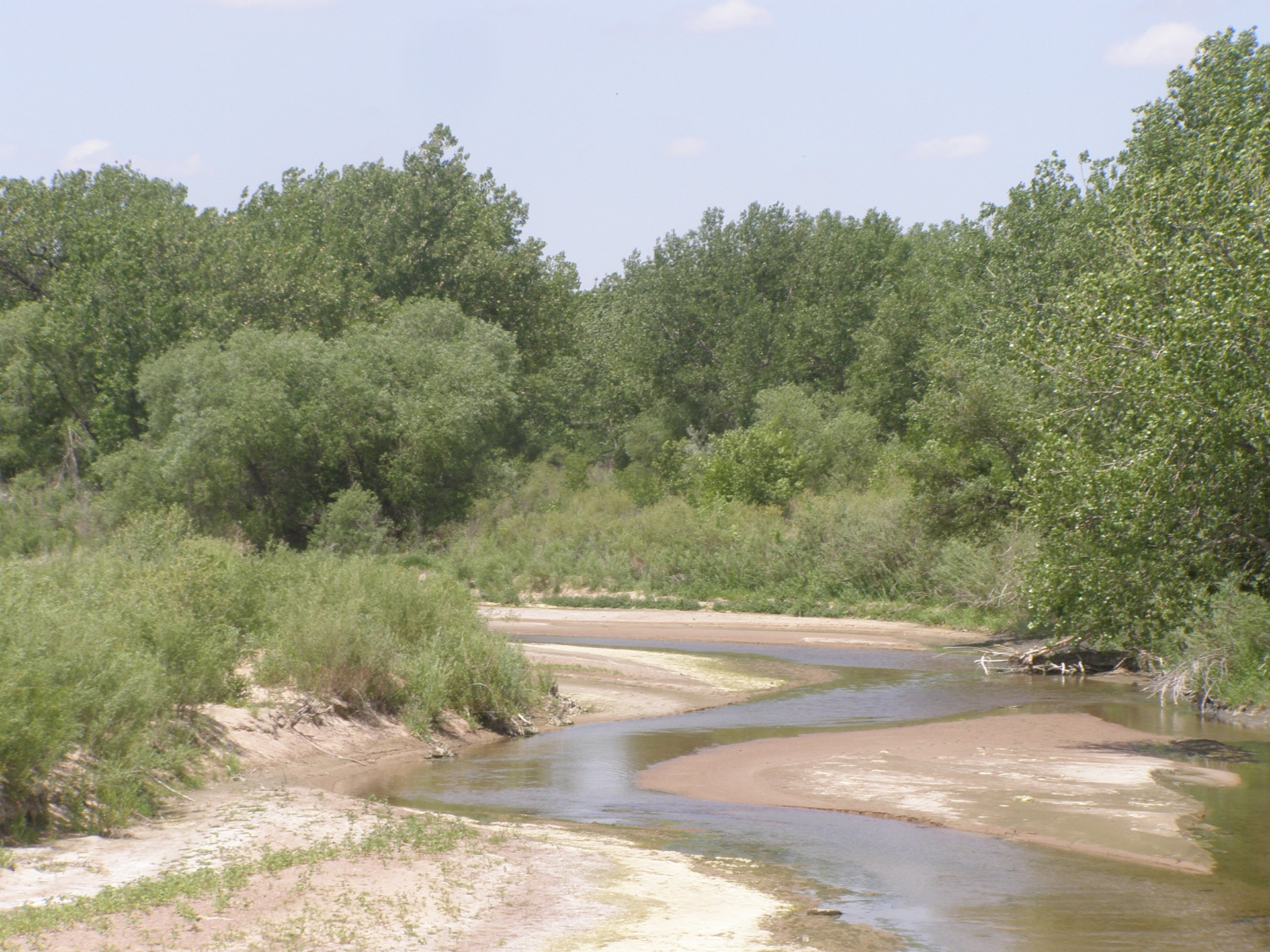
Pictured: South Platte at County Road 27.8, the Ovid crossing . Chris Light, June 2012. Licensed under the Creative Commons Attribution-Share Alike 4.0 International license.