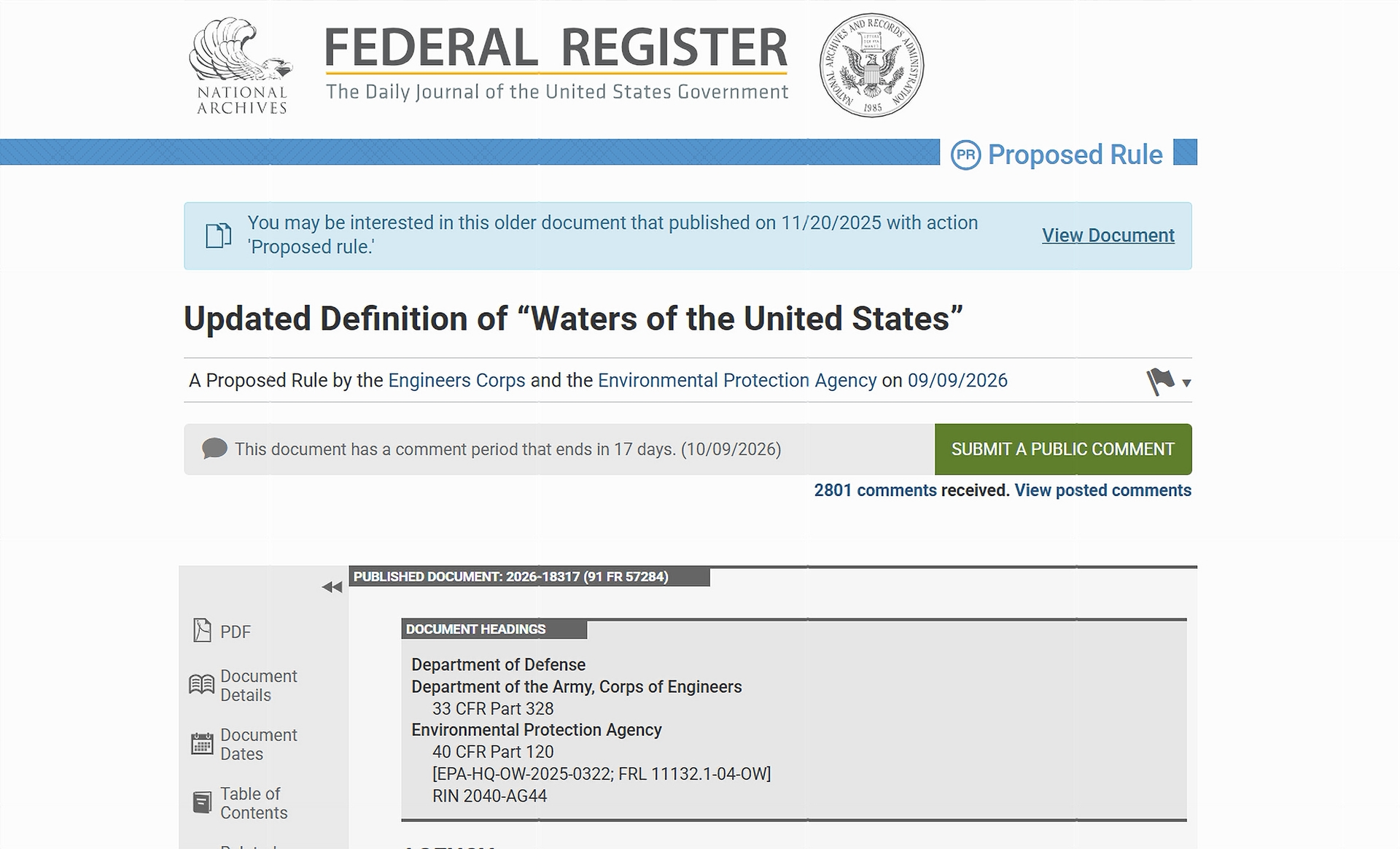
- Federal agencies are seeking more public input on which waters fall under the Clean Water Act.
- One option would generally limit “relatively permanent” waters to perennial waters.
- The proposal also addresses when wetlands have a continuous surface connection to federally regulated waters.
- The agencies received about 220,000 comments on their earlier 2025 proposal.
- Another 2,801 comments had been received on the supplemental proposal as of September 22, 2026.
- The new public comment period closes October 9, 2026.
Tuesday, September 22, 2026 — The federal government is again asking the public where to draw the line around waters protected by the Clean Water Act.
The U.S. Environmental Protection Agency and U.S. Army Corps of Engineers published a supplemental proposal on September 9, 2026, addressing the definition of “waters of the United States.”
That definition matters because it determines which waters fall under federal Clean Water Act jurisdiction.
The latest proposal does not replace everything the agencies proposed in November 2025. Instead, it asks for more public input on specific parts of that earlier proposal after the agencies received approximately 220,000 comments.
As of September 22, the agencies had received another 2,801 comments on the supplemental proposal. The deadline for submitting comments is October 9, 2026 .
.
The Supreme Court Decision Behind the Rule.
The agencies are revisiting the definition following the U.S. Supreme Court’s 2023 decision in Sackett v. Environmental Protection Agency.
In that case, the Supreme Court addressed how far federal Clean Water Act jurisdiction extends.
The agencies responded with a proposed rule in November 2025. Among other changes, that proposal attempted to define terms including “relatively permanent” and “continuous surface connection.”
Public comments on that proposal raised disagreements over how those terms should be interpreted and applied. Some commenters supported the proposed approach, while others argued for either broader or narrower federal jurisdiction.
The agencies are now putting additional options before the public.
What Does “Relatively Permanent” Mean?
One of the central questions involves the meaning of “relatively permanent.”
The November 2025 proposal would have defined relatively permanent waters as standing or continuously flowing surface waters that remain that way year-round or at least during the wet season.
The new supplemental option takes a different approach.
Under that option, “relatively permanent” would mean “perennial bodies of water.”
The agencies are considering defining perennial as having standing or continuously flowing water every day of the year under ordinary conditions.
There would be exceptions.
A perennial water would not necessarily lose federal jurisdiction simply because it temporarily dries up during an unusual event such as drought. The agencies are also considering an exception for predictable events such as low tide or a regularly occurring dry spell.
Under the supplemental option, one temporary interruption of up to 30 consecutive days in a year could occur because of such ordinary events without causing the water to lose its perennial status.
But multiple ordinary interruptions could produce a different result.
The agencies give an example of a water body that stops flowing twice during a year, with each interruption lasting 10 consecutive days. If those interruptions are ordinary rather than unusual, the water would not qualify as relatively permanent under the supplemental option.
Drought Raises Another Question.
The agencies are also asking how drought should be treated.
They are considering using the U.S. Drought Monitor to help determine when drought represents an unusual condition rather than the ordinary climate of an area.
One option under consideration would treat only extreme drought (D3) and exceptional drought (D4), the two highest U.S. Drought Monitor categories, as unusual drought conditions capable of temporarily interrupting perennial flow without changing a water body’s status.
The agencies are seeking public comment on that approach.
Wetlands Are Part of the Discussion.
The supplemental proposal also addresses wetlands and what constitutes a “continuous surface connection.”
Under the November 2025 proposal, a wetland could meet this requirement if it had surface water at least during the wet season and touched a federally regulated water.
The supplemental option would be more specific.
It would require perennial surface water in a wetland to be continuously connected to surface water in the federally regulated water, so it is difficult to determine where the regulated water ends and the wetland begins.
Temporary interruptions could still occur because of drought, dry spells, or low tides.
For ordinary events such as low tide or a regularly occurring dry spell, the interruption generally could not exceed one period of up to 30 consecutive days in a year.
The agencies are also asking whether the terms “adjacent” and “abutting” are needed at all in the definition.
Under one alternative being considered, federal jurisdiction would instead focus on whether the wetland is indistinguishably part of a water that is already federally regulated.
Only the portion of the wetland that meets that standard would be federally regulated under that approach.
Western Waters Were Part of the Earlier Debate.
The earlier public comments show why creating a single national definition can be complicated.
When the agencies previously asked whether a minimum number of flowing days should determine whether water is relatively permanent, commenters offered widely different suggestions.
Some supported thresholds of 30, 90, or 270 days. Some commenters favored regional standards, including a 90-day threshold for western states.
Others opposed fixed time limits, arguing that water flow naturally varies and that rigid national thresholds may not reflect regional conditions.
The agencies are now seeking additional public input rather than adopting one of those approaches in the supplemental notice.
Earlier Comments Still Count.
People who commented on the November 2025 proposal do not need to resubmit those same comments.
The Environmental Protection Agency and Army Corps said they will continue considering the approximately 220,000 comments already received as they review the original proposal and the new alternatives.
The supplemental comment period is intended for the additional options presented in September.
Comments become part of the public rulemaking docket. The agencies caution that comments may be posted publicly, including personal information included in a submission.
You can also view comments on the supplemental proposal through the public Regulations.gov docket.
The deadline for new comments is October 9, 2026. The Federal Register has an online comment form and other information about how to submit a comment.