
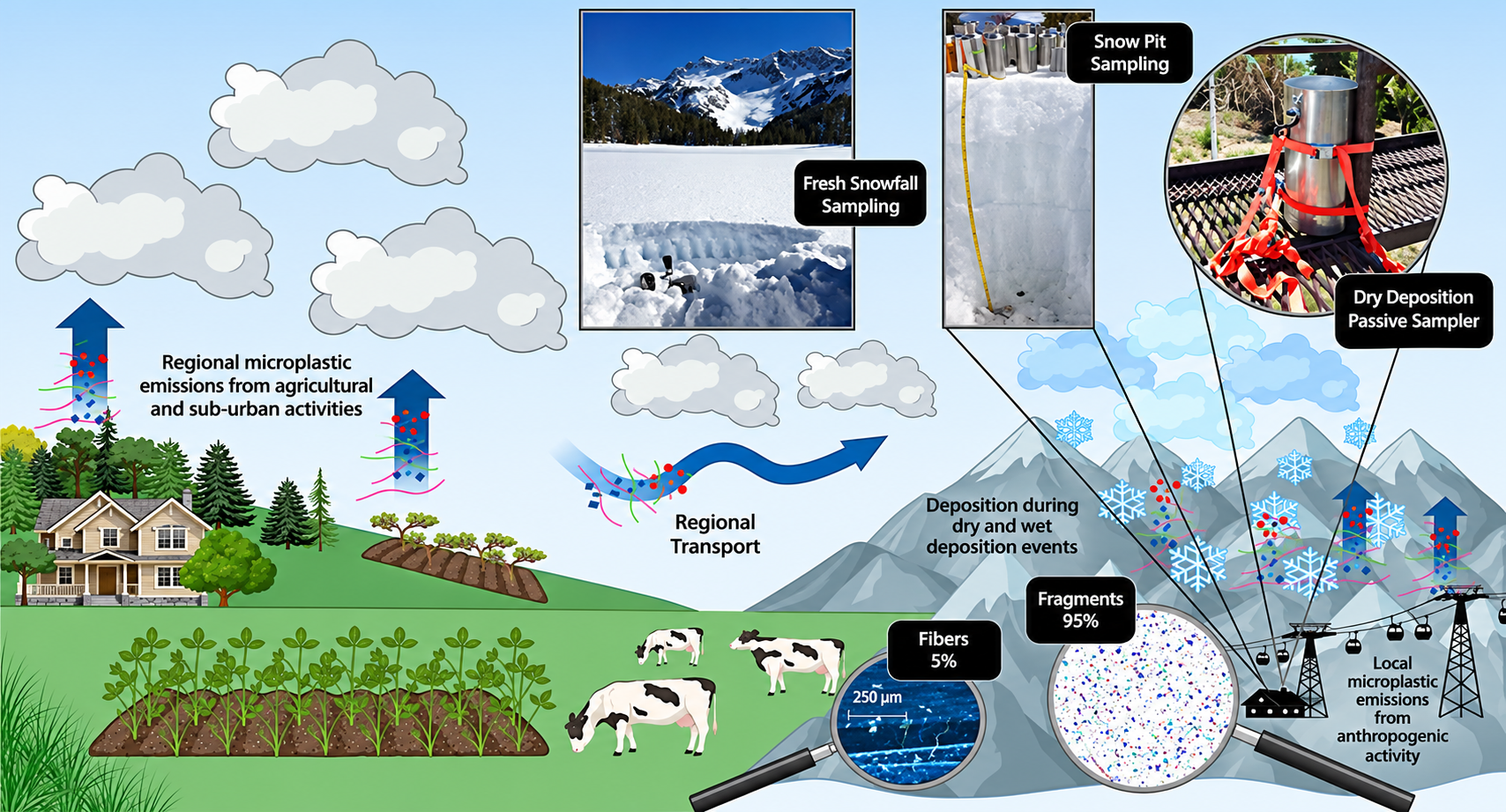
- Researchers found microplastics at all seven Sierra Nevada sampling sites.
- Snow carried more plastic to the ground than dry weather did.
- A Mammoth Mountain site recorded higher particle counts than remote locations.
- The study did not measure drinking water contamination or health effects.
Saturday, October 31, 2026 — Fresh mountain snow can look spotless. In the Sierra Nevada, laboratory tests revealed something too small to see: plastic particles falling with the flakes, even in places researchers had to reach on skis.
According to an October 28 report from the University of California, Riverside , scientists measured how much microplastic pollution reached the ground during individual snowstorms. They found it at every sampling location.
The findings concern a major water source. Sierra Nevada snowpack supplies about 30% of California’s freshwater, the university reported. However, the study did not determine how much of the plastic eventually reaches drinking water.
How Plastic Gets Into Snow.
Plastic products can release tiny fibers and fragments as they wear down. Clothing sheds fibers during everyday use and through dryer vents. Wind can also lift particles from the ground and carry them elsewhere, according to the university’s report.
Falling snowflakes collect some of that airborne material and bring it to the surface. Researchers measured substantially more plastic settling onto the ground during snowfall than during dry weather.
The research, published in Environmental Science and Technology, connected those measurements to specific storms. Earlier studies had already found microplastics in snow in the western United States.
Thousands of Particles, Little Total Weight.
During the strongest part of sampled storms, remote sites received between 270 and 3,200 plastic particles per square meter each day, according to the university.
At one location in the Mammoth Mountain ski area, researchers measured between 2,600 and 7,500 particles per square meter daily. Nearby human activity and heavier snow accumulation could help explain the higher amounts.
Those counts represent a small total weight. At the highest estimated rate, snow falling across an acre would deposit about 1.5 grams of plastic in a day.
To confirm their findings, researchers used infrared light to identify each material’s chemical signature. That helped distinguish plastics from dirt and plant matter.
Common plastics included polyethylene, polypropylene, and polyester materials used in packaging and clothing. Researchers also identified chemically modified plant-based materials used in consumer products.
Where Did the Plastic Come From?
Researchers traced the air that carried the sampled storms into the mountains. Most had traveled over Fresno and Madera counties, suggesting California’s Central Valley could have contributed some particles.
That finding did not establish an exact source. The computer models also could not rule out plastic arriving from farther away, the university reported.
The study did not evaluate health effects. Its measurements document plastic arriving with mountain snowfall, while leaving unanswered how much reaches drinking water and what effects that exposure might have.
Image: Visual abstract from Event-Scale Deposition of Atmospheric Microplastics in Snowfall of the Sierra Nevada in North America.