
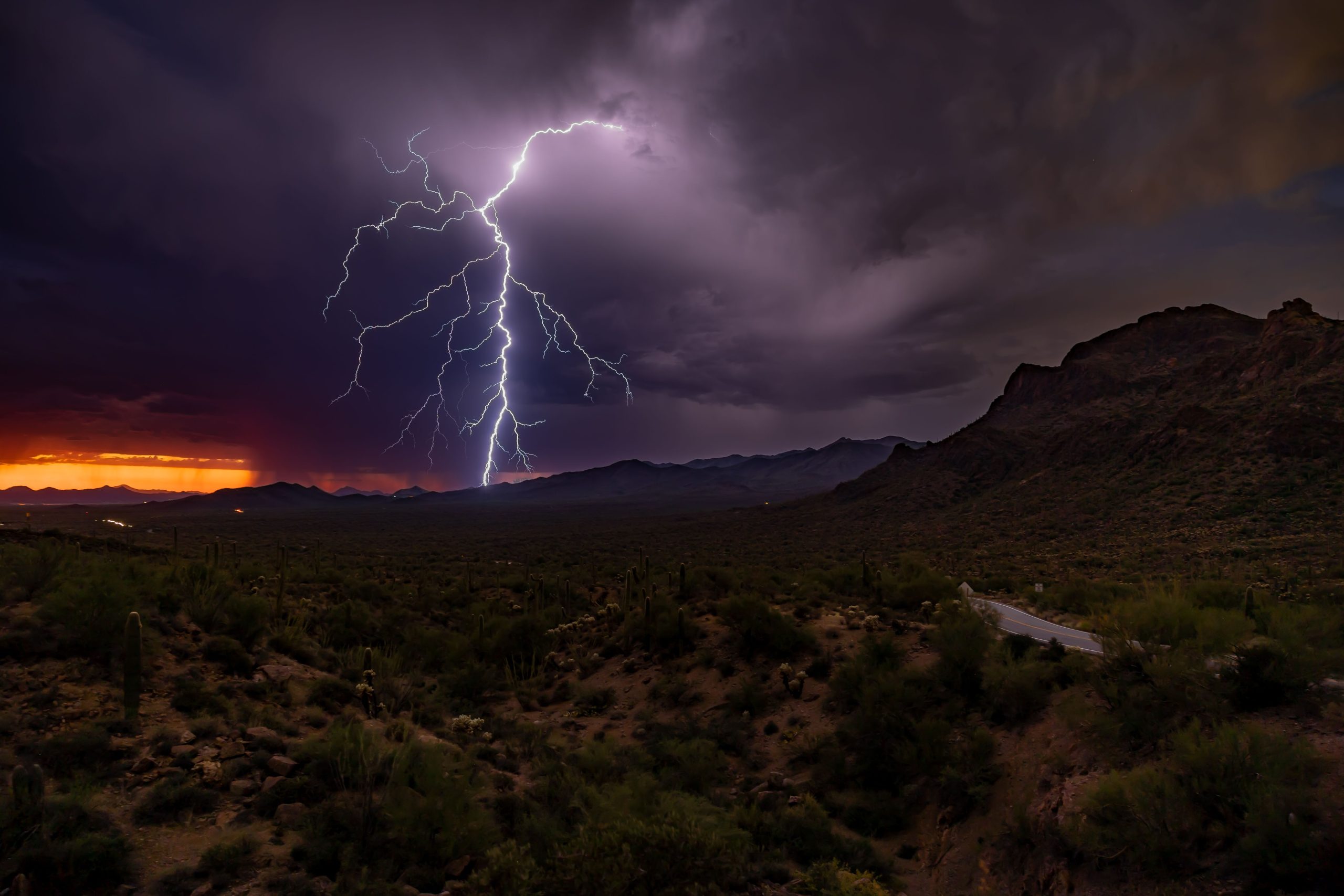
- Warm ocean water building off the coast of Baja California could fuel a stronger-than-normal summer monsoon season across Arizona and the broader Southwest.
- A National Weather Service meteorologist says the region’s drought conditions make the prospect of added moisture especially significant this year.
- Rainfall from October 2025 through March 2026 came in below historical averages across the state.
- Arizona’s monsoon season runs from June 15 through September 30 and brings serious risks including flash flooding, lightning, dangerous dust storms, and extreme heat.
- Multiple state and federal agencies marked Monsoon Awareness Week last week to help residents prepare for what could be an unusually active storm season.
Wednesday, June 10, 2026 — Most of the headlines this spring have zeroed in on the so-called Super El Niño, the rapidly warming stretch of water spreading across the eastern Pacific Ocean. It is a weather story that has captured public attention in a big way. But a quieter, perhaps equally important development has been taking shape closer to home, and water managers in Arizona want people to know about it.
Off the coast of California’s Baja Peninsula, a pool of unusually warm ocean water has been building. According to the Arizona Department of Water Resources , which published a report on June 1, 2026, that warm water patch could play a meaningful role in shaping the Southwest’s upcoming summer monsoon season, potentially delivering desperately needed rainfall to a region that has been running dry.
A Weather Ingredient Worth Watching.
Mark O’Malley, a meteorologist with the National Weather Service, put it plainly.
“There’s a lot of warm water out there,” O’Malley said. “And that’s actually a good sign for us in terms of producing desperately needed moisture in our drought-plagued region.”
The science behind his optimism is fairly straightforward. Warmer ocean water evaporates more readily, releasing moisture into the atmosphere. When the right wind patterns set up over the region, that moisture gets pulled northward from the Baja and into the American Southwest, where it can fuel the thunderstorms that define monsoon season.
“It could be a source area for moisture coming up from the Baja into the American Southwest during the summer monsoon season,” O’Malley said. “With the warm water, we can easily bring up the moisture once we get into the proper circulation pattern.”
He also noted that the warm Baja water could encourage tropical storm development later in the fall and into the winter months, a secondary effect worth keeping an eye on.
No Guarantees, But Reasons for Cautious Hope.
Even with those favorable ocean conditions in place, O’Malley was careful not to promise a wet summer. The memory of the 2016 El Niño, which was expected to deliver significant rainfall but instead produced bone-dry conditions across much of the Southwest, still looms large for forecasters.
“It’s not a guarantee,” O’Malley said. “But it has happened before in developing El Niño situations.”
That uncertainty is part of what makes monsoon forecasting so difficult. A Super El Niño can sometimes supercharge moisture delivery into the region. Other times, it can actually suppress the monsoon pattern, leaving communities high and dry despite the promising setup. The warm Baja water adds another variable to an already complicated equation.
What is clear is that the moisture is badly needed. Precipitation records from October 2025 through March 2026 came in below historical averages, a troubling data point for a state that has been grappling with drought conditions for years.
When Storms Arrive, So Does Danger.
Whether the coming monsoon season turns out to be a wet one or a forgettable one, the storms that do arrive carry real risks. That is the message at the heart of Monsoon Awareness Week 2026, which the National Weather Service held last week in partnership with a broad coalition of state and federal agencies.
Participating agencies include the National Park Service, the Arizona Department of Emergency and Military Affairs, the Arizona Department of Environmental Quality, the Arizona Department of Health Services, the Arizona Department of Insurance and Financial Institutions, the Arizona Department of Transportation, the Arizona Department of Public Safety, and the Arizona Department of Water Resources.
Together, those agencies are urging Arizona residents to take the approaching season seriously. Monsoon thunderstorms can generate a range of hazards that strike fast and with little warning. Lightning, powerful wind gusts, localized flash flooding, and blinding dust storms known as haboobs can all develop within minutes and pose life-threatening risks.
Flash flooding is especially dangerous and deceptive. Dry desert washes can go from bone dry to raging torrents in a matter of moments, even when no storm is visible overhead. Rainfall miles away in the mountains can send a wall of water rushing downstream before residents in lower areas ever see a single drop.
Dust storms present a different kind of peril. A large haboob can reduce visibility to near zero in seconds, creating extremely hazardous driving conditions on major highways.
Heat: The Hidden Monsoon Hazard.
Because monsoon season overlaps entirely with Arizona’s most punishing summer months, heat itself is a serious concern alongside the storms. The agencies involved in Monsoon Awareness Week emphasized that extreme heat and storm danger go hand in hand during this stretch of the calendar.
Heat-related illnesses including dehydration, heat exhaustion, and heat stroke can develop quickly, especially for older adults, young children, outdoor workers, and anyone who is not adequately hydrated. Limiting time outdoors during peak heat hours, seeking shade and air conditioning, and drinking water regularly are all recommended precautions.
What Comes Next.
The official start of Arizona’s monsoon season is June 15, 2026. Whether the warm Baja waters and the still-developing Super El Niño ultimately produce a summer of record rainfall or something far more modest remains to be seen.
What water managers, forecasters, and emergency officials agree on is this: the potential is there for an active and impactful season. Residents across the state would be well served to take that possibility seriously, prepare their homes and families for severe weather, and stay informed as the season unfolds.
Watah: