
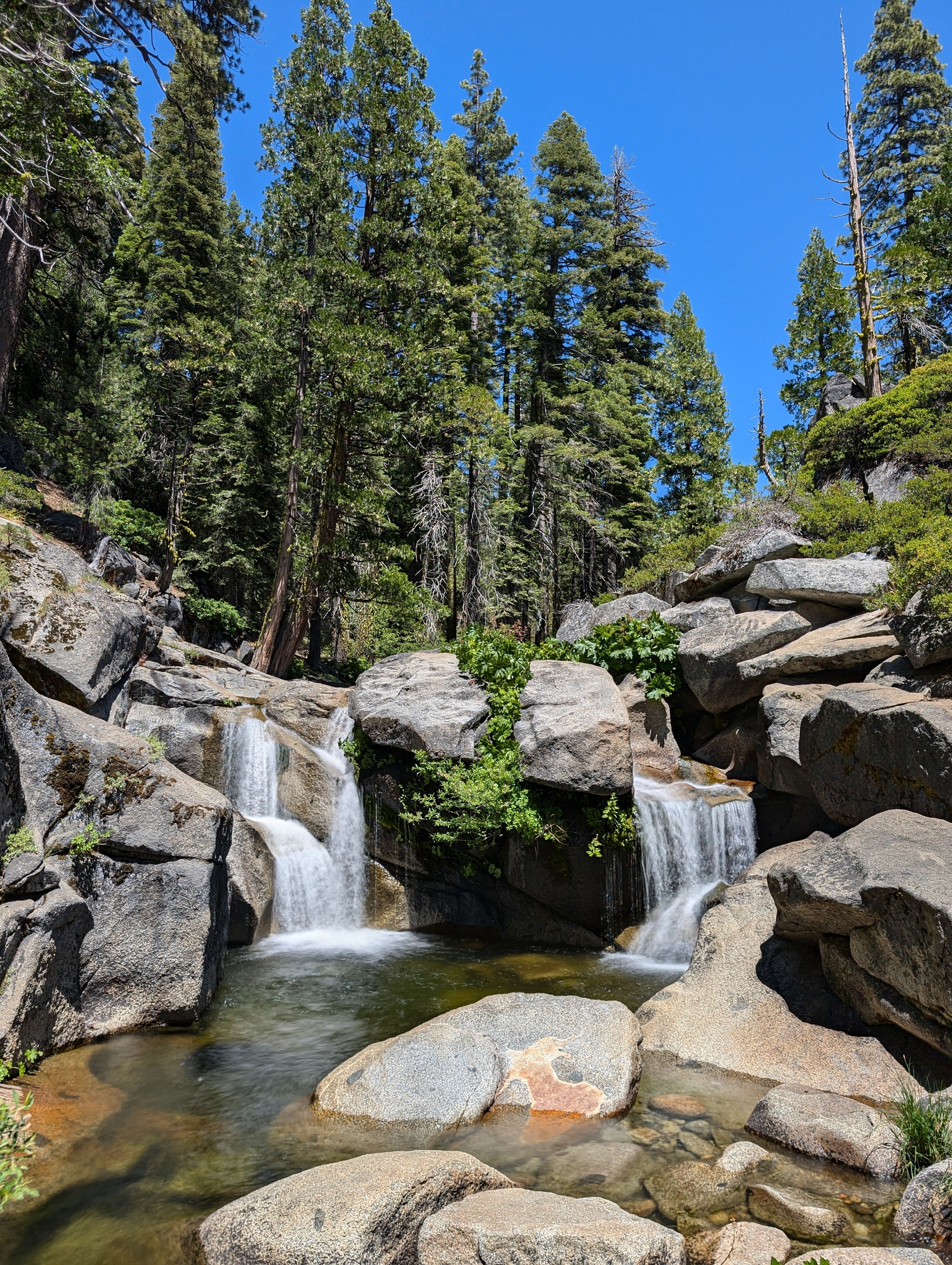
- Researchers studied 30 mountain ponds in California’s Sierra Nevada across four summers.
- Winter snowfall shaped pond size, water temperature, nutrient levels and zooplankton numbers.
- The Sierra Nevada is projected to lose 70 percent of its snowpack by 2100.
Thursday, July 23, 2026 — Most people who hike the high country walk right past them. Small pools of water sitting in granite bowls, some no bigger than a backyard hot tub, others wide enough to skip a rock across. They rarely get names on a map. They almost never get studied.
A team of scientists spent four summers changing that.
Their findings were published in the July 2026 issue of the journal Ecosphere , and the headline is simple enough for anyone who has ever watched a snowpack report in February. What falls on the mountains in winter decides almost everything about what lives in those little ponds by August.
What the researchers did.
Christine C. Bonadonna, Mary Jade Farruggia, Steven Sadro and Celia C. Symons surveyed 30 ponds scattered across the Sierra Nevada, on both the eastern and western sides of the range. They worked between June and September from 2020 through 2023, based out of the Sierra Nevada Aquatic Research Laboratory in California.
The ponds they picked were small and shallow by design. Surface areas ranged from about one one-hundredth of an acre up to roughly seven acres. Depths ran from four inches to about 14 feet, with an average closer to five and a half feet. Volumes spanned from four cubic meters, or about 1,000 gallons, up to 3,361 cubic meters, a little under three acre-feet. The sites sat between 7,540 and 11,300 feet in elevation, surrounded by everything from bare granite to montane forest.
The crews measured water temperature, dissolved oxygen, nitrogen, phosphorus, dissolved organic carbon, conductivity and chlorophyll. They dropped temperature sensors that logged readings every 15 minutes. In 14 of the ponds, they also netted zooplankton, the tiny drifting animals that form the base of the food web.
Then they compared all of it against snowfall data pulled from a national gridded weather dataset.
Four summers, two very different winters.
Timing gave the team a natural experiment.
The first three years were dry. Snowfall across the sites, measured as snow water equivalent, ran between roughly 361 and 803 millimeters, or about 14 to 32 inches of water locked up in snow.
Then came the winter of 2022 into 2023, one of the biggest on record. Snowfall at the study sites jumped to between about 1,447 and 3,002 millimeters, which works out to roughly 57 to 118 inches of water content. Some of the ponds still had snow around them in July.
That contrast let the researchers watch what a wet year and a dry year each do to the same set of ponds.
More snow, cooler and cleaner water.
The pattern held across nearly every measurement.
Heavy snow meant more meltwater, and more meltwater meant bigger ponds through the summer. Bigger ponds stayed cooler on average. They also swung less between their daily high and low temperatures.
Nutrients told a similar story. Total nitrogen dropped in the high snowfall year, diluted by all that extra water. Specific conductivity, which is a rough measure of how much dissolved mineral content is in the water, also dropped. Smaller ponds held more phosphorus and more dissolved organic carbon, which the authors linked to both hydroclimate and the way these ponds shrink as summer wears on.
Ponds start each season at their fullest and evaporate from there. A few of the study ponds were nearly or completely dry by the end of some seasons. So the amount of snowmelt a pond receives in June sets both its starting nutrient concentration and how fast those nutrients get concentrated by evaporation over the following months.
Elevation mattered too. Higher ponds ran colder, which follows the general rule that temperatures fall as elevation climbs.
The mixing surprise.
The most unexpected result had nothing to do with snow.
Water bodies tend to layer. Warm water sits on top, cold water settles below, and the two do not readily blend. Existing research on temperate ponds suggested that ponds deeper than roughly two and a half feet and smaller than about ten acres rarely mix at all.
The Sierra ponds did not behave that way. Of the 16 ponds fitted with vertical sensor arrays, 14 mixed on at least 90 percent of the days in at least one season. The mixing happened at night.
The likely explanation is cold mountain air. Summer nights at these elevations get far colder than nights in the lowland regions where earlier pond research was done. The surface water chills, gets heavier, and sinks. The whole pond turns over, night after night.
That churn, combined with strong daytime sun, produces temperature swings the authors describe as remarkable. Daily ranges exceeded 20 degrees Celsius, or about 36 degrees Fahrenheit. The paper calls these ponds “some of the most thermally variable aquatic ecosystems on earth.”
What lives there responds.
Zooplankton communities tracked the water conditions closely.
Zooplankton abundance rose along with total nitrogen and with warmer average pond temperatures, and both of those conditions showed up in the low snowfall years. Species richness, meaning the count of different types present, responded to more environmental factors than any other biological measure the team tracked. Community composition was most strongly linked to pH and to the daily temperature swing, more so than to average temperature. Copepods and rotifers dominated the communities, with cladocerans also present.
One measure did not budge. Shannon diversity, a common index that blends richness and evenness, showed no relationship to any environmental predictor the team examined.
Pond productivity was another blank. Neither chlorophyll concentration nor gross primary productivity, a measure of how much the plant life in a pond produces, lined up with any variable the researchers measured. The authors note that something they did not measure could be driving it, listing possibilities such as light intensity, plant coverage or pressure from larger invertebrates eating the algae.
Why it matters going forward.
The study points to a chain reaction rather than a single effect. Less snow leads to warmer, smaller ponds. Warmer, smaller ponds concentrate nutrients. Concentrated nutrients and higher temperatures push zooplankton numbers up.
That matters because the trend line for Sierra snow points down. The authors cite research projecting the Sierra Nevada will lose 70 percent of its snowpack by 2100. The region has already logged both the driest year on record and one of the wettest inside the past decade.
Ponds are not a footnote in the western landscape either. They make up more than 90 percent of all mapped standing water bodies worldwide. Within the Sierra Nevada, nearly 75 percent of the thousands of lakes and ponds cover less than half a hectare, a little over an acre.
The researchers conclude that mountain ponds do not fit neatly into the existing scientific categories built for either lowland ponds or mountain lakes. They mix more than the models predicted. They swing hotter and colder than almost anything else in fresh water.
And for the ponds that manage to hang on through drier winters, the study projects a future of warmer water, wider temperature swings, higher nutrient loads and denser populations of the small creatures that live in them.
The data and code behind the study were made publicly available through the Dryad repository. Funding came from the University of California Natural Reserve System, the Department of Education, a University of California Irvine Hellman Grant, the National Science Foundation Graduate Research Fellowship Program and the American Alpine Club. The authors declared no conflicts of interest.
Citation.
Snowfall and pond volume drive summer mountain pond dynamics in California’s Sierra Nevada
Christine C. Bonadonna, Mary Jade Farruggia, Steven Sadro, Celia C. Symons
First published: 14 July 2026 https://doi.org/10.1002/ecs2.70706



We see this in the importance of snowpack. Action to steward our world thoughtfully is long overdue and we are suffering the likely existential results of our greed and stupidity.