
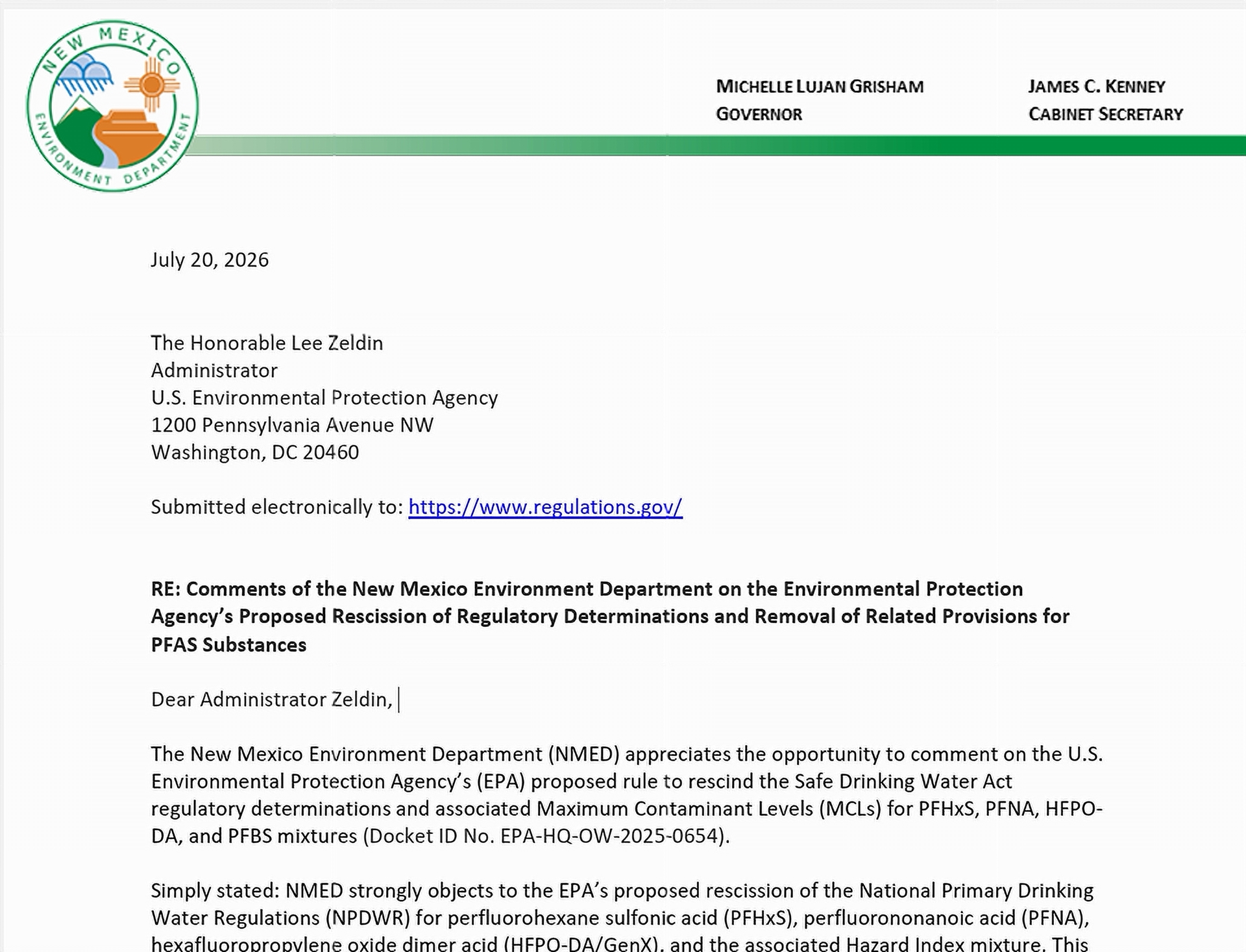
- New Mexico formally objected to the EPA’s plan to erase drinking water limits for four “forever chemicals.”
- The EPA says a procedural mistake from 2024 voids the rules; New Mexico says that argument is legally and scientifically flawed.
- Blood tests near Cannon Air Force Base found per- and polyfluoroalkyl substances in 99.7 percent of participants’ blood.
Wednesday, July 22, 2026 — Thousands of synthetic chemicals known as per- and polyfluoroalkyl substances, often shortened to PFAS, have been in wide use since the mid-20th century. Manufacturers put them in firefighting foams, nonstick cookware coatings, waterproof clothing, food packaging, and countless other products. Scientists call them “forever chemicals” because they resist breaking down in the environment and in the human body. Once they enter human blood, they can remain for years or even decades. The U.S. Environmental Protection Agency and independent researchers have linked these chemicals to liver damage, thyroid disruption, immune system harm, elevated cholesterol, and increased cancer risk.
Military bases across the country, including Cannon Air Force Base in Curry County, New Mexico, used PFAS-containing firefighting foams for training and emergency drills going back to the 1970s. That history is central to what is happening now.
The EPA’s Proposal.
In May 2026, the U.S. Environmental Protection Agency published a proposed rule in the Federal Register that would erase drinking water limits for four specific per- and polyfluoroalkyl substances: perfluorohexane sulfonic acid, perfluorononanoic acid, hexafluoropropylene oxide dimer acid (also known as GenX chemicals), and mixtures of those three chemicals plus perfluorobutane sulfonic acid.
Those limits were established in 2024 as part of the National Primary Drinking Water Regulations, a landmark federal rule requiring public water systems across the country to test for and, where necessary, treat their water to remove these chemicals.
The EPA now says the 2024 rule was created through an unlawful procedure. The Safe Drinking Water Act, the agency argues, requires a specific sequence of steps: first publish a preliminary decision to regulate a chemical, take public comment, issue a final determination, and only then propose the actual water quality standard. In 2024, the EPA ran several of those steps simultaneously. The current administration concludes that was a procedural error, and it is now proposing to erase the four PFAS rules because of it.
The proposed rollback does not affect drinking water limits already in place for two other PFAS chemicals, perfluorooctanoic acid and perfluorooctane sulfonate. Those standards remain intact. The public comment period on the proposed rollback closed July 20, 2026.
New Mexico Pushes Back.
On that same day, July 20, 2026, New Mexico Environment Department Cabinet Secretary James C. Kenney submitted a formal comment letter to EPA Administrator Lee Zeldin. The letter, submitted along with an attached blood testing report, ran 87 pages in total and outlined nine specific objections.
“Simply stated,” the letter opens, the New Mexico Environment Department “strongly objects to the EPA’s proposed rescission of the National Primary Drinking Water Regulations” for the four chemicals in question. The letter characterizes the proposal as one that “would actively dismantle drinking water public health protections across the nation and in New Mexico and create considerable uncertainty for regulators and the public.”
On the procedural question, the state concedes that the EPA made a misstep in 2024. But New Mexico argues that the mistake was minor and caused no real harm. Under the federal Administrative Procedure Act, courts are instructed to apply what lawyers call the “harmless error” rule: not every procedural slip-up is serious enough to void an entire regulation.
During the 2024 rulemaking, the public, state agencies, and industry all had a full 60-day window to comment on both the regulatory decisions and the underlying science and economics. No one was shut out of that process. “The EPA cannot ignore its own science and technical findings to focus exclusively on a manufactured procedural technicality,” the letter states, adding that courts will now scrutinize EPA’s legal reasoning independently following a 2024 Supreme Court ruling that changed how federal agency decisions are reviewed.
New Mexico also argues that the proposed rollback fails a separate legal test from a 1983 U.S. Supreme Court decision, Motor Vehicle Manufacturers Association versus State Farm Mutual Automobile Insurance Company. Under that ruling, a federal agency reversing course must provide a reasonable explanation grounded in evidence. The EPA’s own 2024 assessments found these four chemicals cause serious developmental, liver, and cancer-related harm, and that the rules would prevent thousands of illnesses and deaths in the coming decades. None of that science is being challenged now. The agency is invoking only the procedural argument.
“To withdraw these protections while leaving the scientific record unchallenged is the very definition of arbitrary and capricious agency action,” the letter states.
The comment letter also points to what is known as the Safe Drinking Water Act’s “anti-backsliding” provision. That section of the law says any regulatory revision must maintain or improve public health protections. New Mexico argues the EPA cannot sidestep that requirement simply because the compliance deadlines for the four chemicals had not yet arrived.
Children Left Out of the Picture.
New Mexico’s letter argues the EPA also failed to follow federal directives that require agencies to evaluate environmental health risks for children before taking regulatory action. The EPA’s proposal claims health risks are “beyond the scope of this action.” The letter calls that “categorically false.”
These chemicals accumulate in fetal and infant tissue. The EPA’s own documents, the letter notes, acknowledge the developmental risks. By refusing to include health data in the official record based on a self-described procedural technicality, the agency, New Mexico argues, is ignoring its own executive mandate to protect children from known environmental hazards.
The Blood Testing Report.
Attached to the comment letter as formal evidence was a blood testing report published in August 2025 by the New Mexico Department of Health and the New Mexico Environment Department.
That project, conducted in 2024 near Cannon Air Force Base, recruited participants through a community hotline and held three week-long blood collection events in Clovis, New Mexico, in September, October, and November of that year. A total of 628 eligible participants donated blood samples, which a commercial laboratory tested for 33 different per- and polyfluoroalkyl substances.
The results were stark. 99.7 percent of participants (626 out of 628) had at least one per- and polyfluoroalkyl substance detectable in their blood. The chemicals found most frequently were perfluorooctane sulfonate (found in 99.7 percent of samples), perfluorooctanoic acid (99.5 percent), perfluorohexane sulfonic acid (98.2 percent), and perfluorononanoic acid (90.4 percent). The last two are among the four chemicals the EPA now proposes to stop regulating.
Participants who had ever lived or worked in the area of the contamination plume extending from Cannon Air Force Base showed significantly higher blood levels than others. For perfluorohexane sulfonic acid specifically, the geometric mean blood concentration among plume area participants was more than three times higher than the national average. Twenty-six percent of plume area participants fell into the highest concentration tier identified in the medical screening guidelines of the National Academies of Sciences, Engineering, and Medicine, an independent scientific advisory group. That was more than ten times the rate seen across all 628 participants in the study.
The project cost $1,214,284 and was funded entirely by New Mexico state dollars. The U.S. Department of Defense and the U.S. Air Force provided no financial or technical support.
Cannon Air Force Base first notified the New Mexico Environment Department of PFAS contamination in groundwater in October 2018. The base had been using PFAS-containing firefighting foams since the 1970s, meaning the chemicals had likely been entering the soil and groundwater for decades before the problem was formally identified.
Separate statewide testing conducted with the U.S. Geological Survey in 2020, 2021, and 2023 found that short-chain per- and polyfluoroalkyl compounds, a category that includes several of the four chemicals targeted by the EPA’s proposed rollback, were among the most frequently detected in New Mexico’s groundwater and surface water. Concentrations reached as high as 93 parts per trillion at specific locations.
New Mexico also noted that it is currently in active litigation with the U.S. Department of Justice and the U.S. Department of Defense over PFAS plumes migrating from both Cannon and Holloman Air Force Bases.
The Financial Argument Does Not Hold Up, New Mexico Says.
The EPA’s economic analysis estimates the proposed rule would reduce previously expected national health benefits by approximately $6.7 million per year while saving regulated water systems about $11.6 million per year in monitoring and treatment costs.
New Mexico disputes those numbers on several fronts.
Water systems that already treat for perfluorooctanoic acid and perfluorooctane sulfonate use the same equipment, specifically granular activated carbon filters and anion exchange systems, that also removes the other four chemicals. In communities where all six per- and polyfluoroalkyl substances occur together, which the state’s own sampling confirms is the normal pattern in New Mexico, removing the four chemical limits changes almost nothing about what a water utility must actually do in practice. The true marginal cost savings, New Mexico argues, may be close to zero.
The letter further criticizes the EPA for relying heavily on what the agency calls a “sensitivity analysis” projecting an additional $82.4 million in potential national savings, while acknowledging the underlying data are too broad and too uncertain to produce reliable local estimates. New Mexico’s comment letter notes that this macro-level modeling completely hides the concentrated health burdens in states like New Mexico, where specific short-chain replacement compounds are actively moving through public water infrastructure.
New Mexico also notes that the EPA did not complete a required Health Risk Reduction and Cost Analysis before publishing the proposal. Without that analysis, there is no reliable basis for weighing short-term utility cost savings against long-term healthcare burdens for states, families, and local governments.
A Regulatory Burden Shifted to States.
New Mexico has spent years building monitoring programs, water quality standards, and enforcement actions calibrated to the federal limits. The proposed rollback would not eliminate the per- and polyfluoroalkyl substance problem. It would remove the federal baseline that anchored the state’s legal and regulatory work, forcing the state to spend scarce administrative resources rebuilding a regulatory framework from scratch.
The comment letter argues the EPA’s proposal also violates Executive Order 13132 on federalism, which requires meaningful consultation with governors and state agencies before taking federal actions that impose significant costs on state governments. New Mexico says no such consultation occurred.
“By removing the four PFAS limits from the National Primary Drinking Water Regulations, the EPA creates an unworkable regulatory contrast that indemnifies polluters while penalizing states,” the letter states.
The department added that its data monitoring system had already detected perfluorobutane sulfonic acid in multiple New Mexico water systems. While concentrations have not yet reached levels that trigger individual regulatory action on their own, the EPA’s proposal would also eliminate what is called the Hazard Index, a tool that evaluates how multiple chemicals, each below its individual limit, can still combine to pose a meaningful health risk. Losing that framework, New Mexico argues, would leave state agencies blind to the cumulative danger of chemical mixtures in drinking water.
What New Mexico Is Asking.
Cabinet Secretary Kenney’s letter closes with specific requests. The New Mexico Environment Department asks the EPA to reverse the proposed rule entirely. If the agency proceeds, the letter calls on the EPA to conduct a rigorous health risk assessment specific to the four chemicals, complete a full Health Risk Reduction and Cost Analysis using real-world data rather than broad national estimates, revise its economic analysis to account for cumulative treatment costs, and hold formal consultation with governors, state legislatures, and local governments before taking final action.
The letter was signed by Cabinet Secretary Kenney and copied to Courtney Kerster, a senior advisor in the Office of Governor Michelle Lujan Grisham.


 wpDiscuz