- The Colorado River system held just 34 percent of its total storage capacity as of June 8, 2026, with Lake Powell sitting only about 37 feet above the level needed to keep generating hydropower.
- Seven basin states have missed multiple deadlines to reach a new water management agreement before the current federal operating guidelines expire October 1, 2026.
- The Department of the Interior is pressing forward with a 10-year management framework and a separate two-year operational plan covering 2027 and 2028.
- A broad coalition of ranchers, water utilities, conservation groups, and tribal advocates called on Congress to invest roughly $2 billion in near-term federal drought relief.
- Utah officials cautioned that emergency water releases from Flaming Gorge Reservoir cannot serve as an unlimited safety valve for the river system and must be capped and fully recovered.
Friday, June 12, 2026 — The numbers are hard to ignore. As of June 8, 2026, the Colorado River system held just about one-third of its total water storage capacity. Lake Powell, the massive reservoir straddling the Utah-Arizona border, sat at 25 percent capacity. Lake Mead, the nation’s largest reservoir, was at 29 percent. Together, the two great lakes of the American West are approaching record lows.
Lake Powell has dropped by roughly 172 feet from its full level. More alarming still, the reservoir now sits only about 37 feet above what engineers call the minimum power pool, the lowest point at which Glen Canyon Dam can still generate electricity. If the water drops below that line, the consequences ripple fast and far, from power outages across the Southwest to threats to the dam’s physical infrastructure.
“Once you get to that point, you dip below minimum power pool — all kinds of things go wrong,” Senator Mike Lee of Utah, who chairs the Senate Energy and Natural Resources Committee , told his colleagues last Wednesday.
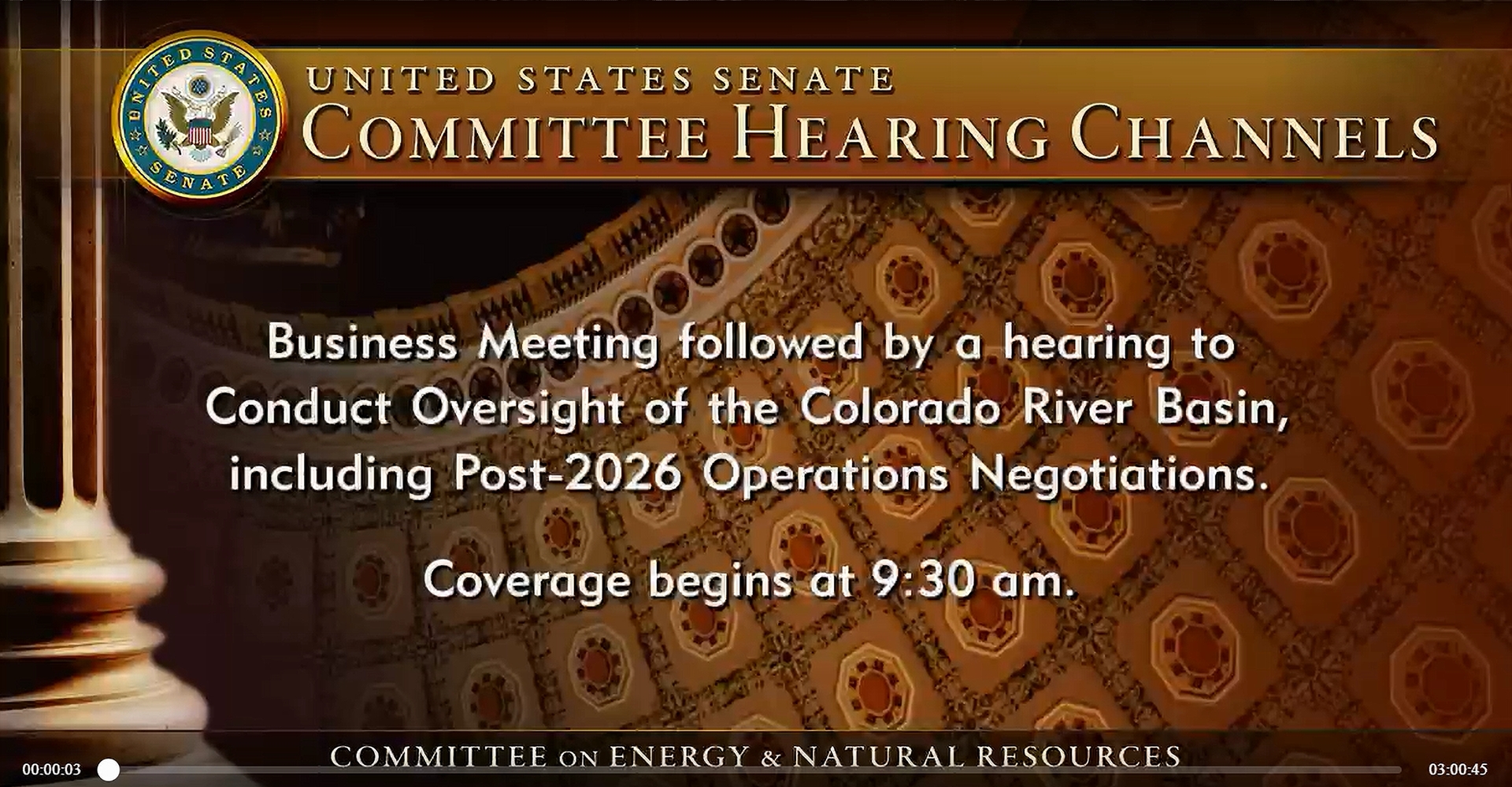
This is the backdrop against which the committee gathered on June 10, 2026, to conduct an oversight hearing on the Colorado River Basin and the stalled negotiations over how the river will be managed after 2026.
A River in its 27th Year of Drought.
The Colorado River Basin is now in its 27th consecutive year of historic drought. This year has been particularly brutal. The forecast for water flowing into Lake Powell between April and July came in at roughly 950,000 acre feet, which is just 15 percent of the long-term average. The spring snowpack set record lows. Temperatures this spring broke records too.
The effects are already showing up on the ground. The Ute Mountain Tribe in southwestern Colorado is expected to receive less than 14 percent of its typical water supply this year. Senator John Hickenlooper of Colorado put it plainly: “We’re breaking records for how low we can go.”
To put the problem in plain terms, an acre foot of water is roughly what an average American family of four uses in a year. The river system that supplies water to 40 million people across seven western states, irrigates more than 5 million acres of farmland, and powers cities from Phoenix to Las Vegas is running critically short.
Deadlines Missed, Patience Running Thin.
The seven states that share the Colorado River, Colorado, New Mexico, Utah, and Wyoming in the upper basin, and Arizona, California, and Nevada in the lower basin, have spent years negotiating new rules to replace the current operating guidelines, which expire October 1, 2026.
They were expected to reach an agreement by November 11, 2025, and finalize it by February 14, 2026. Neither deadline was met. The late-May and early-June targets that followed also slipped by.
Chairman Lee did not mince words. “Instead, we’re seeing increasingly unhelpful rhetoric from some of the states,” he said. “We have lower basin state commissioners taking out ads in local newspapers attacking the upper basin. We’re reading reports that some of these states are preparing actively for litigation.”
He made one thing clear: states that sue their neighbors should not expect Congress to open the federal checkbook for them. “Compact taxpayers should not be asked to subsidize litigation among states,” he said.
What the Federal Government Is Doing Right Now.
The Department of the Interior has not been sitting still. In April, the agency took two significant steps to protect Lake Powell from a catastrophic drop. It authorized the release of between 660,000 and up to 1 million acre-feet of water from Flaming Gorge Reservoir in Utah and Wyoming into the river system. At the same time, it reduced the amount of water released annually from Glen Canyon Dam by 1.48 million acre-feet, bringing the total through September to 6 million acre-feet.
Combined, those moves are expected to raise the surface level of Lake Powell by roughly 54 feet, bringing it to at least an elevation of 3,500 feet and keeping it safely above the minimum power pool threshold for now.
Assistant Secretary of the Interior Andrea Travnicek, who oversees water and science issues, told the committee that the Department is also developing a 10-year management framework for the river. Because the states have not yet reached consensus, the Department is focused on a two-year operational plan for 2027 and 2028 as well. The final environmental review document is expected to be published this summer, with a formal decision to follow shortly after.
“We still believe a seven-state consensus offers the most durable path forward,” Travnicek said. “But the new water year begins October 1.”
David Palumbo, the Bureau of Reclamation’s deputy commissioner of operations, stressed that the federal government plans to restore, not permanently drain, the water released from Flaming Gorge. “Recovery is going to be extremely important,” he said. “We want to make sure that we do get recovery back into Flaming Gorge. We know how important that is to the system.”
Money Spent, Money Left, and Hard Choices Ahead.
Over the last five years, the seven basin states have received more than $9 billion in supplemental federal spending. In just the past month, the Department released roughly $700 million more, including $454 million through the Inflation Reduction Act and additional drought-response funding.
But the well is nearly dry on those special accounts. Palumbo confirmed that less than $100 million remains in Inflation Reduction Act funds dedicated to the Colorado River Basin, and about $240 million remains from the Bipartisan Infrastructure Law. The agency is working to get those dollars out the door before the September 30 fiscal year deadline.
Meanwhile, some states have floated wish lists of future infrastructure projects topping $50 billion. Palumbo described that figure as very early in the process and said the Department is focused on identifying realistic short- and long-term priorities.
Senator Catherine Cortez Masto of Nevada noted that her state has already done significant work, removing grass from yards, restricting decorative fountains, and recycling close to 100 percent of its indoor water. “What do you need from us in dollars to help us supplement the water along the Colorado River?” she asked.
Voices from the Basin.
The hearing’s second panel brought in perspectives from outside Washington, and each witness offered a different window into what is at stake.
Amy Haas, executive director of the Colorado River Authority of Utah and a veteran of nearly two decades of Colorado River negotiations, was direct. “The window to solve this without lawyers, judges, and generational damage to basin relationships is shrinking faster than Lake Powell,” she said.
Haas said Utah is willing to commit to conserving up to 23,000 acre feet of water in 2027 and 2028 through its own state-funded conservation program. The upper basin states, as a whole, have committed to conserving 100,000 acre-feet in the first two post-2026 years. But she drew a firm line on Flaming Gorge. “Flaming Gorge will not save the system,” she said. “It is good for one, maybe two, major releases.” Utah is calling for a cap on those releases, a guarantee that the water will be fully recovered, and a requirement that the releases actually protect Lake Powell rather than simply adding water downstream.
Mike Vickery, a fifth-generation rancher from Pinedale, Wyoming, offered a ground-level view of life at the headwaters of the Green River, the Colorado’s chief tributary. His family’s ranch, like others in the upper Green River Basin, relies entirely on the yearly snowpack with no reservoir storage to fall back on. “No certainty, no promises, just hope weather patterns will take care of us,” he said.
Vickery pushed back on the notion that upper basin ranchers have little to contribute. In Wyoming’s small southwestern corner alone, ranchers produce enough beef to feed 1.3 million people each year. The region is also home to trona mines, a mineral used in everything from glass to detergent, with an estimated economic value of about $2 billion. And tourism has surged as visitors come to fish in the same riparian areas that flood irrigation helped create over generations.
Tom Kiernan, president and chief executive officer of the nonprofit organization American Rivers, called on Congress to authorize roughly $2 billion in near-term drought funding and to maintain strong environmental protections as part of any new framework. He pointed to the value of natural systems like wetlands and floodplains that slow water down, let it sink into the soil, and release it gradually over the summer months. “It is allowing nature to work for us,” he said.
Bill Hasencamp, who manages Colorado River resources for the Metropolitan Water District of Southern California, the largest drinking water provider in the United States, noted that his agency serves 19 million people in Southern California and depends on the Colorado River for roughly half of its imported supply. Metropolitan has already pledged to reduce its use by 440,000 acre feet per year as part of a long-term deal. He urged the committee to consider the lessons of California’s own difficult water cuts back in 2000, when a firm federal deadline and the threat of supply cuts ultimately forced a resolution.
“Strong federal leadership, perhaps with mediation, with meaningful deadlines,” Hasencamp said. “And not a one-size-fits-all approach, recognizing that different states, different agencies have different ways of conserving.”
The Road Ahead.
The clock is ticking loudly. With the current operating guidelines set to expire October 1, 2026, the Department of the Interior is working toward publishing its final environmental review this summer, followed by a formal record of decision. Some operational decisions for 2027 and 2028 will need to be made as early as August.
Whether the seven states ultimately reach a consensus agreement or the federal government steps in with its own plan, Senator Lee made clear that Congress will be paying close attention, and that any framework will face scrutiny under the constitutional authority Congress holds over interstate water compacts.
Senator Martin Heinrich of New Mexico, the committee’s ranking Democrat, put the stakes plainly. “Without a seven-state agreement, the consequences are clear,” he said. “More litigation, unplanned water shortages, economic disruption, and heightened risk to communities least able to absorb it.”
As Ben Franklin once warned, Heinrich reminded the room, “When the well is dry, we learn the worth of water.”
The Colorado River Basin, which supports a $1.4 trillion regional economy and the daily lives of 40 million people, cannot afford to learn that lesson the hard way.
The Senate Energy and Natural Resources Committee hearing on the Colorado River Basin was held on June 10, 2026. Additional written questions may be submitted to witnesses through June 11, 2026, and senators may add statements to the record through June 17, 2026.