
- Lake Powell and Lake Mead have both dropped to their lowest July levels in 30 years.
- The full Colorado River system stands at 33 percent of capacity, down from 39 percent a year ago.
- Heat and dry weather deepened drought in eastern Colorado and southeastern Wyoming.
- California’s reservoirs remain at or above their historical averages for this time of year.
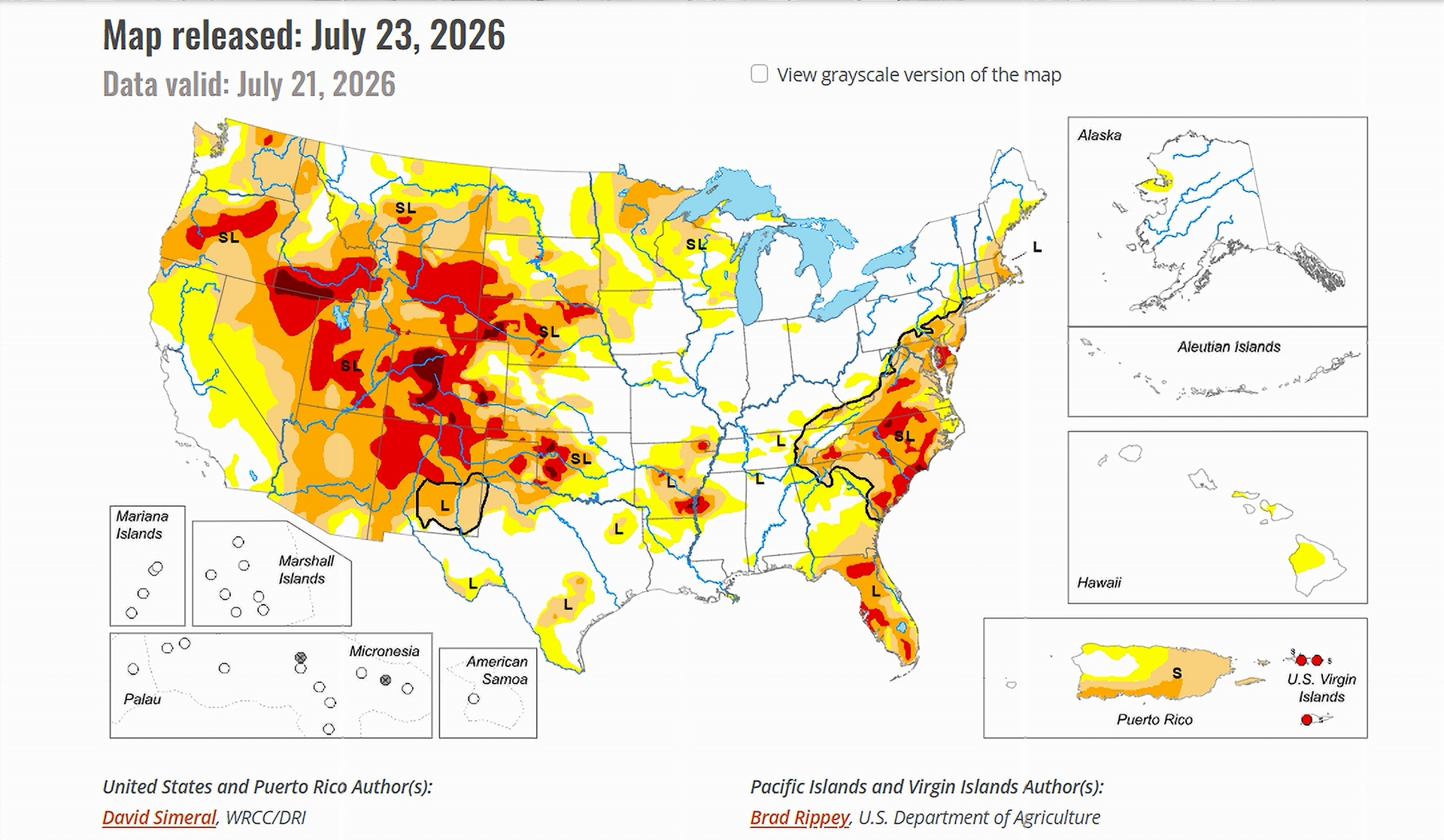
Saturday, July 25 ,2026 — The latest U.S. Drought Monitor , released July 23, shows a nation splitting into wet and dry halves. Over the past week, rain soaked much of the South, the Southeast, the Mid-Atlantic, and the Northeast, easing drought across those regions. At the same time, drought tightened its grip on the Plains, the Upper Midwest, and Florida.
The central and northern Plains had the hardest time. Hot, dry weather pushed temperatures anywhere from 2 to more than 10 degrees above normal, and drought both spread and grew more severe. Ranchers reported poor conditions on grazing land. The situation was serious enough that South Dakota’s governor signed a drought emergency order.
Texas offered a sharp contrast. Another round of heavy rain fell on the Hill Country, with totals of 5 to 10 inches and a few spots topping 15 inches. The rain chipped away at a long-running drought, but it also set off severe and dangerous flash flooding.
The West landed somewhere in the middle, with some areas improving and others sliding backward.
A Split Week in the Colorado River Basin.
The seven states that lean on the Colorado River, namely Arizona, California, Colorado, Nevada, New Mexico, Utah, and Wyoming, saw conditions move in both directions.
In eastern Colorado and southeastern Wyoming, things got worse. Dry weather, excessive heat, and thirsty air combined to deepen the drought. That thirsty air is what scientists call elevated evaporative demand, which is essentially the atmosphere pulling extra moisture out of soil and plants.
There was some good news as well. In the Southwest, summer monsoon thunderstorms dropped welcome rain on scattered parts of the Four Corners states, meaning Arizona, Colorado, New Mexico, and Utah, along with eastern Nevada. Farther west, though, dry weather held firm across the western Great Basin and the Pacific states.
A few Arizona towns actually logged one of their wettest stretches on record over the past month. Nogales had its third-wettest such period, running 2.43 inches above normal. Wilcox came in seventh-wettest at 2.03 inches above normal, and the Flagstaff airport ranked tenth-wettest at 1.76 inches above normal.
The Big Reservoirs Keep Falling.
The numbers that draw the most attention in the basin come from its largest reservoirs, and the figures from the U.S. Bureau of Reclamation are sobering.
As of July 19, Lake Powell sat at just 22 percent full. That is only 34 percent of its normal level for the date, and the lowest the reservoir has been on this date in the past 30 years. Lake Mead was in similar shape at 27 percent full, or 45 percent of average for the date, also a 30-year low for the date.
Put together, the entire Colorado River system was at 33 percent of capacity on July 19. A year earlier, it stood at 39 percent.
The strain shows up at smaller reservoirs too. Elephant Butte Reservoir in New Mexico had fallen to just 2 percent of capacity. Blue Mesa Reservoir in southwestern Colorado was 32 percent full.
California stands out as the bright spot. As of July 21, its reservoirs were at or above their historical averages for the date. The state’s two largest, Lake Shasta and Lake Oroville, were at 110 percent and 100 percent of average, respectively.
What Comes Next.
Forecasters expect the heat to hang on. The National Weather Service outlook for July 27 through 31 favors above-normal temperatures across much of California, the Great Basin, and the central and southern Rockies.
A little relief is possible in spots. Over the coming week, higher elevations in the central and southern Rockies and parts of the Southwest, including Arizona’s Mogollon Rim, could pick up localized totals of 1 to more than 2 inches. The six-to-ten-day outlook also leans toward above-normal rainfall across parts of the Southwest and the central Rockies.


With climate change, it is impossible to maintain the same water lifestyle.